There are two simultaneous shocks to the sociology job market this year: 1) a precipitous decline in the number of positions; and 2) a discontinuous shift in the share of positions in different areas within the discipline.
1/8
In sociology, a much higher share of positions (inc. postdocs) this year are for scholars of race. This shift is understandable given the times, BLM, and renewed internal and external pressure on universities to diversity the curricula, the faculty, or both.
2/8
The first type of shock, the decline in positions, hurts all JMCs. One response is to extend PhD funding for current cohorts. In practice, this increases inequality across cohorts, because extra funding for current or late-stage cohorts means no funding for a new cohort.
3/8
The second shock to the market this year, the shift in search areas, disproportionately harms JMCs who do not focus on race. Although on average all JMCs are affected by fewer positions (type 1 shock), pain for JMCs who study race partially offset by share shift (type 2 shock).
It's not reasonable to tell 3rd, 4th, or 5th year students that they should switch to studying race if they want to compete for academic jobs. Interests just don't work that way. Besides, it takes time to master a literature and publish in a new area. However, ...
5/8
Any effort to offset the effects of second type of shock to the market will run afoul of other definitions of equity. E.g., a program that gives 1 extra year of funding to students who study race but 2 extra years to others would be enormously unpopular, to say least.
6/8
In this regard, figuring out how to support grad students runs into similar challenges as parental accommodations: mothers, on average, lose more research time to parenthood, but some (most?) unis give equivalent accommodations to mothers and fathers. Fair, or not fair?
7/8
I don't have answers. I don't know the best (and for whom?) or fairest way to respond to the massive structural shifts in this and most likely the next few years' job markets. But, discussions should acknowledge that shifts are in kind as well as in number of jobs.
8/8
• • •
Missing some Tweet in this thread? You can try to
force a refresh
Study based on @Cornell data from Fall 2020, when uni went to hybrid instruction. Roughly 28% of class meetings in person.
A few results: 1) Fall 2020 face-to-face network connected a much smaller share of students: about 47% in F2020 vs. 100% in F2019.
2/7
2) The average student in the F2F enrollment network encountered 65 other students in person over a week of classes, assuming 100% attendance. In F2019, average was 529 unique contacts.
In F2020, 0.6% of student pairs in F2F network tied directly, i.e., taking same class.
3/7
Unis planning in-person or hybrid terms don't want to go all-in on formal surveillance and policing to enforce behavioral expectations or rules. Instead, they are putting faith in informal social control (usually framed benignly as norms) and community or self-"policing." 🧵1/9
I get it. Few faculty, staff, or students want campuses to be mini-police states where a mask violation turns into an interaction b/n campus police & violator. Most understand that this sets stage for abuse, both by police and by community members thru false reports. 2/9
Particularly in this social moment, universities also understand that formal policing of mask policies is likely to be uneven, with Black, Brown, indigenous, LGBTQ, and other historically marginalized communities subject to policing more often given same behavior. 3/9
When I saw Cornell's epi model, I had many of the same reactions as @WStevenHolbrook. (I was on the committee that wrote the reopening report, but a different sub-committee from the one that wrestled with health concerns and did the epi modeling.)
1. A lot of faith being put on results from a student "survey." Survey was always intended to be quick-and-dirty snapshot of opinions, not one that meets social science standards. E.g., no attention to response rates, nonrandom missingness, question wording/ordering, etc.
2. Survey was in late spring. Life was different then. US didn't have 130,000 deaths. The unemployment rate hadn't hit 15%. Covid-19 cases in NE concentrated in NYC & NJ. Few appreciated the extent of physical damage to survivors. We hadn't seen rise in cases among 20-35 yos.
Key findings: the average Cornell student shares courses with a max of 529 other students over a week of classes. (Actual will be lower, because attendance is not 100%.)
This increases to 600 students if just look at undergrads, because grad courses typically smaller. 3/
Should universities resume face-to-face instruction in fall? Ben Cornwell and I posted a working paper with relevant evidence from @Cornell on the structure of enrollment networks that connect students and classes.
Summary in thread, preprint here: osf.io/6kuet/
1/11
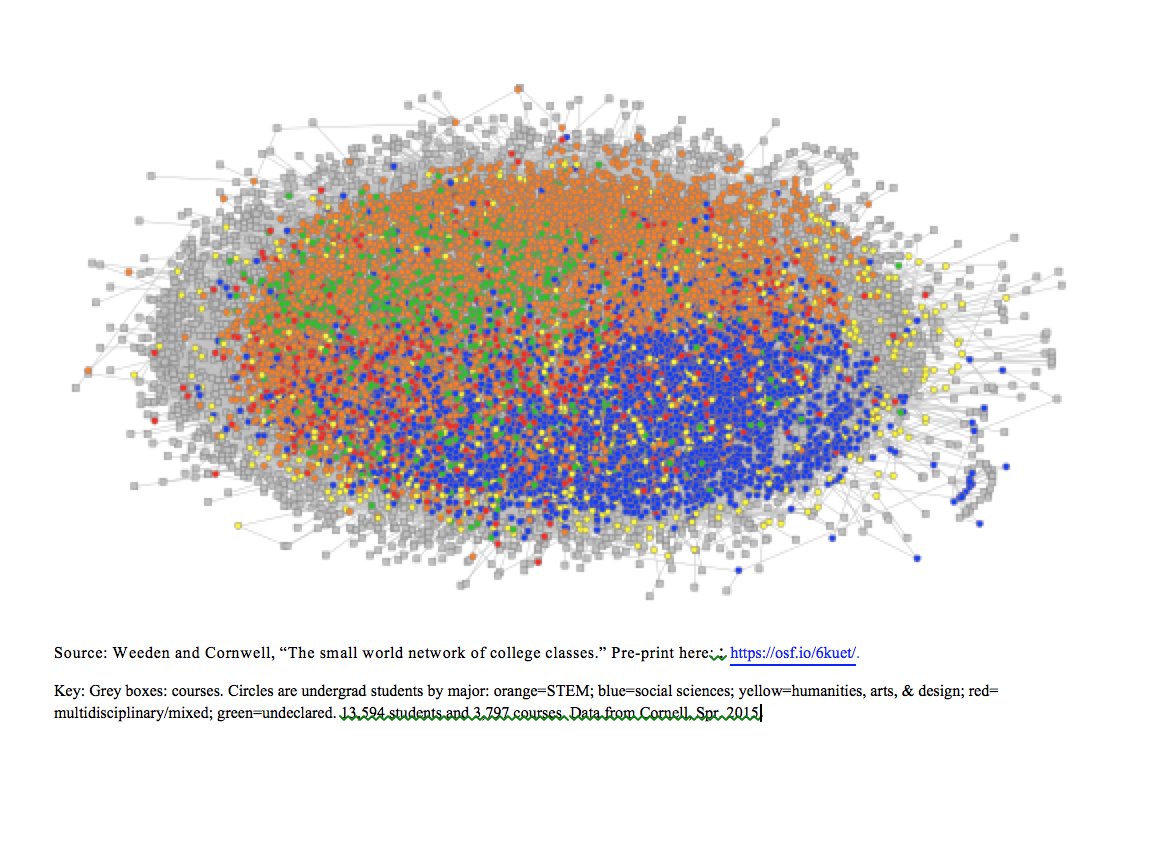
Course enrollment networks are small-world networks, with high clustering and short average path lengths. Although only small share of students are connected directly (in same class), nearly all students are connected indirectly through a third student.
More details...
2/11
99% of students and courses are connected in the main component of the network. Network has a stadium structure, with large gateway courses in the middle and more advanced courses around periphery.
(Same network as in 1/10, but in this graph courses are the top layer.)
3/11
At this point in the term, terrible things, such as a grandmother's death, happen to our students at unnaturally and alarmingly high rates. As instructors, we suspect some excuses are false, but we don't know which ones.
It doesn’t matter.
A story, with a point at the end
/1
Back in 5th-ish grade, my teacher became fed up with students' excuses for why we didn't complete our homework. She had just cause: it had turned into a game, with a group of students daring each other to come up with excuses and try them out on her.
/2
I left it on the bus. The dog ate my homework. My uncle used my math assignment to line the parrot's cage. Aliens from outer space stole my backpack. You know, the type of stuff that 10 or 11 year olds think is funny.
/3