

Might as well respond to this article that's been going around:
currentaffairs.org/2021/01/the-on…
currentaffairs.org/2021/01/the-on…
Hey, I'm right here!
Anyways, I've seen this confusion around many things. A simple rephrasing of econ 101 in terms of class conflict should clear things up: we want the capitalist class to have internal conflict through competition, as this will leave normal folks better off.
Anyways, I've seen this confusion around many things. A simple rephrasing of econ 101 in terms of class conflict should clear things up: we want the capitalist class to have internal conflict through competition, as this will leave normal folks better off.
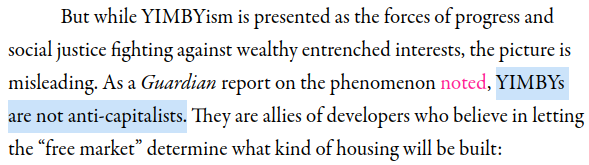
At the extreme end, it's easy to see why anti-capitalists would prefer a perfectly competitive market to a perfect monopoly.
Now of course, certain things are natural monopolies that we want the public to take over. But housing is certainly not one of those.
Now of course, certain things are natural monopolies that we want the public to take over. But housing is certainly not one of those.
There's also this attachment to houses owned by a single family. The thing is, those people are often the reactionaries getting in the way of building affording housing! All else being equal, renters are in a lower class position than homeowners.
Not to mention how homeowners extract value that they don't deserve through land rents.
jacobmkeegan.medium.com/an-introductio…
jacobmkeegan.medium.com/an-introductio…
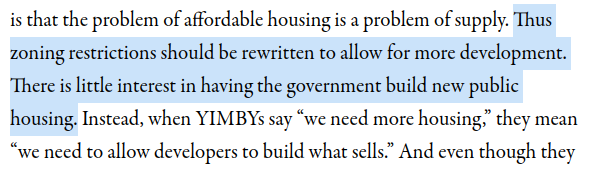
You're welcome to attack YIMBYs for not being supportive enough of public housing. But even if you want more public housing, you'll need to re-write zoning regulations!
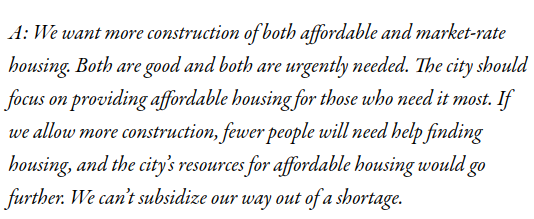
There's some word games going on here. On the left is what a YIMBY group said. On the right is something the author said about them. Here's the problem: market-rate housing just means housing that isn't rent controlled. Obviously, not all non-rent controlled housing is luxury!
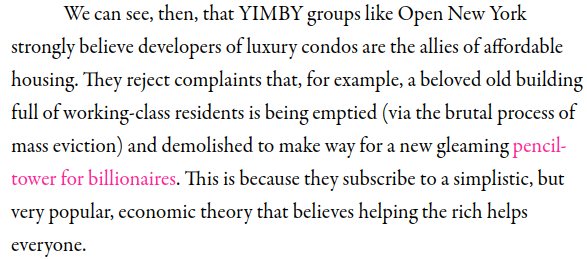
He seems to use the word "affordable housing" to mean "housing for poor people". The problem with that is programs for the poor are poor programs. If you want good public housing, it will need to be for the middle class too.
It's true that it isn't necessary! There's no necessary economic reason for anything really. People could theoretically act in all sorts of ways. What matters is what the models say, and what the data says.

This part is right, within the model he proposed. But the thing is, overall, there will be more housing available to people, because 30 new spots are opened wherever people moved from. You shouldn't just care about a single city!
And if you're worried about speculation, do a LVT.
And if you're worried about speculation, do a LVT.
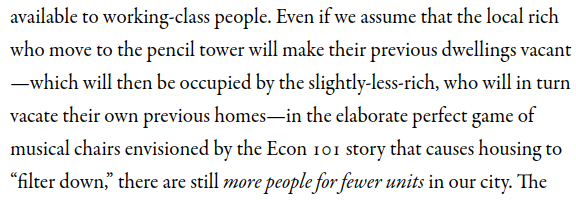
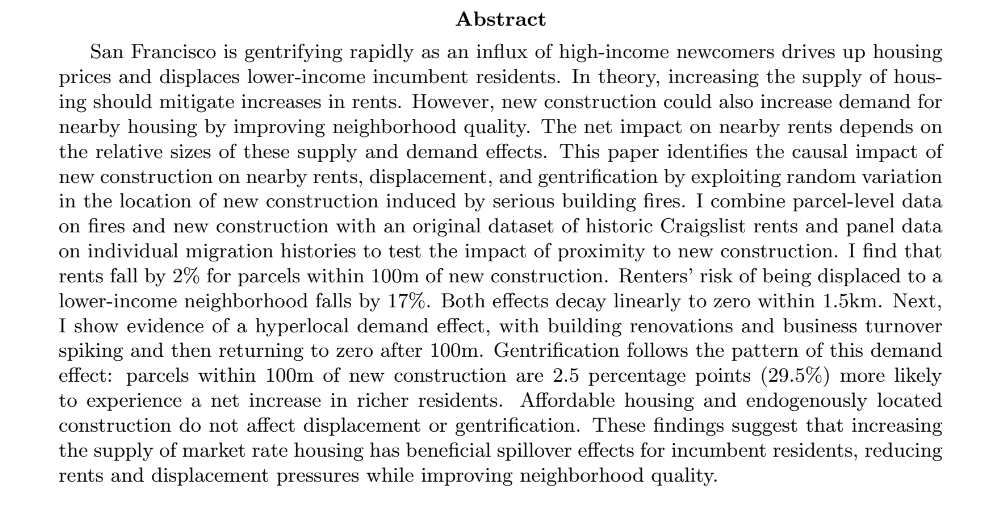
What he really seems concerned about is the costs of moving, and preferences for location as well as the housing itself. It's not exactly like economists ignore those. But sure, it's something to worry about, and something only empirical studies can tell us about.


"nobody deserves to have the future of their neighborhoods determined by developers rather than the democratic process." The thing is, NIMBYism is a result of anti-democratic processes.
dropbox.com/s/k4kzph3ynal3…
dropbox.com/s/k4kzph3ynal3…
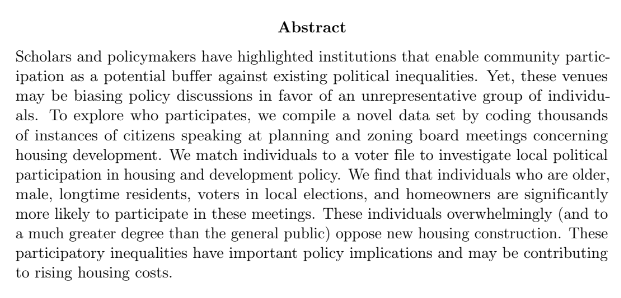
Not to mention that the correct polity to be making these decisions includes not just the people currently living there, but also the people who could live there.
• • •
Missing some Tweet in this thread? You can try to
force a refresh


