"Joy is being fully aware of reality."
~ Simone Weil
~ Simone Weil
"We must not wish for the disappearance of our troubles but for the grace to transform them."
~ Simone Weil
~ Simone Weil
"Pain and suffering are a kind of currency passed from hand to hand until they reach someone who receives them but does not pass them on."
~ Simone Weil
~ Simone Weil
"Just as the power of the sun is the only force in the natural universe that causes a plant to grow against gravity, so the grace of God is the only force in the spiritual universe that causes a person to grow against the gravity of their own ego."
~ Simone Weil
~ Simone Weil
"It is not religion but revolution which is the opium of the people." ~ Simone Weil
"There are only two things that pierce the human heart. One is beauty. The other is affliction."
~ Simone Weil
~ Simone Weil
"Human beings are so made that the ones who do the crushing feel nothing; it is the person crushed who feels what is happening. Unless one has placed oneself on the side of the oppressed, to feel with them, one cannot understand."
~ Simone Weil
~ Simone Weil
"The love of our neighbor in all its fullness simply means being able to say, "What are you going through?"
~ Simone Weil
~ Simone Weil
"A mind enclosed in language is in prison."
~ Simone Weil
~ Simone Weil
"Love: To feel with one's whole self the existence of another being."
~ Simone Weil
~ Simone Weil
"Love is not consolation, it is light."
~ Simone Weil
~ Simone Weil
"Fortunately the sky is beautiful everywhere."
~ Simone Weil
~ Simone Weil
"The sea is not less beautiful in our eyes because we know that sometimes ships are wrecked by it."
~ Simone Weil
~ Simone Weil
"The intelligent man who is proud of his intelligence is like the condemned man who is proud of his large cell."
~ Simone Weil
~ Simone Weil
"Compassion directed toward oneself is true humility."
~ Simone Weil
~ Simone Weil
"To be rooted is perhaps the most important and least recognized need of the human soul."
~ Simone Weil
~ Simone Weil
"Whether the mask is labeled fascism, democracy, or dictatorship of the proletariat, our great adversary remains the apparatus—the bureaucracy, the police, the military. ... the one that calls itself our protector and makes us its slaves. ...
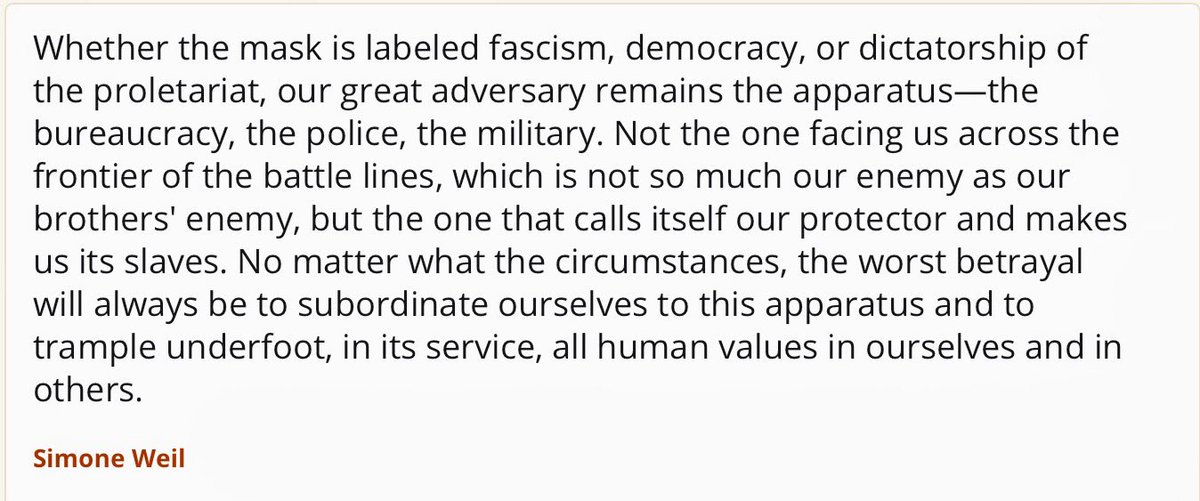
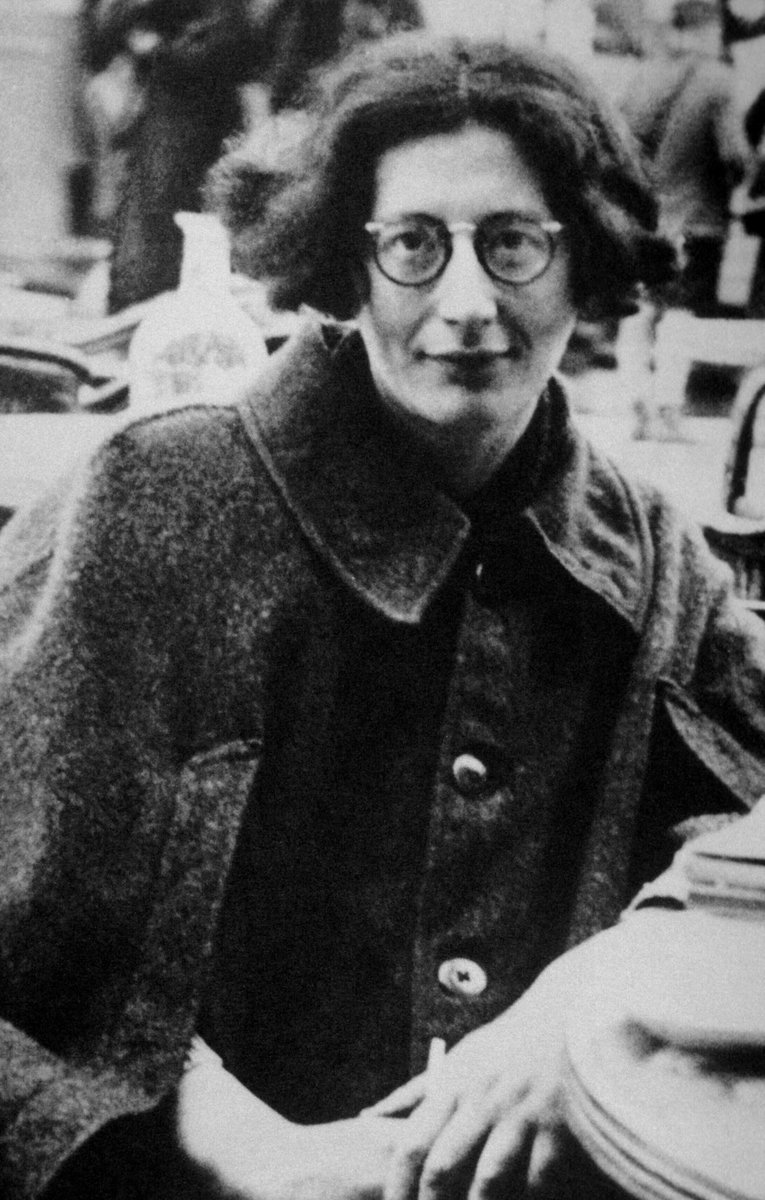
... No matter what the circumstances, the worst betrayal will always be to subordinate ourselves to this apparatus and to trample underfoot, in its service, all human values in ourselves and in others."
~ Simone Weil
~ Simone Weil
"Everything beautiful has a mark of eternity."
~ Simone Weil
~ Simone Weil
"It is a fault to wish to be understood before we have made ourselves clear to ourselves."
~ Simone Weil
~ Simone Weil
"To be always relevant, you have to say things which are eternal." ~ Simone Weil
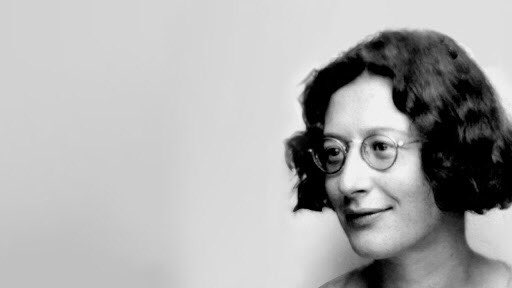
"Art is the symbol of the two noblest human efforts: to construct and to refrain from destruction."
~ Simone Weil
~ Simone Weil
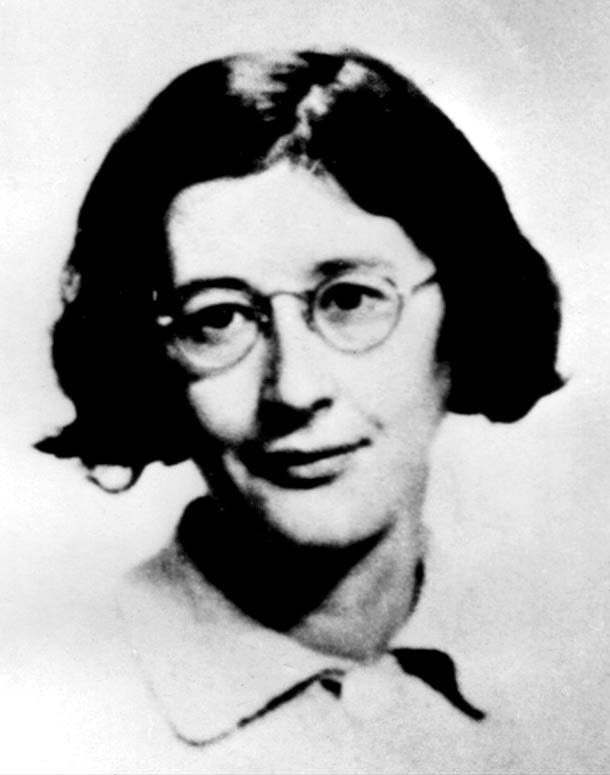
Weil was born into a secular household and raised in "complete agnosticism". As a teenager, she considered the existence of God for herself and decided nothing could be known either way.
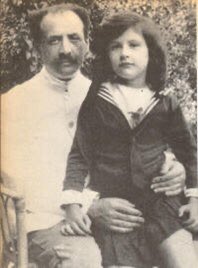
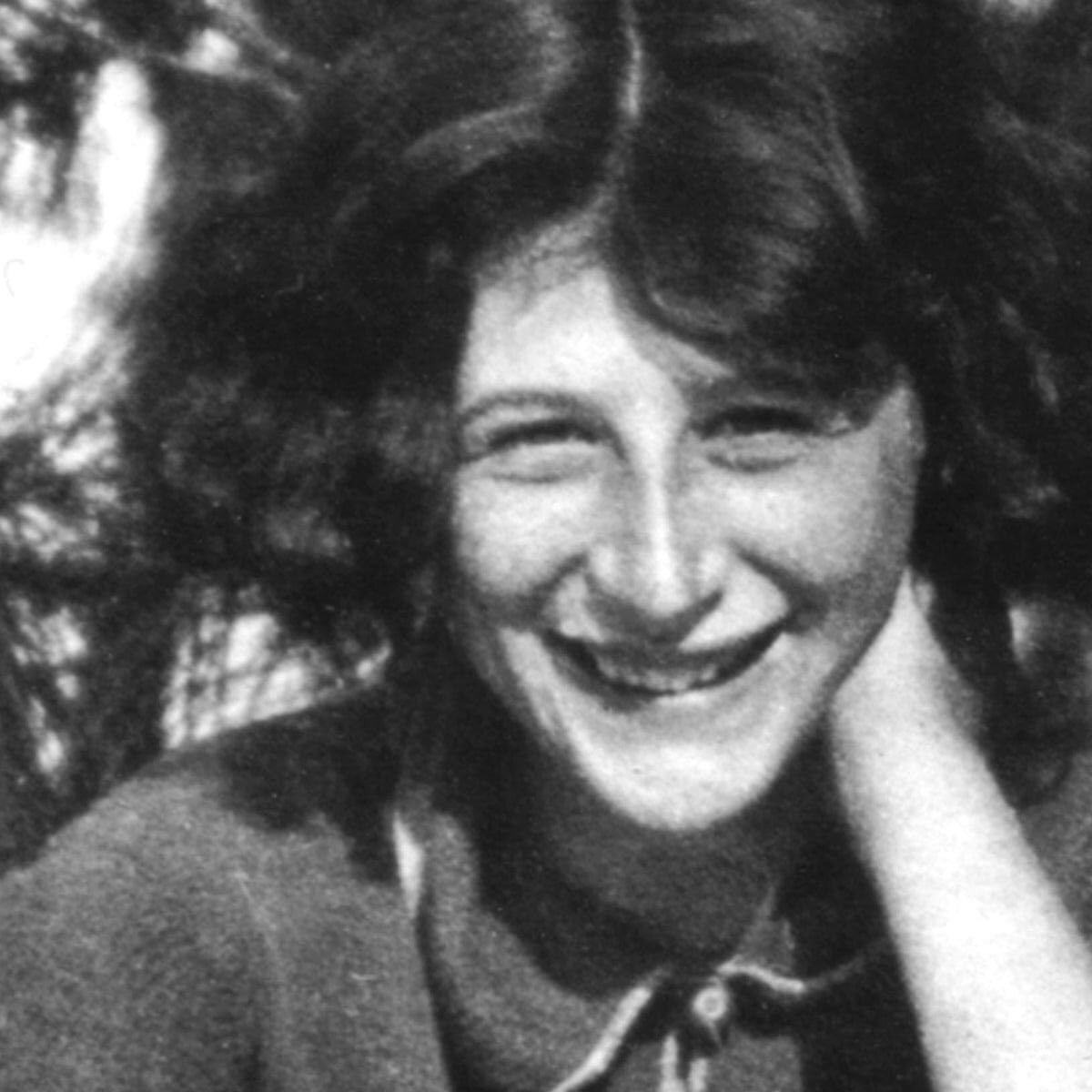
In her Spiritual Autobiography however, Weil records that she always had a Christian outlook, taking to heart from her earliest childhood the idea of loving one's neighbour.
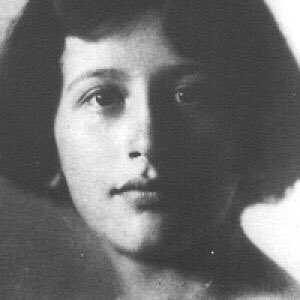
Weil became attracted to the Christian faith beginning in 1935, the first of three pivotal experiences for her being when she was moved by the beauty of villagers singing hymns during an outdoor service she stumbled across during a holiday to Portugal.
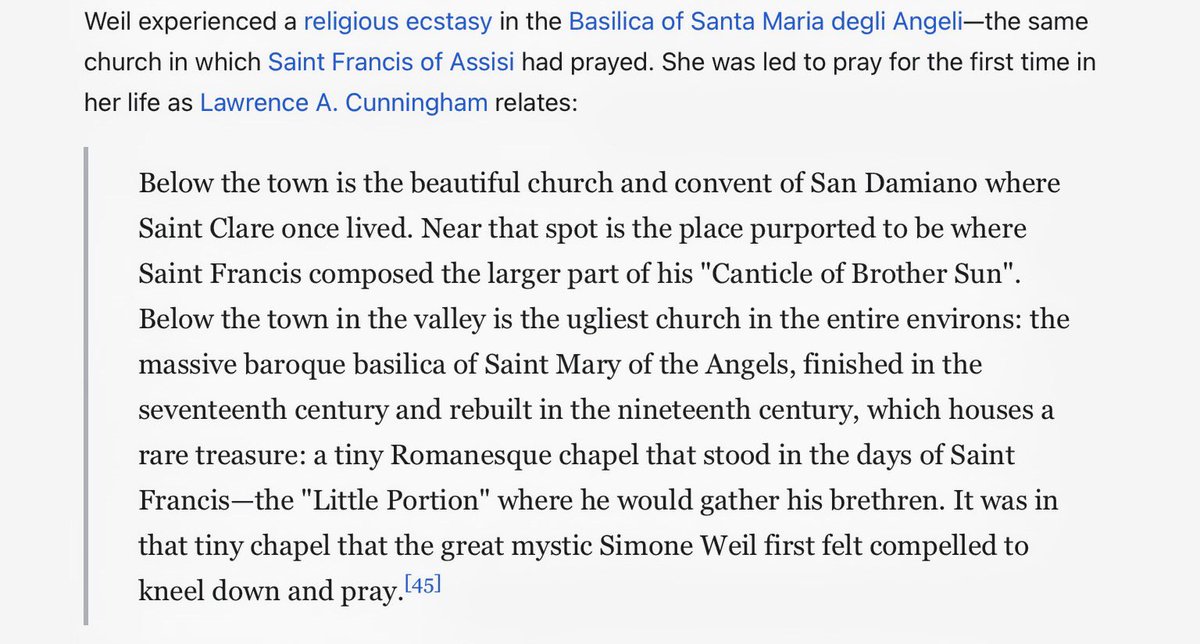
While in Assisi in the spring of 1937, Weil experienced a religious ecstasy in the Basilica of Santa Maria degli Angeli—the same church in which Saint Francis of Assisi had prayed. She was led to pray for the first time in her life...
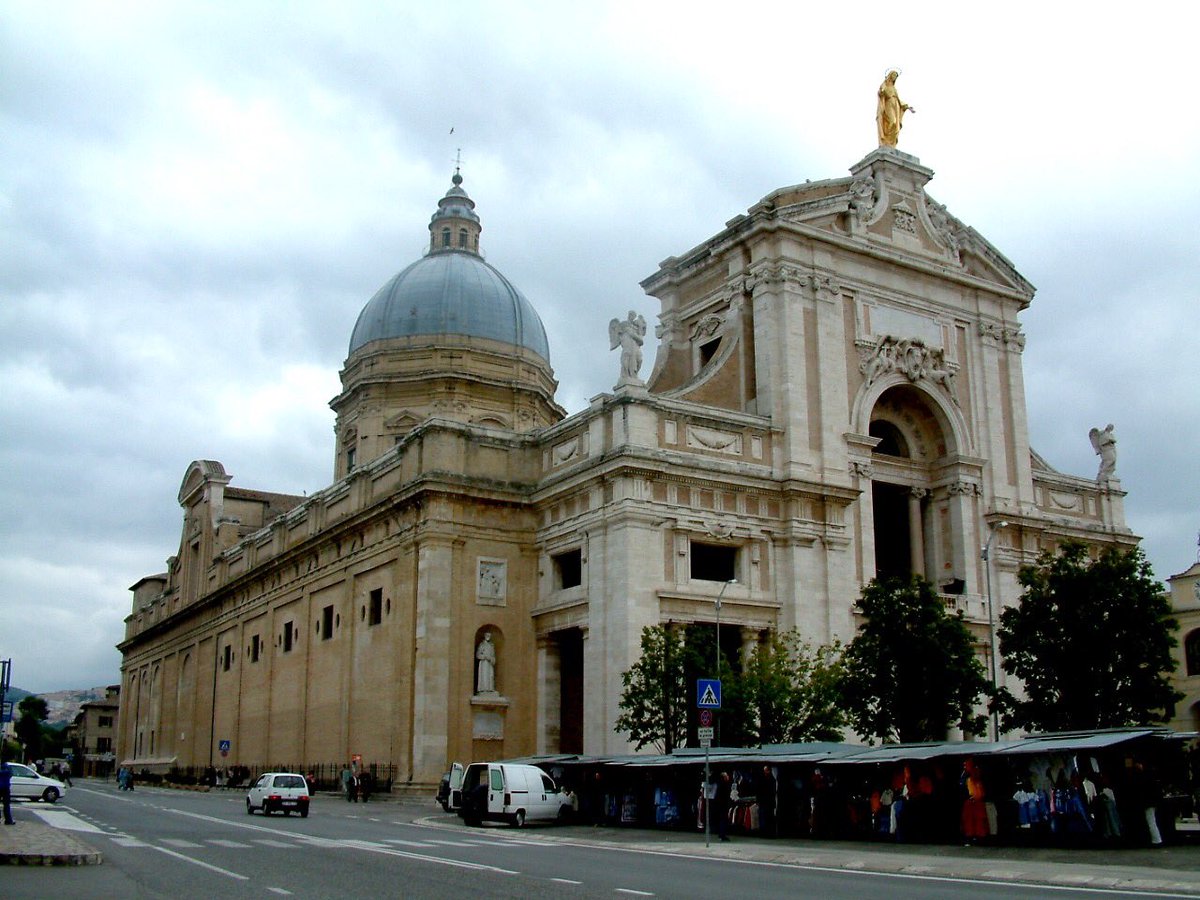
While in Assisi in the spring of 1937, Weil experienced a religious ecstasy ...
Weil had another more powerful revelation while reciting George Herbert's poem Love III,after which "Christ himself came down and took possession of me", and, from 1938 on,her writings became more mystical and spiritual, while retaining their focus on social and political issues.
Weil was interested in other religious traditions [in addition to Christianity] — the Greek and Egyptian mysteries; Hinduism (the Upanishads and the Bhagavad Gita); and Mahayana Buddhism. She believed that all these and other traditions contained elements of genuine revelation.
“Greece, Egypt, ancient India, the beauty of the world, the pure and authentic reflection of this beauty in art and science...these things have done as much as the visibly Christian ones to deliver me into Christ's hands as his captive. I think I might even say more.” Simone Weil
Nevertheless, Weil was opposed to religious syncretism:
“Each religion is alone true... at the moment we are thinking of it we must bring as much attention to bear on it as if there were nothing else. A "synthesis" of religion implies a lower quality of attention.”
“Each religion is alone true... at the moment we are thinking of it we must bring as much attention to bear on it as if there were nothing else. A "synthesis" of religion implies a lower quality of attention.”
In 1943, Weil was diagnosed with tuberculosis and instructed to rest and eat well. However, she refused special treatment because of her long-standing political idealism and her detachment from material things. ...
... Instead, Weil limited her food intake to what she believed residents of German-occupied France ate. It is probable that she was baptized during this period...
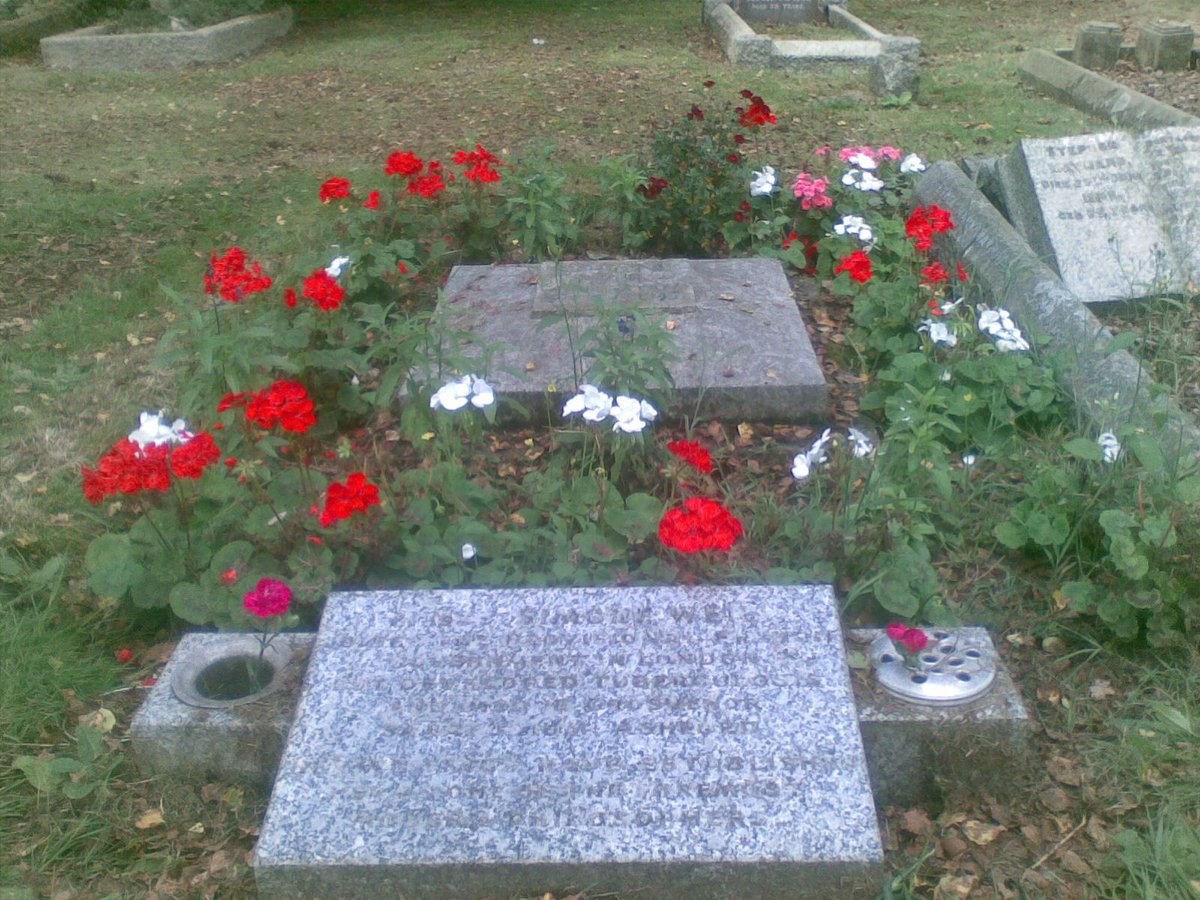
After a lifetime of battling illness and frailty, Weil died in August 1943 from cardiac failure at the age of 34.
After a lifetime of battling illness and frailty, Weil died in August 1943 from cardiac failure at the age of 34.
• • •
Missing some Tweet in this thread? You can try to
force a refresh