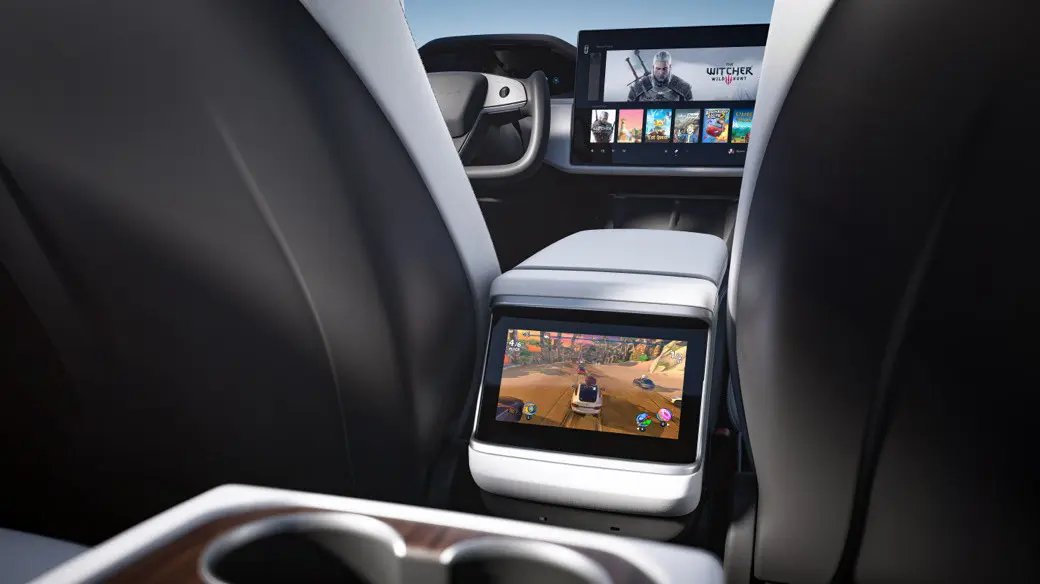
I have a bad motion sickness and this marketing picture makes me feel nauseous. I don't want a car with more screen. If I sit in the back seat, I sit in the middle and stare to the road. Same when I am driving the car. I stare to the road. Give me a projected HUD instead of this.
These big panorama glass roofs on the other hand help with motion sickness. I am glad that many new cars have them. Many new EVs have projected HUDs too. Tesla doesn't yet have it. You need to glance to the screen regularly, which is painful for motion sick people.
Because of my motion sickness I have developed a very smooth style of driving. It was easy to drive like this on other EV's since they have control over regenerative braking balance (between gas/brake pedal). But Tesla removed this in 2021 models. Big red flag for me.
If you are suffering from motion sickness, I recommend test driving a lot of different EVs before buying. Don't preorder without testing. Test each of them in a different day to avoid the sick feeling carrying over from the previous car to the next.
I would also recommend asking for a test car that has HUD and other high tech tools to test whether they make your motion sickness better. Some tools might make the situation worse. You never know without testing.

• • •

Missing some Tweet in this thread? You can try to force a refresh

 

Keep Current with Sebastian Aaltonen

Sebastian Aaltonen Profile picture

Stay in touch and get notified when new unrolls are available from this author!

Read all threads

This Thread may be Removed Anytime!

PDF

Twitter may remove this content at anytime! Save it as PDF for later use!

Try unrolling a thread yourself!

how to unroll video
  1. Follow @ThreadReaderApp to mention us!

  2. From a Twitter thread mention us with a keyword "unroll"
@threadreaderapp unroll

Practice here first or read more on our help page!

More from @SebAaltonen

4 Jun
Huawei's VP of Cyber Security was interviewed by @KauppalehtiFi. He proposed 7 day (80h) weeks with no weekends. He hasn't got a summer vacation in four years. And he is worried that Finland can't compete with China / Silicon Valley without doing the same.

Thread...
I can only talk about programmers here, as I am not familiar with other people. Programmers write bad code when they are stressed out. They can still write a lot of code, but the architecture designs are terrible and there's lot of technical debt.
The only way to make programmers thing about the architecture (bigger picture) is to give them some breathing room. People I know often get their best ideas outside the work (walking the dog, swimming, biking to home, etc). Best ideas never occur during stress.
Read 6 tweets
13 Nov 20
With the resizable BAR support getting more adaptation. Standard swizzle is becoming more important too:
docs.microsoft.com/en-us/windows/…

With standard swizzle, you can do the swizzle on CPU side (even store swizzled textures on disk) and write to GPU memory directly without a copy.
I am just wondering how good the standard swizzle support is nowadays. AFAIK only Intel supported this feature in the beginning. What's the current situation? Is it supported on Nvidia and AMD? If yes, is it fast?
If the optimal tiling layout is 5%+ faster than standard swizzled, then there's no point in using it. Just pay the GPU copy cost for better runtime performance. But if the cost is tiny, then simply use RBAR memory for everything :)
Read 4 tweets
13 Nov 20
Let me explain the PCI-E resizable BAR: docs.microsoft.com/en-us/windows-…

Why is it better to get full GPU memory visible from CPU side compared to a small 256 MB region?

Thread...
Traditionally people allocate an upload heap. Which is CPU system memory visible to the GPU.

The CPU writes data there, and the GPU can directly read the data over PCI-E bus. Recently I measured 28 GB/s GPU read bandwidth from CPU system memory over PCI-E 4.0.
The two most common use cases are:

1. Dynamic data: CPU writes to upload heap. GPU reads it from there directly in pixel/vertex/compute shader. Examples: constant buffers, dynamic vertex data...

2. Static data: CPU writes to upload heap. GPU timeline copy to GPU resource.
Read 15 tweets
12 Nov 20
Going to implement GPU-driven occlusion culling to my SDF cube renderer next. This is important part of the final sparse SDF renderer.

Even in a random sparse cloud (1M cubes) the occlusion eventually wins. No background color is seen.

Thread...

I am going to implement a depth pyramid based approach first.

Would also like to test the new Nvidia extension that eliminates all pixels of a triangle after the first passed one. This way you don't even need a depth pyramid. Just write to visible bitfield in pixel shader.
New GPU culling algorithm:
1. Render last frame's visible list
2. Generate depth pyramid from the Z buffer
3. Do a 2x2 sample test for each instance using gather (refer to my SIGGRAPH 2015 presentation)
4. Write newly visible instances also to buffer B
5. Render visible list B
Read 4 tweets
12 Nov 20
What should I implement next to my Rust Vulkan prototype?
It has plenty of occlusion potential, even though it's a sparse asteroid field of 1 million instances. Should be able to cull 90%+ easily...
I need the occlusion culling for efficient rendering of the sparse volume. Otherwise the brick raster results in overdraw. However the backfaces of SDF bricks terminate the root finding immediately as the ray starts from the inside. Could early out normal calc too...
Read 4 tweets
12 Nov 20
Most people missed this presentation by @LottesTimothy in GDC 2019:

gpuopen.com/gdc-presentati…

It was about image kernels and their memory access patterns. Filled with GCN architecture specifics, but the most noteworthy detail was the LDS sliding window algorithm.

Thread...
Blur kernels are very popular, and the most annoying part about writing one is how you avoid fetching the neighborhood again and again. Tiny changes in execution order can have massive effect in cache utilization. The problem is especially tricky in separable X/Y gaussian blurs.
Naive separable gaussian blur fetches a long strip along X axis. Each pixel does the same. Pixel Y and Y+n share zero input pixels with each other. Pixels along the X axis share inputs. But if the kernel is wide enough it's hard to keep all of that data reliably in caches.
Read 14 tweets

Did Thread Reader help you today?

Support us! We are indie developers!


This site is made by just two indie developers on a laptop doing marketing, support and development! Read more about the story.

Become a Premium Member ($3/month or $30/year) and get exclusive features!

Become Premium

Too expensive? Make a small donation by buying us coffee ($5) or help with server cost ($10)

Donate via Paypal Become our Patreon

Thank you for your support!

Follow Us on Twitter!

:(