Let's talk about building muscle! 💪
Specifically ...
How FAST can you build muscle? ⏳
Specifically ...
How FAST can you build muscle? ⏳

TYPICAL muscle gains in training studies lasting 2–3 months are:
Beginners
+5–15% muscle thickness
+10–30% muscle area
+2–3 kg fat-free mass
Trained
+3–10% muscle thickness
+6–20% muscle area
+1–2 kg fat-free mass
Beginners
+5–15% muscle thickness
+10–30% muscle area
+2–3 kg fat-free mass
Trained
+3–10% muscle thickness
+6–20% muscle area
+1–2 kg fat-free mass
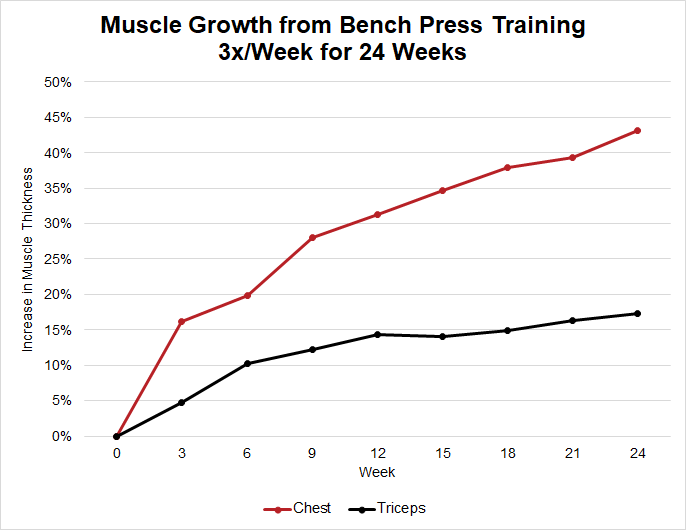
You'll grow fastest in the beginning.
Here's a good example of that from a Japanese study.
Young men benched 3 sets x 10 reps, 3 x/week, for five months.
Chest grew 43%
Triceps grew 17%
Bench Press 1RM increased 52%
Here's a good example of that from a Japanese study.
Young men benched 3 sets x 10 reps, 3 x/week, for five months.
Chest grew 43%
Triceps grew 17%
Bench Press 1RM increased 52%
How fast your muscles grow depends on several factors, such as your …
- Training program
- Training status
- Age
- Genes
- Diet
- Sleep
- Other stress
Even if you and another person would follow the same program, you could get wildly different results.
- Training program
- Training status
- Age
- Genes
- Diet
- Sleep
- Other stress
Even if you and another person would follow the same program, you could get wildly different results.
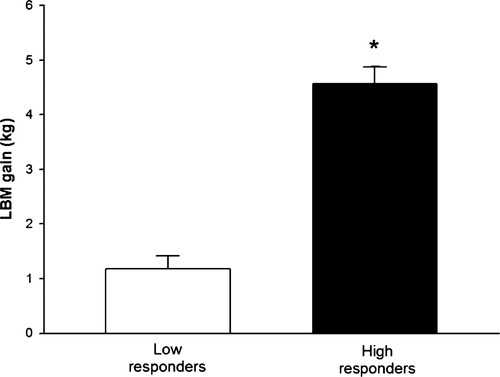
There's plenty of evidence that we build muscle at different rates.
One study found that the persons that responded most favorably to the resistance training (“high-responders”) built four times more muscle mass than the “low-responders” did during the 12 weeks of training.
One study found that the persons that responded most favorably to the resistance training (“high-responders”) built four times more muscle mass than the “low-responders” did during the 12 weeks of training.
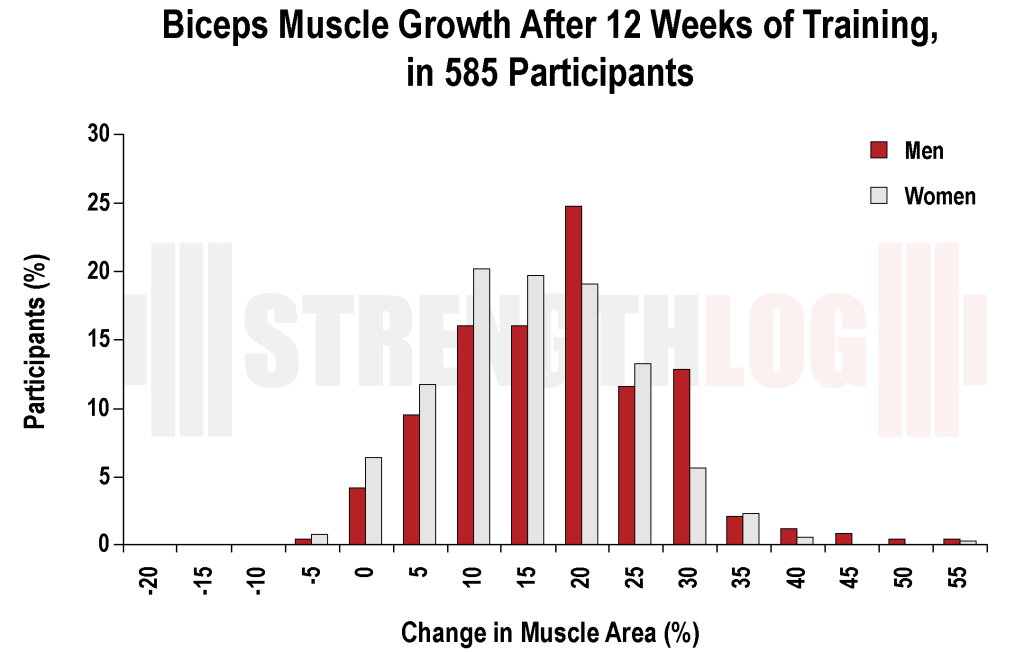
One study had 585 participants train their biceps 2x/week for 12 weeks.
The average gain in bicep area was 15–20%, but some decreased their muscle area by 5% while others increased it by a crazy 55%.
The average gain in bicep area was 15–20%, but some decreased their muscle area by 5% while others increased it by a crazy 55%.
You’ll generally see the quickest muscle growth in young, previously untrained persons that start following an ambitious and well-planned whole-body training routine, while at the same time eating a slight caloric surplus and covering their protein requirements.
We find two examples of very rapid muscle growth in a study where 56 young, previously untrained men trained five times a week, following a rotating push/pull/legs routine, for 12 weeks.
Immediately after each workout, the participants drank 18 grams of protein from either skim milk or a soy protein shake.
One hour later, they drank one more of the same sort.
One hour later, they drank one more of the same sort.
After 12 weeks, the participants had increased their fat-free mass by 3–4 kg.
However, the results of two participants stood out from the rest: they had gained 7.5 and 7.0 kg of fat-free mass, respectively!
Not bad after only twelve weeks of training!
However, the results of two participants stood out from the rest: they had gained 7.5 and 7.0 kg of fat-free mass, respectively!
Not bad after only twelve weeks of training!
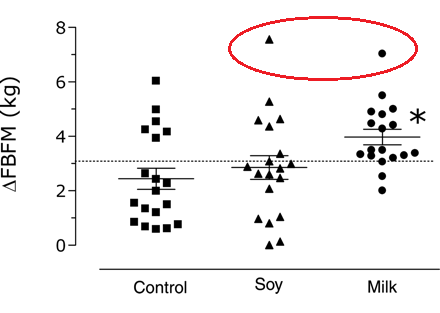
An interesting result is that as the participants gained 3–4 kg of lean mass, they also lost half a kilo of fat.
The group that drank skim milk increased their lean mass the most (by 4 kg on average), and also lost the most fat simultaneously: almost 1 kg on average.
The group that drank skim milk increased their lean mass the most (by 4 kg on average), and also lost the most fat simultaneously: almost 1 kg on average.
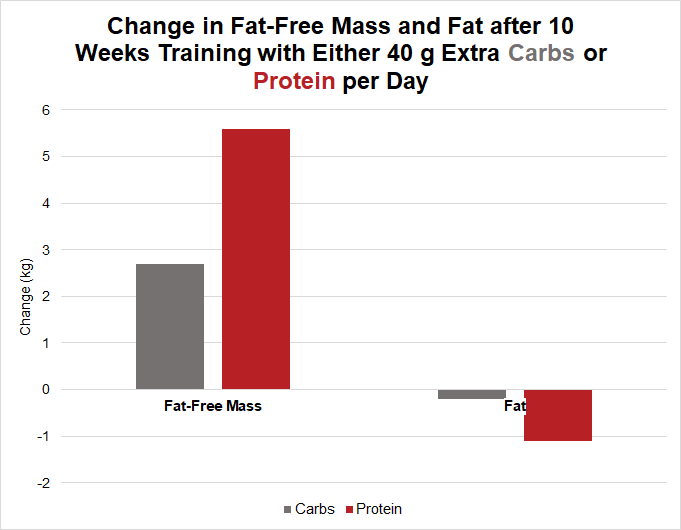
In another study, 19 untrained young men trained 4x/week for 10 weeks: two upper/lower body workouts.
Every day, they ingested two shakes of either 20 g of carbohydrates (dextrose) or 20 g of protein, for 40 g of either carbohydrates or protein in total.
Every day, they ingested two shakes of either 20 g of carbohydrates (dextrose) or 20 g of protein, for 40 g of either carbohydrates or protein in total.
After 10 weeks, the group that had received 40 g of extra protein per day, had gained 5.6 kg of lean mass on average, while simultaneously losing 1.1 kg of fat mass.
So, what’s the matter if you don’t gain muscle as quickly as the participants in the example studies above?
Sure, genetics might be a factor. But it is more productive to focus on what you actually can influence yourself.
Sure, genetics might be a factor. But it is more productive to focus on what you actually can influence yourself.
Do you really train as hard as you know you could?
Do you really eat and sleep well enough to support good training results, or can you improve those parts?
If you want your results to surpass the ordinary, so must your actions.
Now go build some muscle, buddy!
Do you really eat and sleep well enough to support good training results, or can you improve those parts?
If you want your results to surpass the ordinary, so must your actions.
Now go build some muscle, buddy!
• • •
Missing some Tweet in this thread? You can try to
force a refresh