Yesterday a lot of people were dissatisfied with a distinction I drew between the work of an activist and that of a writer. Quick thread for those who weren't instigating but were genuinely asking, and for whom my responses to Rufo seemed unnecessarily dismissive. /1
I appreciate the people here who are, as I wish to be, seeking clarity. I owe you a fuller answer.
The distinction between writer and activist is important to insist on. The activist (or ideologue) is married to a position, which may or may not be correct on a given subject. /2
By definition the activist’s mission is not to allow doubt or ambiguity to undermine their priors. That's antithetical to the mission of the serious writer, who's there to raise questions and complicate issues—to allow the possibility that new information will change her mind. /3
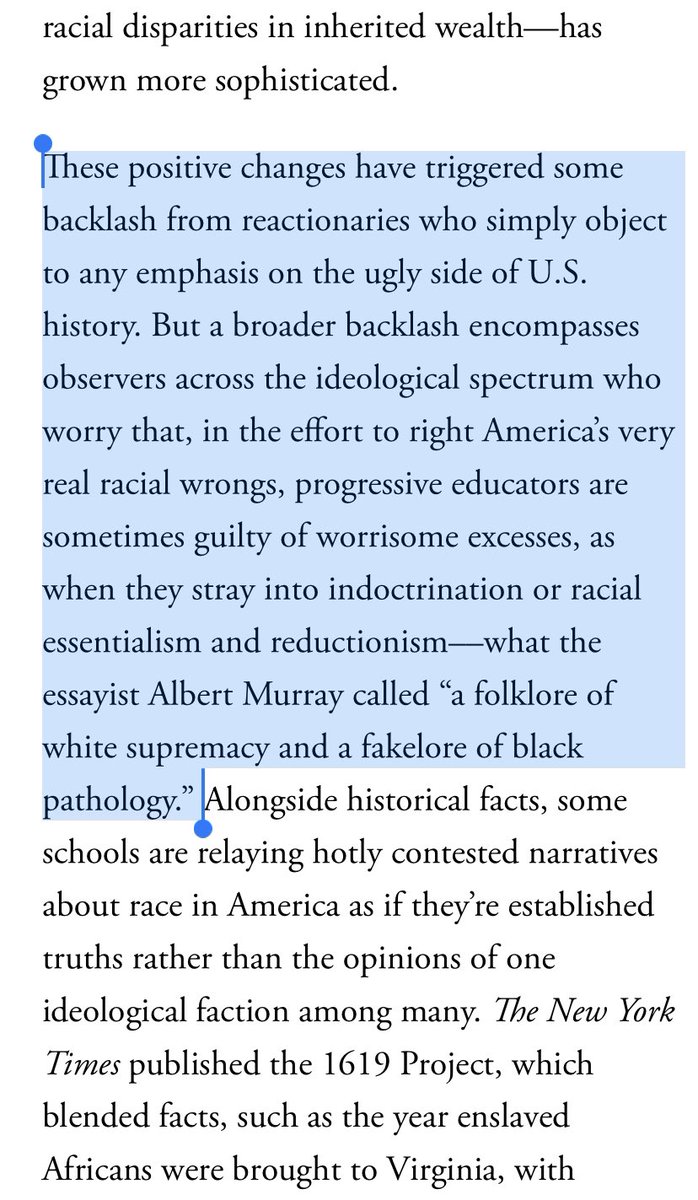
“Yet conservatives, of all people, should recognize compelling arguments for declining to pass a state law that interferes with the prerogatives of local control” @conor64 clearsighted as usual: theatlantic.com/ideas/archive/…
“commentators on the right have spent decades warning about potential and actual excesses of antidiscrimination statutes, and the many ways that they may conflict with other goods, such as 1stA protections, academic freedom, freedom of religious conscience, freedom of expression”
Essentially child abuse. Hard to imagine anything a genuine white racist could say that would be *more* damaging to the self-image and academic development of a young black child than this:
I can’t even imagine what would have happened if an “educator” tried to say something like this to my black father when I was a student. I feel like the space-time continuum would have ripped.
It's also especially pernicious to pretend that black Americans are somehow not "western," as @NewLiberalsPod pointed out. This was Baldwin's point, and Ellison's and Murrays and many others'. US blacks aren't *really* from elsewhere, in fact they predate most whites here.
Only beginning to read Foucault systematically, but this jumped out at me:
“Nothing in man—not even his body—is sufficiently stable to serve as the basis for self-recognition or for understanding other men.”
Question: For those who have spent time on Foucault, how does a statement like that complicate the common assumption that racial and feminist discourses emphasizing "the body" are derived from his thinking?
People criticize artists for failing to represent their particular lived experiences. I've never seen a movie that encapsulates my own, so I co-wrote a screenplay. Maybe it'll be made, maybe not. I'm not complaining about anyone else. How many of Manuel's critics have even tried?
*Miranda's
Furthermore, it’s not the representation of personal experiences or identity alone that amounts to art or insight. Those are simply starting points, raw materials to be drawn from and transformed through empathy and imagination into something striving for the universal.