There is better historical evidence for the existence of Jesus Christ than there is for Plato, Julius Caesar, and Alexander the Great. If you doubt the existence of Jesus because "the New Testament was written decades after he existed," you also have to doubt the other three.
The best biographical source for Plato comes from Diogenes Laërtius' "Lives and Opinions of Eminent Philosophers," written over 500 years after Plato’s death. The oldest extant copy dates from the late 11th century. Historians consider it a crucial source of history.
As for Julius Caesar: Two of the most important historical documents telling us about his life come from Suetonius and Plutarch, both of which were written more than 100 years after his death in 44 B.C. But the extant copies possessed today are even farther removed.
According to New Testament scholar Darrel Bock:
Alexander the Great lived from 356-323 B.C., but historians get all their information about him from sources beginning in the first century B.C. The most valuable of these is (once again) "Plutarch’s Lives," written almost four centuries after Alexander.
So there you have three figures, considered indisputable parts of history, whose existence, based on the available sources, no one would—or should—ever doubt. Now, how do Jesus and the Gospels compare?
The four Gospels were all written within 100 years of Christ’s death. St. Mark's is generally dated to within 40 years of the Crucifixion, with St. Matthew's and St. Luke's not long after. St. John's is usually dated to around A.D. 100.
Several of St. Paul’s letters—even more impressively—are often dated earlier than St. Mark’s gospel; and within these, at least one recorded creed of the early Christians has been traced back to within five years of Christ’s death (see 1 Cor. 15:3-4).
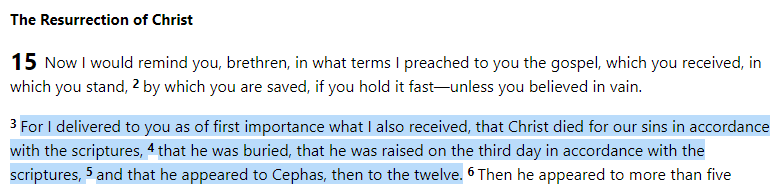
The extremely early dating of this creed is incredibly significant because, first, it's recorded well within the lifetimes of eyewitnesses who could correct and critique it if necessary, and second, because it provides direct evidence of early belief in the resurrection of Jesus.
Thus, we shouldn't dismiss the historical value of the New Testament because it was written a few decades after Christ existed—unless we’re ready to jettison some of history’s best known philosophers, emperors, and conquerors along with him.
Has Pope Francis banned the traditional Latin Mass? Is there still an option for those who prefer the pre-Vatican-II liturgy? What informed the Pope's decision? Here's our overview of Traditionis Custodes and its immediate impact: catholic.com/magazine/onlin…
Under the provisions of Benedict XVI’s 2007 document Summorum Pontificum, the individual priest was the primary decision-maker concerning when Mass would be celebrated according to the older form. Under the new document, the bishop has this responsibility.
Although there are not as many opportunities to celebrate the traditional liturgy as when every individual priest could decide to perform it, there is no sudden end to its celebration.
"Easter is a pagan holiday. Its timing is based on the full moon and the spring equinox, and it’s named after the goddess Ishtar."
No matter how widespread this claim has become, it has no basis in history or reality. (THREAD) (1/10)
The word Easter is of English origin. Ishtar was worshipped in Mesopotamia (modern Iraq), not England, which is thousands of miles away. Despite sounding similar, the two words are unrelated. (2/)
This theory was based on an incorrect conclusion by St. Bede the Venerable about the etymological origins of the English month that coincides with spring and the celebration of Easter, Eosturmonath. (3/)
The Contingency Argument for God's existence, in simple language (thread):
When we look at the world around us, we see many things that change. For example, at one time a man may be standing, but at another time he may be sitting. Yet he is the same man. (1/)
Philosophers express this fact by saying that the man's posture is contingent, i.e. that it could be different than it is. Humans are contingent beings because they could be different than they are at any given moment. The same is true of everything we see in the universe. (2/)
Living things like people, animals, and plants all grow and develop. Inanimate things like your car, phone, or computer may be turned on or off. Even rocks and gems can be cut, polished, or moved from one place to another. (3/)
Catholics and pro-lifers are being forced to make a difficult discernment in conscience regarding the currently available COVID-19 vaccines, because no completely ethical vaccines are available. With that in mind, today we are featuring...
...a point-counterpoint series about how Catholics can respond to vaccines developed with aborted fetal tissue. These should not be read as a debate over what all Catholics must do; rather, they are a discussion of prudential judgements we should make as witnesses to life.
First, the point from Dr. Joseph Meaney of @NCBCenter: Making use of these vaccines involves remote material cooperation with evil, which is licit for Catholics but requires discernment. catholic.com/magazine/onlin…
Neo-pagans and fundamentalists alike claim that Halloween has its roots in the Gaelic harvest festival of Samhein. Because of this persistent idea, some Christians are hesitant to participate in anything associated with Halloween. 1/16
But, like most claims that Catholicism adopted pagan practices and beliefs, this myth is based on bad research and propaganda that developed post-Reformation. Given the reformers' contempt for the Catholic doctrine of purgatory and prayers for the dead, this isn't surprising. 2/
The word "Halloween" is a contraction of “All Hallows Evening,” the vigil for the Christian holy day All Saints Day, which falls on November 1. Part of the confusion over this holiday arises because many people no longer know what the word "hallows" means. 3/