US coverage of the retreat from Afghanistan is an exercise in solipsism (this headline from the Washington Post). Thousands of troops are being sent to evacuate the embassy, but there is still no plan to evacuate Afghan translators and others marked for execution for helping us.
Another angle in US coverage is whether abandoning all these people to die is making our own soldiers feel bad.
What's happening in Afghanistan is primarily a story about Afghan people, who are human beings with every much a right to live in peace as we have, and stories of their own. The tradition in American journalism that only our troops merit coverage is one reason we suck at empire.
The Biden administration made no plans to evacuate thousands of Afghans who helped US forces. When confronted by indignant veterans and members of Congress, they half-assed a policy, but didn't adopt any measures to physically evacuate allies who are now in peril of their lives.
The decision to re-enact the disaster of Operation Frequent Wind (the best-named operation in American military history) is entirely on Biden. There were no Taliban armored divisions bearing down on Kabul; the US could leave on its own terms and decided to fuck up one last time.
Again, even if you're an American nationalist who doesn't care a whit about Afghan people, needlessly abandoning tens of thousands of those who voluntarily helped us to die will ensure that the next military adventure is that much deadlier for US troops. What a pointless defeat.
What it comes down to is that the most powerful country on earth, after a 20 year occupation, is simply too afraid of Afghans to let thousands of Afghan citizens who saved American lives come and build new lives in our country. Even after Vietnam we weren't this cowardly.
I'm sure a lot of people in Taiwan are watching the fiasco in Afghanistan and feeling really good about American strategic planning and promises of mutual aid.
Just to be crystal clear here—the decision to end the American military occupation of Afghanistan is laudable, the failure to send C-130's filled with green cards and arrange to evacuate the vulnerable before evacuating our troops is what fills me with shame.
Like, there's a whole young generation of Afghan women who got an education and a chance to live a non-medieval life. Imagine what those young women could achieve in America, and how much we would benefit, if we let them immigrate freely.
I've shared this before, but if you want a story about Afghanistan that's not told through the lens of war, this travelogue by a Dari-speaking Polish couple is wonderful. Eight episodes so far, with large parts in spoken English and the rest subtitled.
Semper Fidelis*
* Terms and conditions may apply. Not available in all theaters of war. Offer limited to U.S. citizens or resident aliens aged 18 or older. THERE ARE NO WARRANTIES OR GUARANTEES, EXPRESS OR IMPLIED, RELATING TO WITHDRAWAL OF OCCUPATION FORCES.
The callousness and incompetence on display here is stunning. The bureaucratic crisis at the embassy is entirely self-inflicted, and telling people they and their families have to die because we don't want to finish their paperwork on Guam is unacceptable. washingtonpost.com/national-secur…
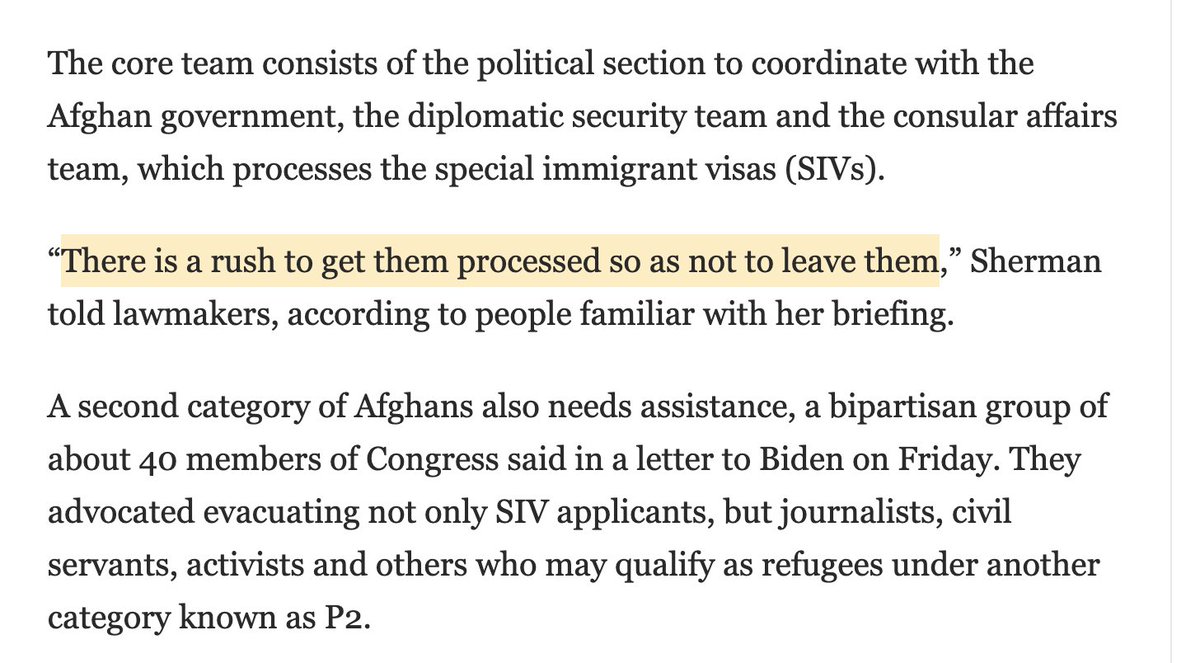
Imagine if it took as much paperwork to kill an Afghan civilian as it does to grant them a visa.
• • •
Missing some Tweet in this thread? You can try to
force a refresh

These windows of opportunity keep getting shorter, and the requirements more fantastical, but this Cassandra mode of climate journalism will continue. Emissions got nowhere near zero even at the peak of the covid shutdown. This is a call for absolutely radical, impossible change
I am critical of this mode of covering climate because I find it paralyzing and totalizing. Even a World War II scale transformation in the global economy, in a context of complete international agreement and cooperation, would not be enough to get to zero net emissions.
What we need instead is a climate version of the Serenity Poem. God grant us the courage to electrify the things we can, the serenity to accept emissions from the things we can't, and the wisdom to pursue carbon sequestration and geoengineering projects that make a difference.
Why New Zealand, possibly the most self-righteous and certainly the least invadable country on Earth, continues to participate in the darkest parts of US intelligence as a full partner is something I have never understood. nationalinterest.org/blog/buzz/afte…
New Zealand made a big fuss about not allowing nukes in the eighties, but stuck with the United States through the shadiest parts of the War on Terror. They event sent troops to Iraq! Why does New Zealand even have troops? How much more ocean do they need to feel secure?
If any countries had learned to say "pass" on sending troops to fight on behalf of foreign empire, it would be Australia and New Zealand. But they love being part of the big boys' club, and sending comically small troop deployments to Vietnam and Iraq has been the price of entry
I attended one of these meetings (working on an article that later got spiked), listened to FBI, big tech, and privacy advocates all speak up, and was very impressed with how it was conducted. The issue is genuinely difficult. Alex Stamos's thread here is very much worth reading.
The ability to share images and video worldwide is unfortunately also a driver for child abuse. Every large site that lets people upload photos and video runs into this fact. The current arrangement (involving NCMEC, fingerprinting, and big tech companies) is a fragile tradeoff
The governance problem here is we have six or seven giant companies that can make unilateral decisions with enormous social impact, and no way of influencing those decisions beyond asking nicely for them to come talk to the affected parties before they act.
I can't believe China had this flag and just gave it up in favor of the current snoozefest. This dragon may be playing with a ball, but he eats "don't tread on me" snakes for breakfast.
Five thousand years of history and you stuck five stars on a red rectangle
Russia had a similar downgrade. They replaced this bad boy with factory seconds from the French flag store
There's a long tradition in the US media of treating Chinese government policy as subtle and inscrutable expression of grand national strategy, so it's particularly funny that the CCP put a guy in charge who is simply a Marxist-Leninist fundamentalist. wsj.com/articles/china…
Like, the answers are all spelled out in the official speeches, but they are so indescribably boring to read it creates a kind of armor against foreign analysis. So we see a lot of nugatory head-scratching about what the CCP's chess moves mean for tech, for markets, and so on
Sometimes as a journalist you just have to grow a pair and read the Party texts. If the Korean analysts can stand to do it, you have no excuse.
If you ignore the ideological content of Jan 6 for a moment and look at the mechanics of the investigation, you get a good lesson in the threat social media poses to public protest. Retroactive forensic analysis in a surveillance society can have a powerful chilling effect
Two traditional aspects of protest are in tension—one is that it's a open display, and the other is that it's ephemeral. A world where police can track participants down years after the fact, maybe even after laws have changed, is a different world from one we've ever lived in
I think about this a lot in the context of Hong Kong, where someone was just put away for six years for displaying a political slogan that was chanted by millions of people over the course of 2019. That conviction wasn't retroactive, but it's just a small further step away.