We have spent the past few years debating how oppressive the U.S. is. These images of Afghans clinging to a U.S. plane and falling from the sky are a damn sobering reminder that while there are no utopias, we'd better appreciate the society we were lucky enough to be born into.
I'll expand this beyond the U.S. I have had conversations with well-to-do Parisians this past year who have said with a straight face that President Macron is "authoritarian," "a tyrant." Let's get some perspective.
If you're lucky enough to be born into a prosperous democracy that isn't dependent on the whims of a foreign presence to keep the forces of chaos and murder at bay, you ought to be critical when necessary but also deeply grateful for the present without being stuck in the past.
Here's a prime example of the devastating lack of perspective that now obtains:
I've recently fallen afoul of both a kind of conservative Twitter (for NYT op-ed against CRT bans) and a kind of social justice Twitter (for assorted wrongthink). Both attacked, but I say this seriously––only a part of "woke" Twitter tried to criticize my physical appearance.
It's only anecdotal experience, but it seriously makes me wonder what kind of progress these "progressives" believe they're fighting for and why they believe their ends can justify any kind of nasty means, which, in theory, they would say they're against.
Conservative Twitter gets angry for sure, but only woke Twitter will be like, "the way you are holding your glass of wine is so stupid." LMAO
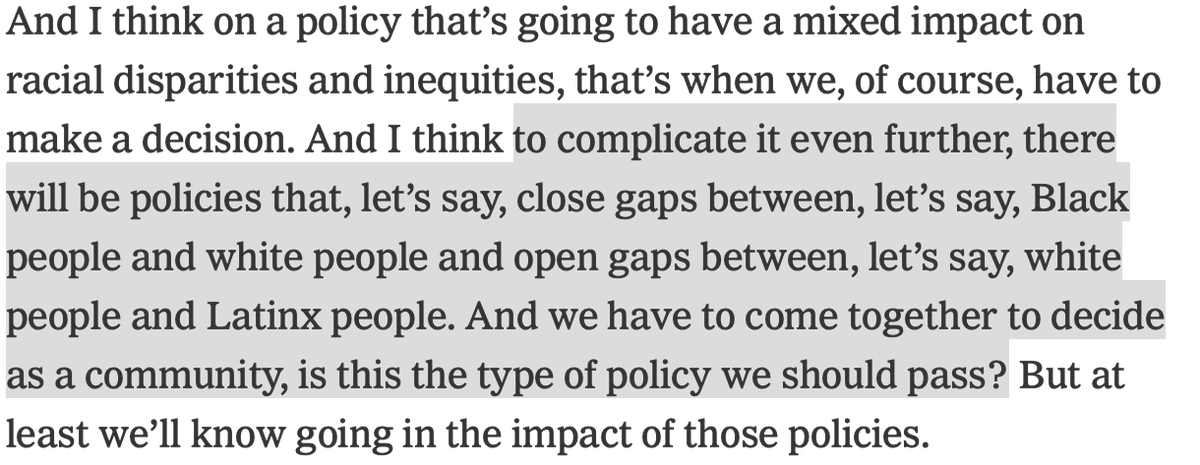
Around 27 minutes in, Kendi's reasoning just becomes tortuous.
Who is the "we" here? Who decides the impact of every policy on one abstract identity group against the imagined interest of another? Who says: "This is in the Latino interest"; "This is in the black interest"?
Then when Klein gently but somewhat insistently pushes about whether defunding the police is in the black interest or not, Kendi gives a series of convoluted and unsatisfying answers. Hard to believe such deliberation can work on every single law and policy going forward.
Yesterday a lot of people were dissatisfied with a distinction I drew between the work of an activist and that of a writer. Quick thread for those who weren't instigating but were genuinely asking, and for whom my responses to Rufo seemed unnecessarily dismissive. /1
I appreciate the people here who are, as I wish to be, seeking clarity. I owe you a fuller answer.
The distinction between writer and activist is important to insist on. The activist (or ideologue) is married to a position, which may or may not be correct on a given subject. /2
By definition the activist’s mission is not to allow doubt or ambiguity to undermine their priors. That's antithetical to the mission of the serious writer, who's there to raise questions and complicate issues—to allow the possibility that new information will change her mind. /3