I really disagree with the framing around the tech press tonight that Apple's new settlement with developers represents a big concession.
I don't see how this changes much. Some companies pretty much already do what Apple says it is suddenly allowing.
nytimes.com/2021/08/27/tec…
I don't see how this changes much. Some companies pretty much already do what Apple says it is suddenly allowing.
nytimes.com/2021/08/27/tec…
An Apple exec told reporters tonight that it was a huge concession that Apple will now let companies tell people in emails that they can buy their services outside their apps.
But Apple will still ban them from telling people that in the app itself.
Here's the current policy.
But Apple will still ban them from telling people that in the app itself.
Here's the current policy.
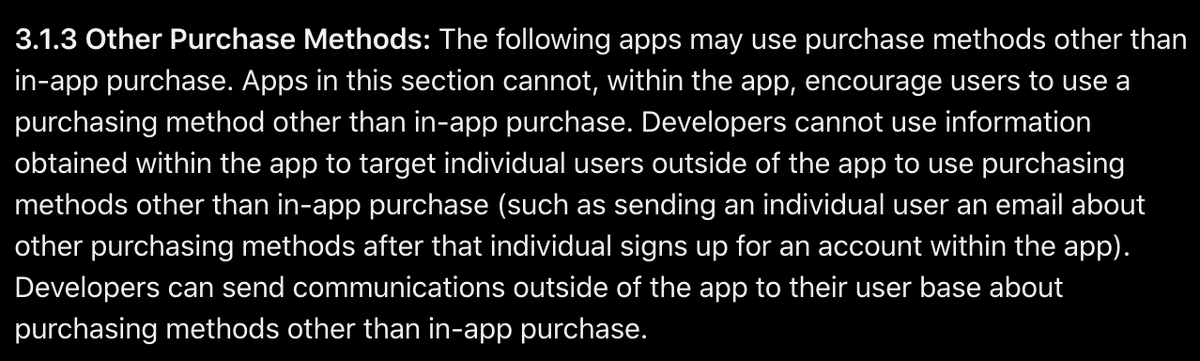
That does not feel like Apple is giving up much.
First of all, it seems like a self-own that Apple is publicly declaring that they have long restricted what other companies can say in private communications with prospective customers, completely outside of Apple's ecosystem.
First of all, it seems like a self-own that Apple is publicly declaring that they have long restricted what other companies can say in private communications with prospective customers, completely outside of Apple's ecosystem.
Secondly, companies like Netflix and Spotify already don't allow people to purchase subscriptions in their apps, allowing them to avoid Apple's 30% commission.
Yet they of course advertise their subscriptions in emails. So this isn't going to change much for them!
Yet they of course advertise their subscriptions in emails. So this isn't going to change much for them!
All in all, Apple made this minor change, agreed to keep its commission rates flat for at least three years, and paid $100 million to make a potentially large legal headache go away.
Seems like a great deal for the richest company in the world.
nytimes.com/2021/08/27/tec…
Seems like a great deal for the richest company in the world.
nytimes.com/2021/08/27/tec…
This is a better analysis of the Apple settlement than any journalist did tonight.
https://twitter.com/rjonesy/status/1431080067942207488?s=21
One key part: The plaintiffs’ lawyers want $30 million of the $100 million fund for small developers.
https://twitter.com/rjonesy/status/1431095409791934467
• • •
Missing some Tweet in this thread? You can try to
force a refresh