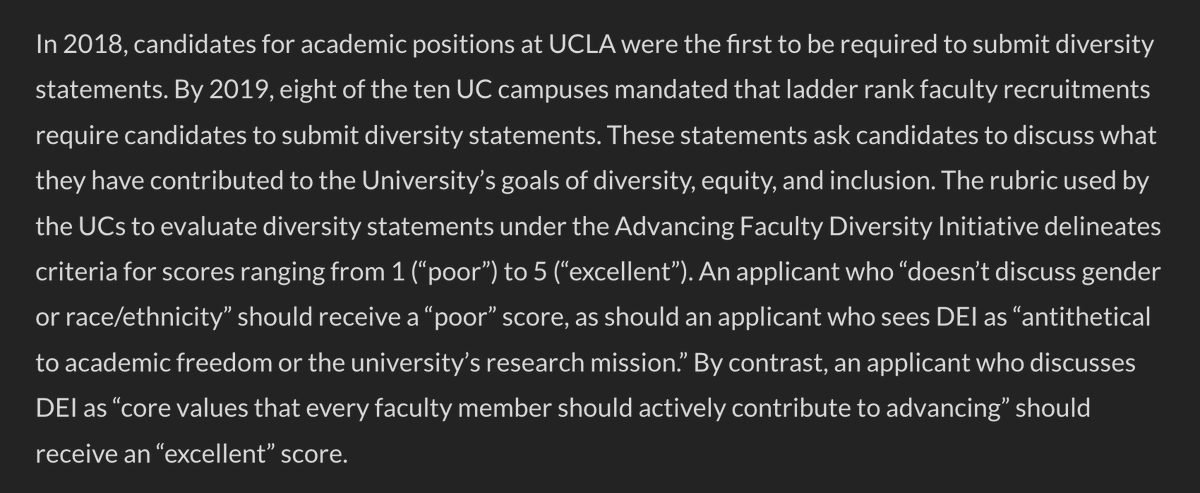
Lots of people are applying for jobs at a UC right about now--which is awesome, especially if its @UCDavisLaw --and a few have reached out to me for advice about the required diversity, equity, & inclusion (DEI) statements. Turns out it's a subject on which I have a LOT to say:
So here's some advice, in case it's useful. First, focus on what you've done or plan to do, not on abstract statements about how much you care about students of all backgrounds. This is a chance for reflection on what you've (hopefully) done to make your field more inclusive.
Don't just rely on the fact that you write/teach about some issue with social justice implications. Regardless of what you teach, have you worked to diversify your reading list? Have you made your own materials to lessen students' financial burdens?
Have you found unusual ways to reach out to students who perhaps didn't arrive as pros about talking in class or navigating office hours or seeking out mentors? Have you introduced students to possibilities (clerkships, summer jobs, law review) that weren't on their radar?
In your scholarship, who do you cite, engage or collaborate with? If you practiced (here I'm thinking law), don't just list your pro bono work; explain how you helped bring new perspectives to a case, what you learned from your client, or whose concerns you centered.
You've either done service work or, if new, been in student orgs. Did you do anything there to disrupt the status quo, whether in what you achieved or in how you ran the committee or organization? Have you done anything to reduce insider advantage in your professional orgs?
In your previous job or clerkship or school, did you notice strategies that worked (or failed) to diversify the office or field? If so, can you work to replicate the ones that worked at the school where you're applying?
All of this is relevant to your DEI statement, and notice that none of it depends on your own identity or background. Here's a good UC-specific guidance document that shows how many types of experiences (or plans) count as valuable DEI contributions: facultydiversity.ucsd.edu/recruitment/C2…
I just want to encourage people to go beyond "I teach/write about/litigated this [social justice] issue" or "I identify as/grew up around/care about [insert demographic group]". You probably have more interesting things to say that that.
I should note that I'm not on my school's appointments committee; I'm just speaking for myself here. But it's a topic I've thought about a lot. Others surely have more (and better) suggestions--they should add them!
…eechcenter.universityofcalifornia.edu/fellows-20-21/…
…eechcenter.universityofcalifornia.edu/fellows-20-21/…
• • •
Missing some Tweet in this thread? You can try to
force a refresh