SCOOP: Emails show that the LAPD
worked w/ Dataminr -- a controversial social media surveillance company -- during the #GeorgeFloyd protests. The LAPD has previously denied using the system to track BLM protests. @LATACO
lataco.com/lapd-social-me…
worked w/ Dataminr -- a controversial social media surveillance company -- during the #GeorgeFloyd protests. The LAPD has previously denied using the system to track BLM protests. @LATACO
lataco.com/lapd-social-me…
Previously the LAPD told @theintercept that they conducted a trial with Dataminr but chose not to enter into a contract with the company. They also denied that they used Dataminr in connection with the early BLM protests last summer. theintercept.com/2020/07/09/twi…
Backed by a contract with Twitter that gives them exclusive access to Tweets directly after they’re published and a team of analysts that monitor other social media platforms, Dataminr compiles public information in realtime and sells it to back their clients.
In one example a Dataminr alert included a Tweet from me while I was on the ground covering a BLM organized protest in the Fairfax area on May 30. Minutes after the Tweet went live a copy landed in LAPD Officer Mathew Rejis' inbox. 
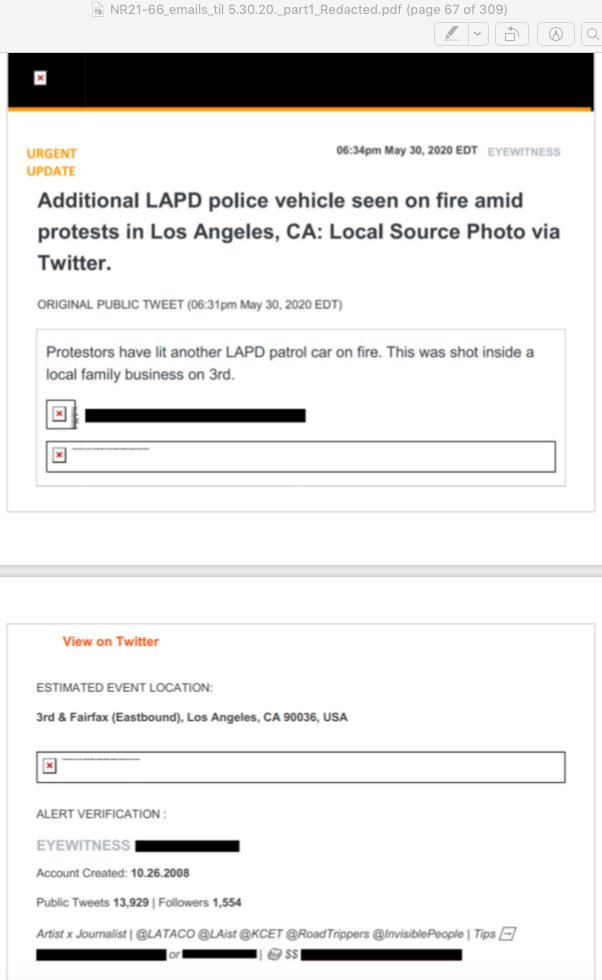
In addition to receiving tips about events happening in LA, the LAPD also received information about protests occurring in other cities across the country and abroad including Oakland, Denver, Seattle, Atlanta, Charlotte, Portland, Chicago, Brooklyn, Minneapolis and even London.
Hamid Khan, an organizer with the LAPD watchdog group, @stoplapdspying, described LAPD’s partnership with Dataminr as “not surprising,” during an interview with L.A. TACO.
According to the longtime organizer, the issue isn’t just the one social media post that might be tracked in the moment of a protest, it's the bigger ramifications of being included in a police database and exposing other people to surveillance.
“That social network analysis and monitoring, really becomes a source for metadata,” Khan said,
explaining how one data point can provide information about other contacts.
explaining how one data point can provide information about other contacts.
“So for example, if we were monitoring you, you have 10 friends, each one of those 10 has another 10...so it becomes this exponential growth, this multiplier effect, where you become a conduit for them to then go after extended social networks and extended relationships..."
During the summer of 2016, the @ACLU_SoCal requested records from more than 60 different law enforcement agencies, across the state, including the LAPD. The results of which found that 40% of respondents had acquired social media surveillance tools.
In 2015 Dataminr reached out to the LAPD with an offer: A three month free trial to a service with unfettered access to 500 million Tweets in real time, proprietary technology that reportedly allowed them to predict the location of 60 percent of Tweets and real time alerts...
The ACLU points out that these surveillance tools have a history of targeting communities of color. Check out their report - aclunc.org/blog/police-us…
• • •
Missing some Tweet in this thread? You can try to
force a refresh