

The case of Graham Dwyer gets underway at the European Court of Justice.
Ireland's Supreme Court has asked for a clarification on EU data retention law after Dwyer's team appealed against a murder conviction by taking issue with police retention and use of mobile phone data
Ireland's Supreme Court has asked for a clarification on EU data retention law after Dwyer's team appealed against a murder conviction by taking issue with police retention and use of mobile phone data
Germany, Belgium, Ireland, Czechia, Denmark, Estonia, Spain, France, Cyprus, Netherlands, Poland, Portugal, Finland and Sweden are all making submissions as they are all interested in the consequences for law enforcement of the outcome.
Two German telecom companies previously challenged requirements to retain data and provide it to law enforcement. Germany appealed and asked for ECJ clarification. It concerns the same directive and regulation so the court is hearing everything together with the Dwyer case.
Timeline:
The parties have submitted written pleas.
Today there are oral submissions, questions and a debate.
In maybe six weeks the advocate general will issue an advisory opinion.
Then the court will rule, clarifying EU data law on this issue.
The parties have submitted written pleas.
Today there are oral submissions, questions and a debate.
In maybe six weeks the advocate general will issue an advisory opinion.
Then the court will rule, clarifying EU data law on this issue.
Remember: The European Court is considering a point of EU data law. It will be up to the Irish courts to determine what the implications of the EU ruling will be for Dwyer's case, ie, whether some evidence used to convict him should be considered inadmissible.
Another important question is whether whatever the European Court decides will be forward-looking or retrospective, ie whether it would have implications for any old cases or just cases going forward.
The legal team of convicted murderer Graham Dwyer have argued that Irish data law provides "the most minimal protection imaginable" and that in Dwyer's case police effectively used mobile phones as "personal tracking devices" irishtimes.com/news/crime-and…
Graham Dwyer's legal team head into the court ahead of the hearing. Barrister Remy Farrell SC has argued that "some of the evidence used in this trial was obtained in breach of his charter rights". 

The outcome is of huge interest to member state governments because of its implications for law enforcement, which is why you can see so many countries here due to speak to the court. More have given written submissions
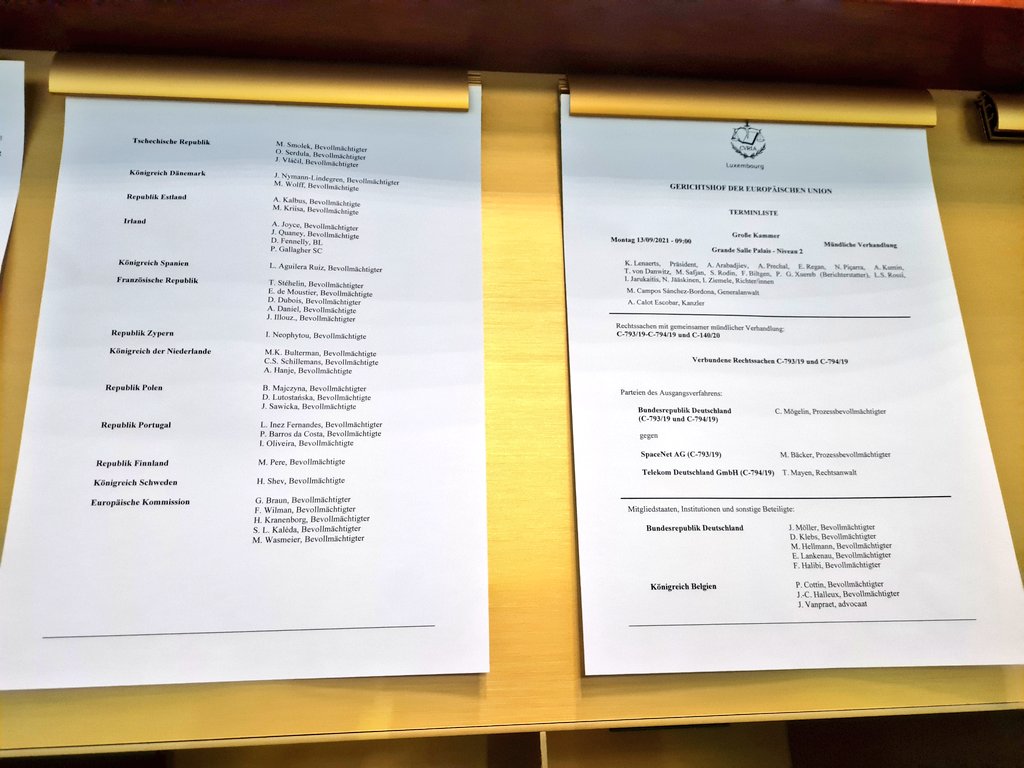
A strong intervention by Tanguy Stehelin for France has very much backed up the Irish state's position that such mobile phone data use by law enforcement is essential to fight serious crime.
"Using modern technology to fight serious crime is the cement of our societies," he said.
"Using modern technology to fight serious crime is the cement of our societies," he said.
Stéhelin described it as an "issue of national security".
"We need to protect our citizens against crime by preventing and investigating," he said, describing it as "a duty".
"There's been such a shift to digital communications this is absolutely vital."
"We need to protect our citizens against crime by preventing and investigating," he said, describing it as "a duty".
"There's been such a shift to digital communications this is absolutely vital."
In many cases such mobile phone data use is the "only" way to solve the case, Stéhelin said, and without such powers police would be blind to first offenders and people with pre-paid phones.
"The case that we saw from Ireland shows the tragic consequences of this," he said.
"The case that we saw from Ireland shows the tragic consequences of this," he said.
"If we don't have efficient tools to ensure security and justice within member states we are putting at threat fundamental freedoms and ar the end of the day democracy," Stéhelin concluded for France, warning of the risks for public faith in EU law.
The Netherlands is speaking now.
So far, states have argued that "general retention is justified in some circumstances, and is necessary to fight criminality", says lawyer for the Hague Ms A Hanje. "The Netherlands agrees with this."
So far, states have argued that "general retention is justified in some circumstances, and is necessary to fight criminality", says lawyer for the Hague Ms A Hanje. "The Netherlands agrees with this."
"This retention duty with the restrictions that your court have put forward is not practicable, and that is because criminality is not to be foreseen, and Ireland put that forth very clearly this morning" Ms Hanje said. "The Netherlands would like to underline that point of view"
Ireland's advocate general has told the European Court of Justice that curtailing the retention and use of mobile phone data would make fighting serious crime impossible and undermine public faith in EU law, as Luxembourg court hears Graham Dwyer case
irishtimes.com/news/crime-and…
irishtimes.com/news/crime-and…
Lawyer for Sweden Hanna Shev has said the kind of restrictions on the retention of data previously outlined by the court would mean "in practice internet crime could be committed with impunity".
A relevant previous ruling of the court is described here: curia.europa.eu/jcms/upload/do…
A relevant previous ruling of the court is described here: curia.europa.eu/jcms/upload/do…

European Commission's Martin Wasmeier has disagreed with an argument put forward by Dwyer's legal team, who argued that traffic and location data (metadata) is more invasive than content-of-messages data, because conclusions can be drawn from the time and frequency of messages...
... whereas people can obscure what they say to each other in messages through their choice of wording, and keep privacy that way.
However, "The court has said that traffic and location data is not on a par with content," European Commission lawyer Martin Wasmeier said.
However, "The court has said that traffic and location data is not on a par with content," European Commission lawyer Martin Wasmeier said.
*attorney general ofc
https://twitter.com/NaomiOhReally/status/1437364032919515136?s=19
After a break the court hearing has resumed and the judge-rapporteur Peter Xuereb is asking questions of those who have made submissions.
Xuereb asked, after Elaine O'Hara's body was found, if Irish authorities could have made a targeted data request of her phone, within EU law.
Xuereb asked, after Elaine O'Hara's body was found, if Irish authorities could have made a targeted data request of her phone, within EU law.
"They weren't using the registered phones," attorney general Paul Gallagher replied.
"Is the problem not that in Ireland you could buy unregistered phones?" asks judge-rapporteur Xuereb
"Is the problem not that in Ireland you could buy unregistered phones?" asks judge-rapporteur Xuereb
"Isn't it in a way incoherent if you ask for a regime in the name of efficiency... of generalised retention, while leaving the possibility to communicate with non-registered phones, meaning you can still hide your identity?" asks judge-rapporteur Xuereb.
"Even if that is addressed, that will not address the circumstances in which people register under a false identity," attorney general Paul Gallagher replies. "Most criminals involved in serious crime use false identities."
Xuereb asks about current rules in Ireland since the challenge to the prior law.
"Under the present regime... there does have to be evidence that the person is involved in a crime," Gallagher says. "It is now necessary to go to court to access the data in any particular suspect."
"Under the present regime... there does have to be evidence that the person is involved in a crime," Gallagher says. "It is now necessary to go to court to access the data in any particular suspect."
EU Commission has proposed a compromise between member states and EU law.
They argue that the court has accepted indiscriminate data retention is permissible in some circumstances, ie a threat to national security.
They propose to equate some serious crimes as equivalent to such.
They argue that the court has accepted indiscriminate data retention is permissible in some circumstances, ie a threat to national security.
They propose to equate some serious crimes as equivalent to such.
This wouldn't be a widening of the case law, just a "different interpretation" Commission's Wasmeier said.
What crimes?
"We think the member states are better placed in deciding what is strictly necessary than the Commission, we are not a practical law enforcement agency."
What crimes?
"We think the member states are better placed in deciding what is strictly necessary than the Commission, we are not a practical law enforcement agency."
Irish ECJ judge Eugene Regan has been asking the Commission about its proposal.
"Having created this exception for national security, what you're saying is that... certain serious crimes can be considered synonymous with with threat to national security?" Regan asked.
"Having created this exception for national security, what you're saying is that... certain serious crimes can be considered synonymous with with threat to national security?" Regan asked.
"Drug trafficking, organised crime, they go to the heart of democratic, just and safe society and that is the logic of what you are suggesting," Regan paraphrases. "The generalised retention of data be permitted for those kind of serious crimes?"
European Commission's representative Wasmeier says yes, that's the idea: "a very high public security objective which would be equivalent to national security would meet justification of general and indiscriminate data retention" -- would help with the "proportionality" question
(Earlier on, France made the case for a broader understanding of national security- like if something was threatening public faith in the state and justice system (like, say, a high profile murder case...) then it is in the interests of national security...)
Judge Regan seems more sympathetic to the member states than some. He notes people have made the point that the court is returning to issues it already dealt with, however, "We come back with experience" with evidence about practical "difficulties of implementing" prior decision
"Every member state today in their intervention said there is no alternative or less onerous means to protect society and prosecute crime in the digital age," judge Regan puts to the Commission. "Do you accept this?"
"We expressed a lot of understanding," the Commission replies.
"We expressed a lot of understanding," the Commission replies.
The closing arguments were interesting. Ireland said that member states had to ensure confidentiality of communications, not be tapping phones, but that a "logical interpretation" of data privacy wouldn't cover eg the Dwyer case.
"There are serious crimes, we are telling you now, that will not be capable of being detected and prosecuted," Gallagher said "Europol have said that, the mem er states have told you that - how can it be ignored without undermining undermining core union value?"
"If citizens are told that a core member states responsibility cannot be discharged, that will undermine confidence in the institution," the attorney general warned, noting that the experience of the last decade showed the consequences if the concerns of citizens are unaddressed
France said "too many limits on storage give rises to significant difficulties as all member states have said".
"We shouldn't have too strict a definition of serious crime," should be "evaluated depending on each individual situation and ms's view of an attack on public security"
"We shouldn't have too strict a definition of serious crime," should be "evaluated depending on each individual situation and ms's view of an attack on public security"
Cyprus said "I speaking for the Republic of Cyprus would like to fully agree with what was said by the representative of Ireland."
The Irish situation is "precisely the same as ours, especially as concerns duration of retained data".
The Irish situation is "precisely the same as ours, especially as concerns duration of retained data".
Spain said "any route is better than losing access to an existing tool."
"As Ireland said we cannot find justifications for citizens to not have access to this toolkit."
"As Ireland said we cannot find justifications for citizens to not have access to this toolkit."
The Dutch:
"We do not agree with your limited interpretation... in terms of the general retention of data"
"We are here to say we would like to make our disagreement clear to the court"
"Your court with this line is going further than the protection that exists in the Convention"
"We do not agree with your limited interpretation... in terms of the general retention of data"
"We are here to say we would like to make our disagreement clear to the court"
"Your court with this line is going further than the protection that exists in the Convention"
Finland: "member states should have at their disposal similar measures to combat the problem because we're talking about interests that are absolutely necessary for society".
Sweden: "obviously if you have a serious crime which you can't investigate or solve that is very destabilising for society, for example murder but other crimes as well."
The Commission as a compromise has proposed extending 'quick freeze plus' (allows states to order telecom operators to store all data temporarily indiscriminately case of of a serious imminent threat to national security), by broadening the understanding of 'national security'
Sweden said "as far as quick freeze plus is concerned... this cannot replace data storage"
Such data concerns "information that the service provider has stored for their own purposes... it's a matter of luck whether a certain piece of information has been stored or not."
Such data concerns "information that the service provider has stored for their own purposes... it's a matter of luck whether a certain piece of information has been stored or not."
The advocate general's opinion is expected on November 18. My piece: irishtimes.com/news/crime-and…
And an analysis: Graham Dwyer case becomes spearhead of an attempt by EU member states to persuade the European Court of Justice to revisit its previous case law, and allow law enforcement to maintain easier access to mobile phone data in investigations irishtimes.com/news/crime-and…
• • •
Missing some Tweet in this thread? You can try to
force a refresh





