Major decision from Court of Appeal interpreting California's Housing Accountability Act. Read @carla_org's thread below for highlights, or continue with this one if you want the legal nitty gritty. /1
https://twitter.com/carla_org/status/1437488478531379201
Context: California is one of two states that nominally prevent local govts from rejecting or downsizing housing development projects on the basis of "subjective" standards. (The other is Oregon.) /2
This limitation has been on the books in CA since 1999, but there was no caselaw applying it, perhaps b/c developers feared that if they sued a city, the city would screw them on their next project. /3
In 2016, the Legislature authorized housing organizations and potential future residents to enforce the HAA in court, and also provided for an award of attorneys fees to the prevailing plaintiff. (Previously, fees were available only in cases about BMR projects.) /4
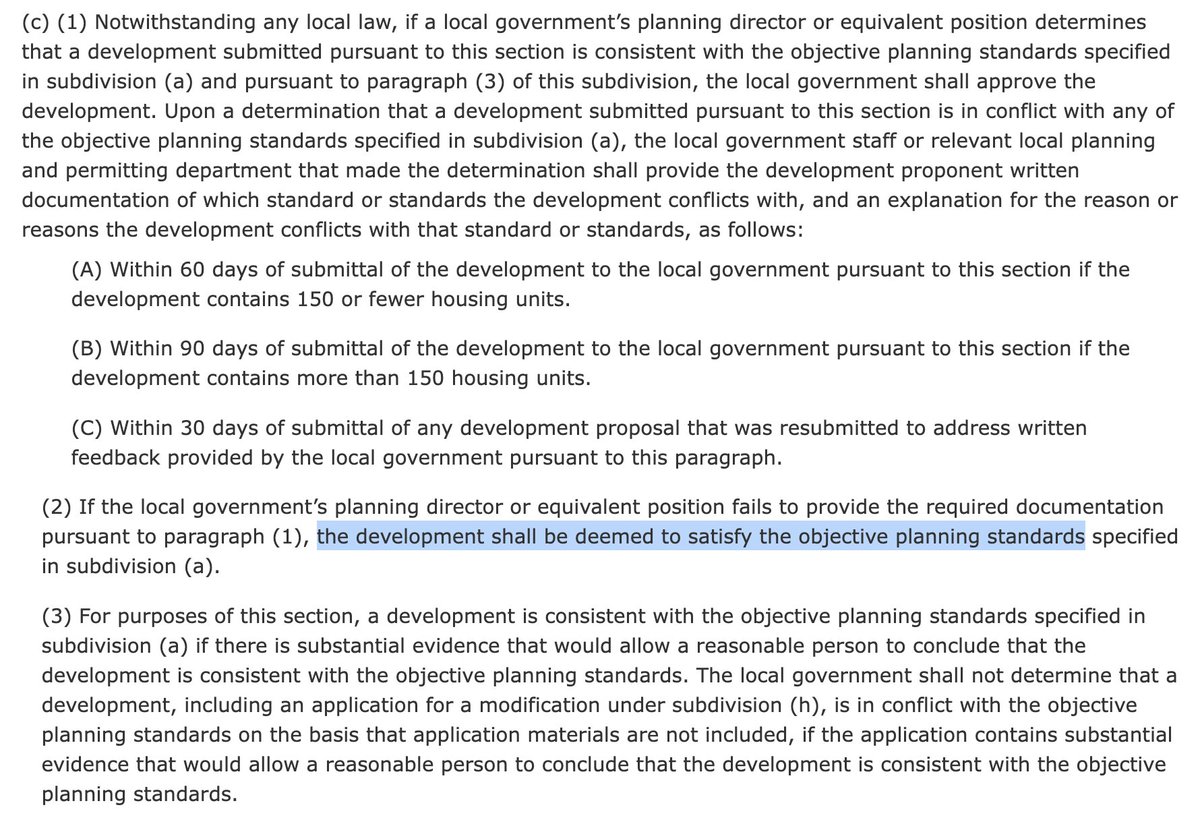
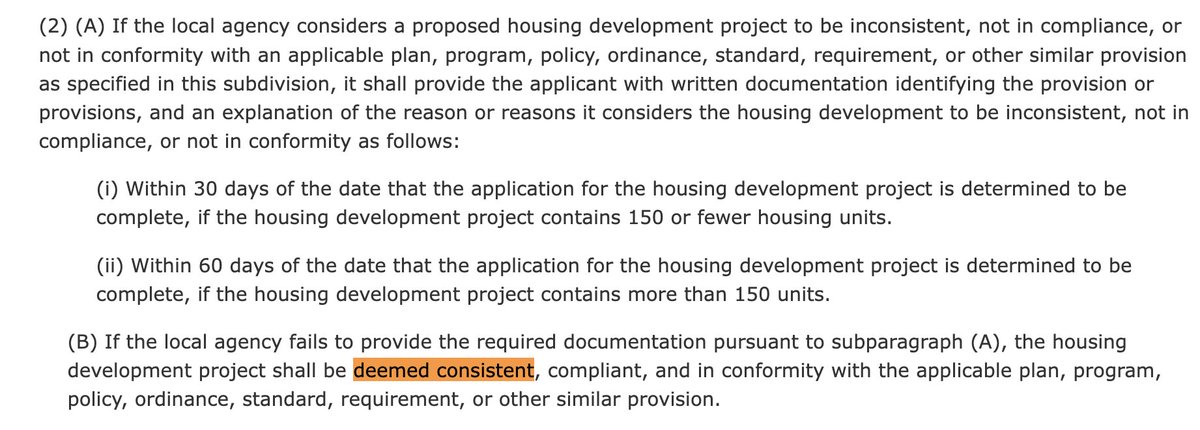
A year later, the Leg backstopped the HAA's "objective standards" requirement by stipulating that a project shall be deemed to comply if there's substantial evidence in record that would *allow* (not require) a "reasonable person" to conclude that project complies. /5
This flips the traditional standard of review on its head: normally, in CA and elsewhere, courts must uphold a city's decision to deny a project if a "reasonable person" could *agree with the city's determination of noncompliance* (even if it's dubious). /6
The HAA's new evidentiary standard is the linchpin of the whole scheme, b/c, as Oregon's experience shows, the question of whether a zoning or development standard is clear enough to qualify as "objective" presently vexing line-drawing problems. /7
As one Oregon adjudicator put it, "Few tasks are less clear or more subjective than attempting to determine whether a particular land use approval criterion is clear and objective.” /8 

The HAA's evidentiary standard lowers stakes of the "is this standard objective enough" question, while prodding cities to write clear zoning standards. (If the standard is mushy, a city would be hard pressed to show that no reasonable person could deem a project compliant.) /9

The trial court in this case ripped heart out of the HAA, holding, inter alia, 1) that a design standard is "objective" if city makes it thus *by interpretation* at the time it denies a project, and 2) that cities are owed deference on such surprise, time-of-denial interps. /10
San Mateo's Multi-Family Design Guidelines call for a "transition or step in height" when project adjoins a SFH. City staff initially said this project's landscaping, trellis, street-facing stepbacks, and distance from neighboring home provided the requisite "transition." /11
But city denied project after NIMBYs mobilized, and at time of denial the city announced (for first time) that "transition or step in height" entails stepbacks on elevation facing SFH, on every floor above height of said SFH. /12
As a law profs' amicus brief argued, this move could be used to deny almost any project, since vague "aesthetic character" guidelines can always be precisified with novel time-of-denial constructions. /13
carlaef.org/legal-case/4-w…
carlaef.org/legal-case/4-w…
And yet, city's legal argument wasn't risible: courts have traditionally deferred to cities on the meaning of their own ordinances, and the text of the HAA's "reasonable person" standard arguably implies that it governs only questions about evidence, not legal meaning. /14

But the Court of Appeal would have none of it: "Precisely because the HAA cabins the discretion of a local agency to reject proposals for new housing, it is inappropriate for us to defer to the City’s interpretation of the Guidelines." /15

The Court held that San Mateo's Guidelines aren't objective. Even more importantly, it also held that the project could not be denied because a "reasonable person" could deem it compliant with Guidelines as they stood when the developer submitted their project application. /16
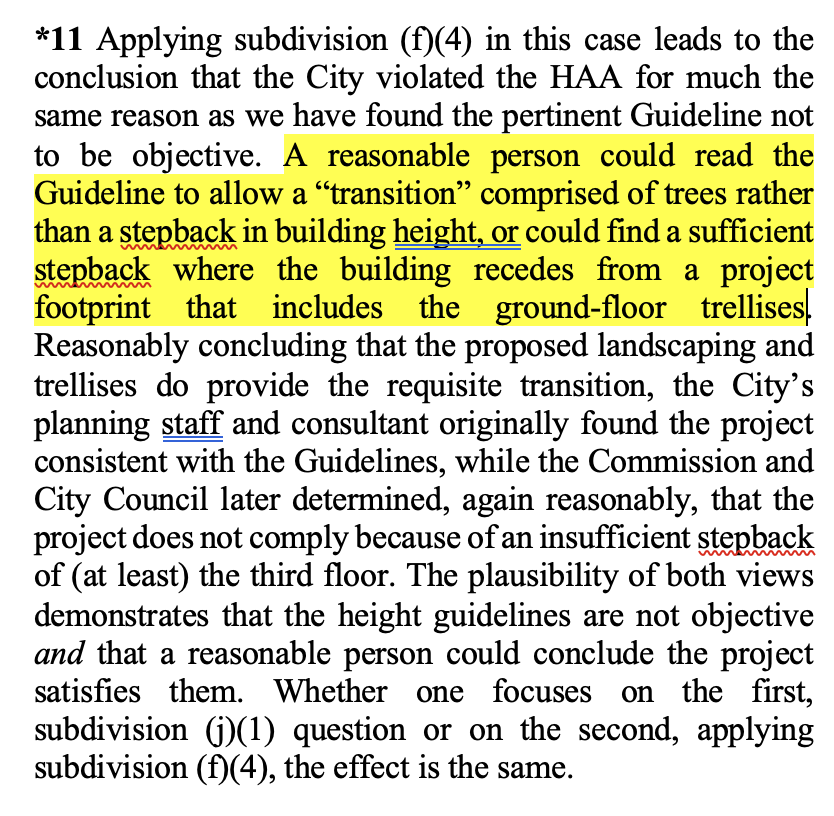
This is tantamount to applying the HAA's reasonable-person standard to the whole of the "mixed law-and-fact" question of whether a project complies with applicable standards. /17
Cities cannot wiggle out of the HAA (as San Mateo tried) by distinguishing law questions from fact questions and demanding deference on the former, even as they kill projects with surprise, time-of-denial interpretations of their own laws. /18
The Court of Appeals's opinion is also important because it methodically breaks down and rejects various constitutional objections the city mustered against the HAA -- home rule, private delegation, due process. (Trial court bit on home rule.) /19
One tiny quibble: the Court labeled compliance with the HAA's reasonable person standard a question of fact, whereas I think it's a question of law. It's kin to the traditional legal question of whether an agency's decision is supported by substantial evidence. /20

But whatever the label, the opinion makes clear that unless a city announces its interpretation *before* the developer submitted her project, the city must accept the developer's theory of how the project complies if a reasonable person could accept it. /21


In sum, this very careful opinion, written by a very well-respected judge, is a huge win for the HAA.
And the central principle it advances will be equally helpful in cases about #SB9 and other housing laws. To wit: when the Legislature acts to curtail... /22
And the central principle it advances will be equally helpful in cases about #SB9 and other housing laws. To wit: when the Legislature acts to curtail... /22
cities' land use authority, courts must review cities' exercise of residual authority with a skeptical eye, lest cities "circumvent what was intended to be a strict limitation on [their] authority." /end @ProfSchleich @RickHills2 @dillonliam @manuelatobiasm @ONeillMoiraK

• • •
Missing some Tweet in this thread? You can try to
force a refresh