KOREAN AND TAMIL CULTURE - A COMPARATIVE STUDY :-
There r several similarities between the Korean and Tamil culture of India in terms of language, foods and culture. This was found out by various scholars from both India and korea. Let's see some of the important similarities
There r several similarities between the Korean and Tamil culture of India in terms of language, foods and culture. This was found out by various scholars from both India and korea. Let's see some of the important similarities

There r many historical evidences to show that the ancient Tamils traded across the seas with different regions of Indian subcontinent and south East Asian countries. The first evidence of ancient maritime contact appears in the second half of first millennium bce from
Ban don ta phet in west central Thailand dated to the early 4th cent bce. Also ancient sangam literature "Nattrinai" narrates commercial as well as cultural link between south india and foreign countries

Similarities in food :-
Koreans consider rice as staple food, same as tamils do. They distribute sweets made up of rice such as Adhirasam, on events such as birth of a child, housewarming ceremony etc., Other items such as Oorugai-pickle ( 김치-Kimchi ),
Koreans consider rice as staple food, same as tamils do. They distribute sweets made up of rice such as Adhirasam, on events such as birth of a child, housewarming ceremony etc., Other items such as Oorugai-pickle ( 김치-Kimchi ),
Kozhukattai-dumplings ( 송편-Songpyeon ), sesame cake (엿강정-yeotgangjeong), adai dosai (김치전-kimchi-jeon), sweet pongal ( 약식-Yaksik ) and also sundakanji-fermented rice ( Makgeolli 막걸리 )

Similarities in culture :-
Pongal is an imp tamil festival celebrated as harvest festival dedicated to suryadeva, indiradev, gomatha etc., One can find a similar tradition in korea as Seolnal (설날) and Chuseok festivals (추석).
Pongal is an imp tamil festival celebrated as harvest festival dedicated to suryadeva, indiradev, gomatha etc., One can find a similar tradition in korea as Seolnal (설날) and Chuseok festivals (추석).

Pearl diving in the deep seas in TN is mentioned in ancient tamil literature poem as Korkaiyam perunturaimuttodu poondu (Chilappadiharam- 14:180). Even today the practices r found. Similarly, the same practices are followed by women in southern costal region of korea.
Ancestor worship is followed in tamil hindu culture widely, the same can be found in "jesa" ancestor worship practiced in korea. Animal sacrifice is an another common thing found in both cultures.

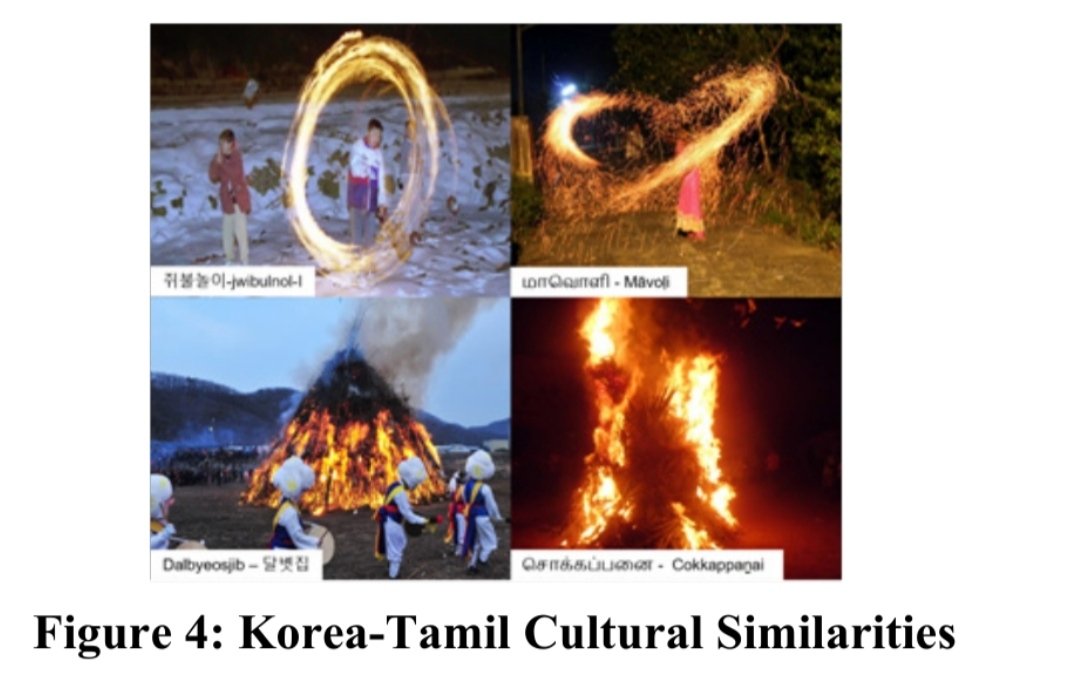
In korea the village ppl would pray to Chilseongnim (칠성님) hoping for a great harvest. Once the ritual is over, they would set fire to the dry weeds using torches (Dalbyeosjib -달볏집). The reason is to kill the insects and fertilize the field before planting crops.
This is practiced as "chokkapanai" in TN. Next there is a play called jwibulnol-I (쥐불놀이) that children would go out in the rice field set a fire in the small tin can with long rope/wire handle attached and enjoy spinning it. In TN, it is known as Māvoli, done during karthikai
Similarities in language :-

Archeological evidence of Tamil trade relations with foreigners :-
Adichanallur prehistoric harbour site (1000bce-600bce) in TN, is considered as the Ancient cradle of iron age civilization, has a long and continuous history of human occupation located 25 km away from korkai port
Adichanallur prehistoric harbour site (1000bce-600bce) in TN, is considered as the Ancient cradle of iron age civilization, has a long and continuous history of human occupation located 25 km away from korkai port
In yr 1986, kenneth Kennedy studied 5 skulls from adichanallur kept at egmore museum, TN. He noticed the existence of 3 major races in adichanallur excavation site - mongoloid, caucasoid, australoid. Also FORDISC analysis report showed the existence of other racial grps such as

Caucasoid 35%, Mongoloid 30%, Negroid 14%, Australoid 5%, dravidian 8% and mixed traits 8% in those areas.
The vast diversity in the population present in those areas represents the active maritime trade happened btw ancient Tamils and NE/SE asian countries.
The vast diversity in the population present in those areas represents the active maritime trade happened btw ancient Tamils and NE/SE asian countries.
You can watch this fun video on cultural similarities shared between korea and Tamilnadu.
This is from another YouTube channel run by korean scholar GI moon yang who learnt tamil and now teaches tamil in korean language.
You can read abt this in detail from the research paper given below.
researchgate.net/publication/34…
researchgate.net/publication/34…
@SriAnuttamanya @Dharmicgoks @Dr_Strange2021 @turbulentflow31 @Indumakalktchi @FervidIndian @VedicWisdom1 @Param_Chaitanya @HinduResponse @tskrishnan @anbezhil12 @IndianHistory0 @GaikwadAnkur @Avyayah_ @RajVedam1 @gyanmparambalam @womaniya108 @porbotialora
• • •
Missing some Tweet in this thread? You can try to
force a refresh