It's easy to spend a lot of time building a mediocre startup.
Epic startups have magic, when a user understands what the product does and smoke comes out of their ears because they need it so much.
Here are the ten steps to find the magic for your startup:
Epic startups have magic, when a user understands what the product does and smoke comes out of their ears because they need it so much.
Here are the ten steps to find the magic for your startup:
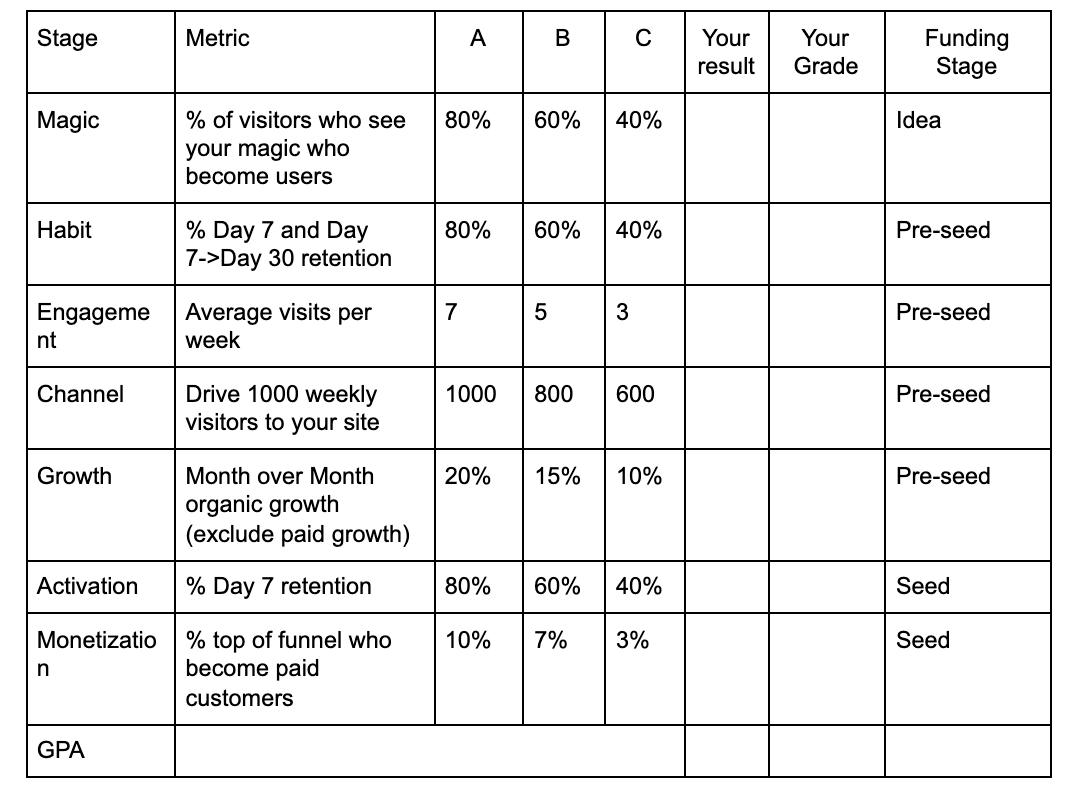
1/Focus only on magic first and set a goal around it.
The one my founders and I work on is that 80% of people who experience your magic take the next step, like registering, free trial, etc.
The one my founders and I work on is that 80% of people who experience your magic take the next step, like registering, free trial, etc.
2/Get really clear on what your magic is.
In quantitative terms, what set of actions does a user need to take after which a very large number make the next step?
In emotional terms, what do you hope is the thing that slaps your users on the side of the head?
In quantitative terms, what set of actions does a user need to take after which a very large number make the next step?
In emotional terms, what do you hope is the thing that slaps your users on the side of the head?
This part is iterative. What you do - the words you use - the way the user is introduced to the magic - are critical.
It's fine if you change your definition of magic as you progress, but if someone asks you, you need to have a crisp answer which is your current hypothesis.
It's fine if you change your definition of magic as you progress, but if someone asks you, you need to have a crisp answer which is your current hypothesis.
3/Measure everything. Use mixpanel, segment, google analytics, etc. to get very clear on what people did and what outcome that produced.
Don't rely on anecdotes here because you will slip into the narrative fallacy.
Only data is strong enough to help you change your mind.
Don't rely on anecdotes here because you will slip into the narrative fallacy.
Only data is strong enough to help you change your mind.
4/Run an experiment every day.
First, you cannot find your magic through intuition yet because you don't understand your users well enough.
Second, unless you experiment, you are relying on luck to find the magic, and that's not a strategy.
First, you cannot find your magic through intuition yet because you don't understand your users well enough.
Second, unless you experiment, you are relying on luck to find the magic, and that's not a strategy.
What is an experiment?
1 - don't write code ( a little html/css is the max)
2 - don't solve the user's problems if you have to write code to do it (you are looking for their desire, not to fulfill it yet)
3 - test a hypothesis with literally the least work possible
1 - don't write code ( a little html/css is the max)
2 - don't solve the user's problems if you have to write code to do it (you are looking for their desire, not to fulfill it yet)
3 - test a hypothesis with literally the least work possible
5/Only experiment around the magic.
Do not go off and figure out d7 or d30 retention at the same time.
Finding your magic is the single hardest thing in a startup, and you need 100% concentration.
Do not go off and figure out d7 or d30 retention at the same time.
Finding your magic is the single hardest thing in a startup, and you need 100% concentration.
6/Each week, come up with your experiments, then at the end of the week review what happened.
Do this live with your co-founders and your team for an hour.
Talk about what you were hoping would happen, the data behind what happened, your take-aways, and new experiments.
Do this live with your co-founders and your team for an hour.
Talk about what you were hoping would happen, the data behind what happened, your take-aways, and new experiments.
7/Bucket your results into three categories - Fail, Meh, and Success.
The bucket criteria will change depending on how far you are from the goal.
If you are at 20% magic and need to get to a goal of 80%, then even 25% bumps go into Meh.
You will need a couple 2-3x bumps.
The bucket criteria will change depending on how far you are from the goal.
If you are at 20% magic and need to get to a goal of 80%, then even 25% bumps go into Meh.
You will need a couple 2-3x bumps.
8/80% of the time, you will Fail or Meh.
When you get a Success, generate five new experiments which are variants of that Success.
You are trying to see if you can get another 2-3x out of that insight.
When you get a Success, generate five new experiments which are variants of that Success.
You are trying to see if you can get another 2-3x out of that insight.
When you don't have a Success, decide if the Fails and Mehs taught you anything and generate new possible experiments that might clarify how users were feeling.
Create new experiments around anything that came up in the meeting.
Writing an experiment in your sheet is free so do it without thinking.
Writing an experiment in your sheet is free so do it without thinking.
9/Now go through your future experiment list and decide which five to run for next week.
It usually takes about 60-120 experiments, 3-6 months to find your magic if it is there.
If you wait, it takes longer, because users and team need to unlearn bad behaviors.
It usually takes about 60-120 experiments, 3-6 months to find your magic if it is there.
If you wait, it takes longer, because users and team need to unlearn bad behaviors.
10/ Although you are relying primarily on user behavior to tell you the truth about your magic, it is also really useful to talk to several users a week.
The two main things to talk to users about is why they did something and how they were feeling when they did it.
The two main things to talk to users about is why they did something and how they were feeling when they did it.
11/ (Bonus!) Keep all of your results in a spreadsheet.
Review your results quarterly as a team.
This generates a bunch of new ideas as you look at the history of your experimentation.
Review your results quarterly as a team.
This generates a bunch of new ideas as you look at the history of your experimentation.
So let's talk about an example of an experiment.
Neil, a friend and founder of @setupget and I were chatting one day.
They built a great live class platform for seniors and were seeing very high engagement.
But we wanted to see if there was even more.
Neil, a friend and founder of @setupget and I were chatting one day.
They built a great live class platform for seniors and were seeing very high engagement.
But we wanted to see if there was even more.
Out of our brainstorm came the idea to add social hours independent of the classes to see if people just wanted to connect.
In some ways, what we were doing here was redefining the magic.
In some ways, what we were doing here was redefining the magic.
The magic before was getting into a room with a bunch of other people and a teacher to learn something.
But we were testing whether people were really using GetSetup to stay connected.
Maybe that was the magic instead?
But we were testing whether people were really using GetSetup to stay connected.
Maybe that was the magic instead?
The important thing here is the way Neil tested this.
He didn't spend three weeks rolling out a social hour feature.
He just put a zoom link below each class that would let a user start or join a social hour after class.
He didn't spend three weeks rolling out a social hour feature.
He just put a zoom link below each class that would let a user start or join a social hour after class.
I remember him telling me Saturday morning, 24 hours after testing this, that 64,000 social hours had already happened.
This type of discovery of 'why' a user is using your app is the key to magic.
Discovering their emotional connection to your product expressed through their behavior is at the heart of experimentation.
Discovering their emotional connection to your product expressed through their behavior is at the heart of experimentation.
Although this experiment worked for Neil, there are hundreds of others that did not.
And that's just fine.
That's why you have to run five a week.
Forever, or at least until you find your magic.
And that's just fine.
That's why you have to run five a week.
Forever, or at least until you find your magic.
This is the first of several threads on the mechanics of finding product-market fit, so please follow me @jwdanner for the rest.
And please retweet this thread to help other founders.
And please retweet this thread to help other founders.
This thread is based on this doc that I work on each week with my founders. docs.google.com/document/d/1ya…
• • •
Missing some Tweet in this thread? You can try to
force a refresh