The question is raised by @dsmitheconomics about a somewhat underwhelming global goods export performance on top of known struggles with EU exports. I suggest in the first instance looking at some big players - Rolls Royce, Honda, Scotch...
The Honda plant that just closed was our major car exporter to the US. That's something we're unlikely to get back. Scotch exports to the US were affected by tariffs which were only recently lifted. Rolls Royce engines for planes will have been in less demand recently we suspect.
What is more worrying about future UK goods exports is the lack of inward investment in that area (services like fintech are keeping the figures looking good). So we'll always have Scotch, aviation and defence, and luxury cars. But where's the growth coming from?
My suspicion has always been that Brexit pushes us further in the direction of our existing services exports strengths, in which case we should be paying a lot more attention in terms of both trade and domestic economic policy. And also the politics of this.
• • •
Missing some Tweet in this thread? You can try to
force a refresh

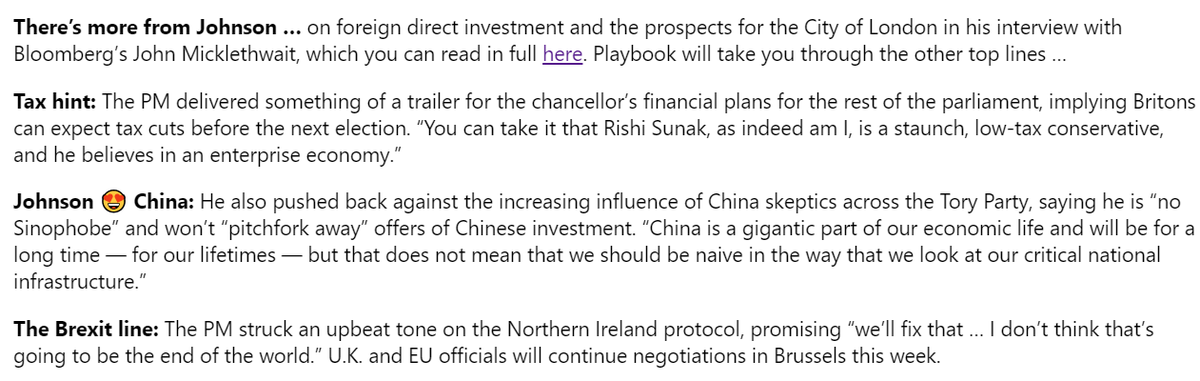
Useful reminder from this morning's playbook on why this government has always previously backed down on threats over Northern Ireland and will probably do so again - the prospect of a trade war with the EU goes down very badly with international investors.
The negotiation that matters with regard to UK-EU relations (in the past, now, and possibly for some time to come) is between sovereignty purists and those in conservative party and wider business community who realise the UK needs the huge market on our doorstep.
The sovereignty purists are backed by the media and obviously delivered Number 10 for Boris Johnson. But ultimately their economic views that the UK doesn't need to trade with neighbours are not ones that a government concerned about the economy can let run.
Probably showing the power of a genuine single market as against trade barriers. Possibly also some element of GB companies using Northern Ireland as their EU bridge.
Continue to stress how this UK government raised trade barriers by more than any other, ever.
Given the extent of modern trade as compared to the past I actually wonder if any government has raised trade barriers by as much as the UK did on January 1. Probably, but even the fact we use no obvious comparator tells its own story.
And this supposedly 'free trade loving' government may yet start a trade war as if they hadn't done enough damage already to UK companies.
This is where purist definitions of sovereignty lead.
Job done for the EU. The political commentariat think the UK won. The trade experts who greeted the proposals with a lot of saying "hmmm" and "that seems like a lot of conditions" can be safely ignored.
We are not blind to our lack of influence. Perhaps as it should be.
Remarkably some other countries achieve their aims in international negotiations without threats and tantrums. Possibly even most countries and more of their aims.
Indeed for the UK it has been so many tantrums and so little winning. So much so that other countries will know now that it is easy to negotiate with the UK, allow the media win, achieve all the detail you want. We can call it the UK-Australia model.
If only the UK free traders who used to warn us of the perils of trade barriers hasn't decided in the last five years to put purist definitions of sovereignty ahead of trade.
Ah. Not that they'll automatically take the opportunities. But almost like imposing a labour supply shock on top of supply chain strains wasn't a good idea...
Oh sheez, not the only offender, but can we make some better attempt to understand negotiations and the EU? Everything is theoretically negotiable if you have the capital. The EU doesn't suddenly offer gold, and didn't yesterday. For the oldies, RTFM.
It might be hard to believe in the UK, but numerous countries are currently negotiating with the EU on all manner of trade subjects. Few involve threats, most are going slow, all involve both sides tweaking negotiating positions regularly, most will deliver something.