To those calling for a return to restrictions, a reminder of some criteria I set out last year that should be used before suppression measures are implemented:
i) Evidence for effectiveness in reducing cases
(particularly in over 60s) hospital admissions & deaths
(1/4)
ii) Evidence that a mandatory approach produces better outcomes than a voluntary one.
iii) Evidence that a blanket approach produces better outcomes than a targeted one. e.g. on adherence, suppression
(2/4)
iv) Evidence for broad public acceptability with high levels of sustainable adherence.
v) Most importantly, that the intervention has been shown through transparent impact-benefit analysis to produce less overall harm. (Health in QALYS, cost per QALY saved.)
(3/4)
vi) And where harms are certain but benefits uncertain, the intervention should not be used
The burden of proof is on those who are calling for restrictions to show that they meet these criteria and will actually reduce overall harm - which is what we should all want.
(4/4)
• • •
Missing some Tweet in this thread? You can try to
force a refresh

Seven persistent myths about Covid and lockdowns in the UK / England.
I thought I would put one thread together on what I think are 7 myths that continue to be propagated - mainly by those who, although well-intentioned, always assume that more restrictions are the answer.
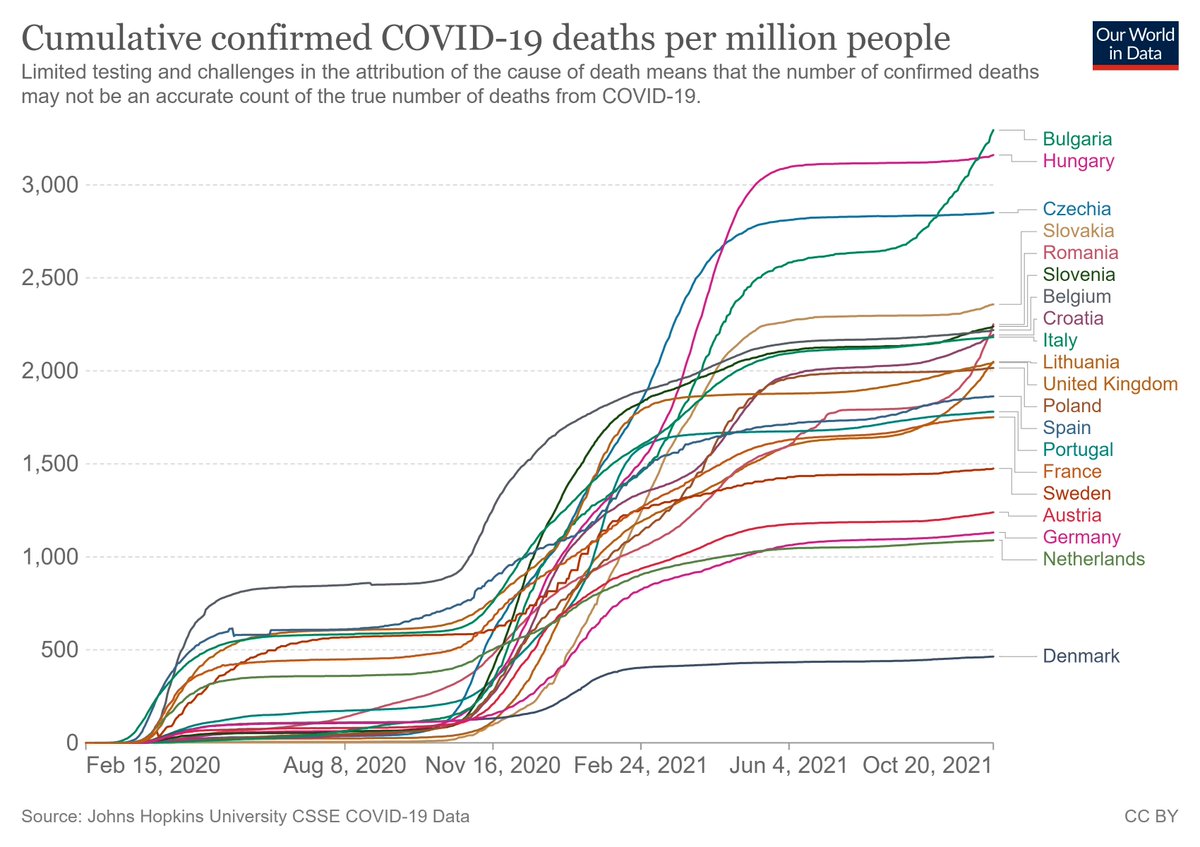
1. The UK has had the highest Covid death rate in Europe during the pandemic - mainly due to being late to lockdown twice. (see myths 2 and 3)
Even compared to EU countries, the UK would be 11th on Covid deaths & 15th on excess deaths (20th in all Europe) economist.com/graphic-detail…
2. Thousands of lives would have been saved if we had locked down earlier in the first wave.
Most of the countries with higher death rates (shown above) did lock down early & had small first waves followed by very large second waves.
Discussed more here: telegraph.co.uk/news/2021/03/2…
Would an earlier lockdown really have saved tens of thousands of lives?
A thread summarising the main points of my article earlier today. (References at the end.)
Many people have claimed that if only the government had ‘followed the science’ last year and locked down a week earlier and closed our borders - as other countries did - we could have saved tens of thousands of lives.
I have tried to look at whether an earlier lockdown really would have reduced our eventual death toll over both waves. I have relied not on the models on which these claims are made, but looked at what has actually happened in Europe over both waves to date.
My final thread of the year - a brief review of the current situation and why I think the govt. is right to resist calls for another national lockdown.
Throughout this pandemic I have tried to stress the twin dangers of fear and complacency -
– excessive fear harms our mental (and overall) health and led to the deaths of thousands in the first wave who were too scared to seek medical help when they needed it. And complacency about the real risks of COVID leads to riskier behavior and increased spread of the virus.
Many recent headlines highlight record numbers of cases and increasing deaths with calls for another national lockdown. And of course it is true that the situation is getting worse but it is important not to panic people by exaggerating the threat but to give the true picture.
A thread on some early evidence on the impact of the new COVID variant - increasing cases, increasing hospital admissions but not yet the expected increase in deaths.
Is the new variant less deadly?
Generally, over the course of the second wave, we have seen a pattern of cases rising overall and then in the over 60s - which is then followed by hospital admissions rising with a 1-2 week lag, and then deaths with a 1-2 week lag.
However, as shown in the figure below, that pattern seems to have changed since cases linked to the new variant started increasing rapidly at the end of November with admissions increasing as expected, but not deaths.
Plan B:
Why Sweden provides a potential model for us to follow - but not for the reasons most people think - and only if we learn from their mistakes.
And why - whichever plan is chosen - we need to build consensus. And how that could be done.
No country has received more attention for its approach to dealing with COVID than Sweden but there continue to be widespread misunderstandings of its strategy - with many thinking they followed the approach outlined in the Great Barrington Declaration.
However, the actual, official Swedish government strategy is ‘to limit the spread of infection in the country and by doing so, to relieve pressure on the health care system and protect people’s lives, health and jobs.’
And as its Chief Epidemiologist, Dr Tegnell has said,
A brief review of where we are - & why we need a plan B.
In general, I think the current government strategy of suppression to keep cases low enough to maintain NHS services and minimise non-COVID health harms while protecting education and jobs is a reasonable compromise.
Furthermore, if virus levels get too high, fear increases and people don’t come to hospital, don’t go out and the economy suffers, etc. I also understand the governments rationale of not wanting to reintroduce shielding due to the mental (and other) health harms it would cause.
I also support the targeting of restrictions based on the local level of cases as opposed to blanket national ones. I find it hard to understand how it can be possibly be fairer to destroy jobs and businesses all over the country including in areas where hospitalisations are low