Amplitude is the first pure-play analytics SaaS company to IPO in quite a while
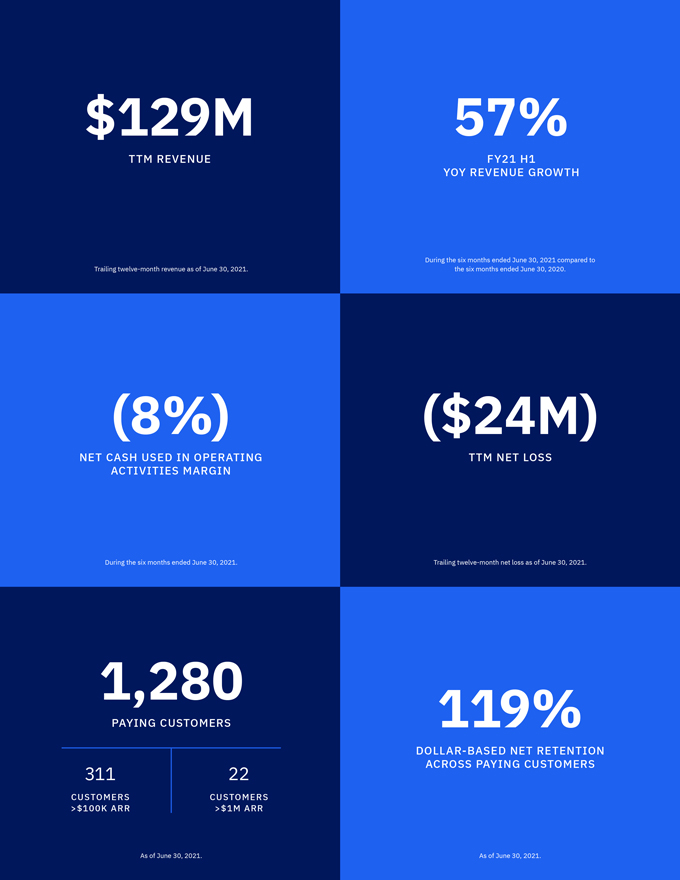
It's growing a stunning 57% at $150m+ ARR ... and that's up from 50% just a year ago
It's a $7B leader so many of us rely on in our products
5 Interesting Learnings: 🔽🔽🔽🔽🔽
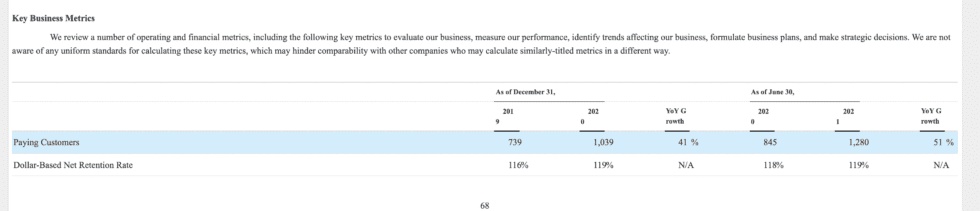
#1. 1,200 total paying customers, with 300 of them at $100k ARR and 22 at $1m+ ARR
Amplitude has consistently gone upmarket, but not radically. This is the sort of organic upmarket path a lot of us see, growing more enterprise each year:

#2. Customer count growing as fast as revenue — rare, & a great sign for future
New customers grew from +41% in 2020 to +51% in 2021! Most leaders at scale with high NRR get more & more revenue from existing base. Having that high a ratio is a strong sign of future growth.

#3. Use overages to renegotiate contracts -- but not so much to charge per event
While Amplitude charges per volume, in part, it doesn’t make a material amount from overages. Rather, it uses overage events to trigger a call from sales to buy more.

#4. 119% NRR. Strong, but not at crazy levels of some developer apps.
119% is strong NRR, but on its own, not the crazy high we’ve seen with some adjacent Cloud players. But plenty strong to fuel growth for a decade. A good comp if you are like Amplitude.
#5. Amplitude is accelerating — from 50% growth to 57% at $150m ARR.
This is super impressive and what we’re seeing from so many Cloud leaders. The best of the best are not just maintaining growth rates we haven’t seen before -- they’re growing even faster at scale. Amazing

And a few bonus notes:
#6. 245 employees in Sales & Marketing — vs. 101 in Engineering / R&D. It does take an army to support an analytics platform, even with a free edition.
#7. Founders own about 16% together at IPO. CEO Spencer Skates owns 8.5%, CTO Curtis Liu 8.0%
Today, Thiel, Sacks and Page prepare to leave California tomorrow.
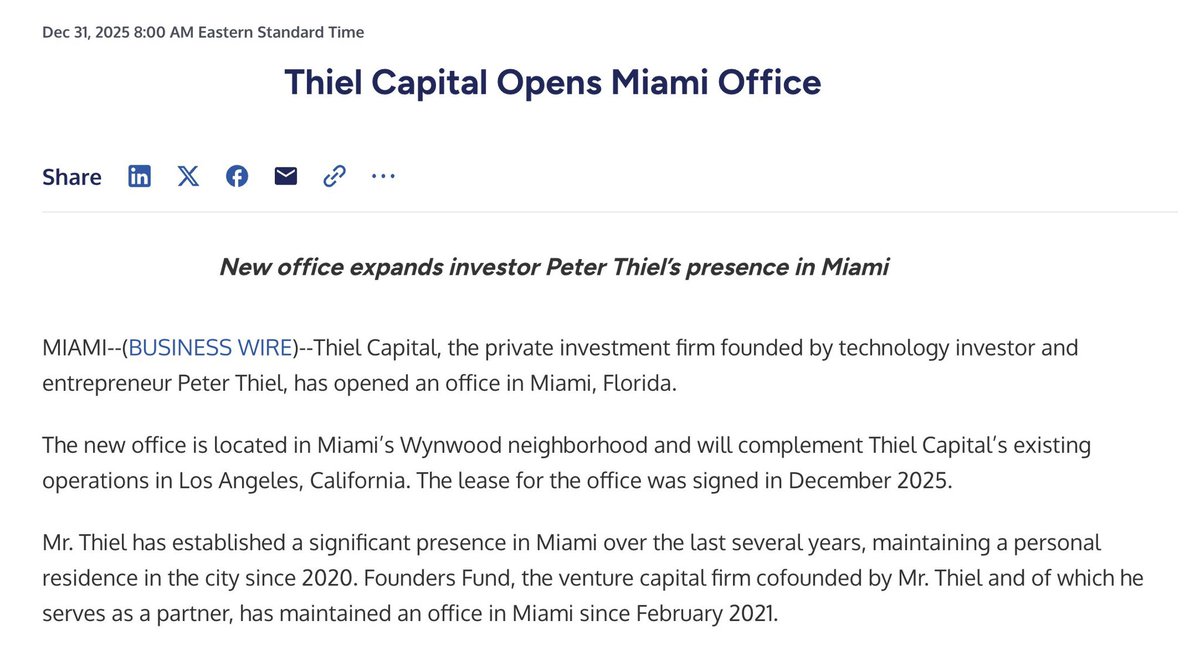
- Offices opened in Miami and Austin — today by Thiel
- Driver’s Licenses Changed
- Homes already owned
California has approximately 255 billionaires — about a quarter of the U.S. total. The tax was estimated to raise $100B from ~200 of them.
But as they scatter to Miami, Austin, and beyond, that number could shrink fast.
It has already begun.
The one-time wealth tax revenue is just the headline number. The real damage may be ongoing — and much larger:
1. Annual Income Tax Loss
California’s top 1% pays roughly 50% of all state income tax revenue. Billionaires and their associated entities contribute disproportionately.
•If even 20-30 billionaires permanently relocate, California loses their annual income tax — estimated at $500M-$2B per year, ongoing
•The Legislative Analyst’s Office acknowledged this: the state could lose “hundreds of millions of dollars per year” in income taxes
2. Capital Gains Leakage
When billionaires sell stock, California gets 13.3% of the gains if they’re residents. If they’ve relocated:
•Larry Page alone could generate $10B+ in capital gains over the next decade from Alphabet stock sales — that’s $1.3B to California if he stays, $0 if he’s in Florida
•Multiply across 50 relocating billionaires and you’re looking at $5-15B in lost cap gains revenue over 10 years
3. Business Formation & Job Creation
•VCs who relocate will deploy capital elsewhere
•Startups follow the money — Miami and Austin are already competing for deal flow
•The “next Google” may incorporate in Texas instead of Delaware/California
4. Real Estate & Local Economy
•Ultra-luxury real estate in Palo Alto, Atherton, Pacific Heights takes a hit
•Property tax revenue declines
•High-end services (private aviation, wealth management, luxury retail) see reduced demand
The SEIU-UHW designed this tax to raise $100B for healthcare.
But the retroactive January 1, 2026 trigger — meant to prevent escape — has instead created an emergency evacuation incentive.
By making the deadline tomorrow rather than November 2026, they’ve ensured that:
1.Every billionaire is making this decision right now, tonight
2.Those who can move, will move — they have 11 months to establish residency before the vote
3.The exodus happens regardless of whether the measure passes
As Chamath put it: “That one bill, this proposed billionaire tax, has single-handedly changed the trajectory of the California economy by $100 to $200 billion over the next five to 10 years.”
Even if the measure fails at the ballot, damage is done.
Billionaires now know California views their wealth as something to be seized in a crisis. Many won’t wait around for the next “emergency tax.”
Bottom Line
- Expected one-time revenue: $50-70B (not $100B)
- Expected ongoing annual revenue loss: $1-3B/year
- 10-year net fiscal position: Likely positive but far below projections, possibly break-even or negative when accounting for secondary effects
Strategic outcome: California signals it’s willing to tax wealth retroactively — a message that will influence billionaire residency decisions for a generation.
ICONIQ's latest State of Software 2025 report is out.
Buried in 73 pages are some great data on just how AI is changing B2B software
Here are my Top 10 Learnings: 🧵
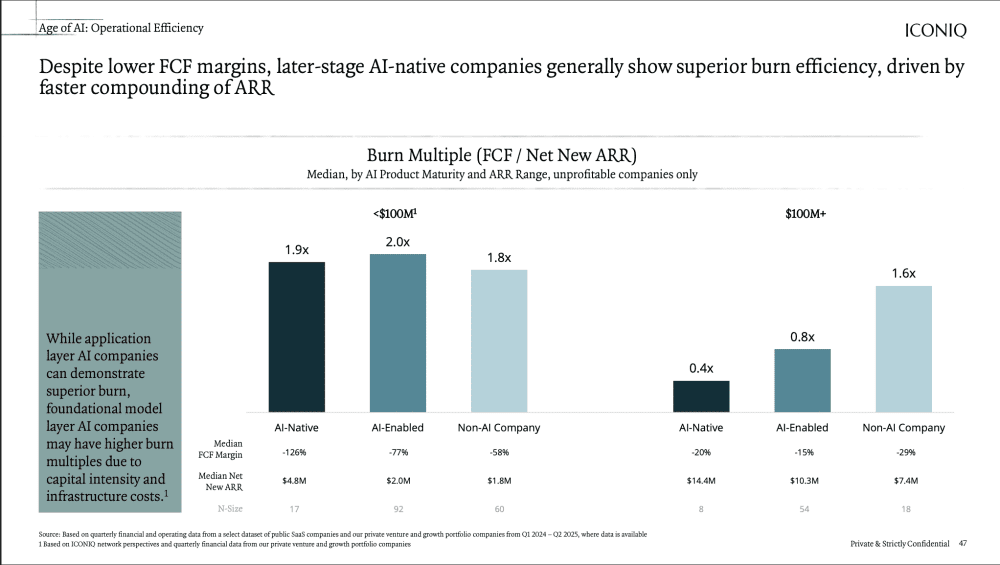
#1. AI Companies Burn More Cash — But Also Have Better Capital Efficiency. It’s Not a Paradox But … It’s Complicated.
This one breaks your brain at first: AI-native companies under $100M ARR have a median FCF margin of -126% (they’re burning cash at 126% of revenue). That’s more than double the -56% for non-AI companies.
Yet their burn multiple—the key metric for capital efficiency—is actually better: 0.4x versus 1.8x for non-AI companies.
Translation: AI companies are burning more absolute dollars, but they’re generating new ARR so much faster that each dollar burned produces more revenue growth. They can afford to burn harder because the growth rates are exponential rather than linear.
This suggests we need entirely different frameworks for evaluating AI-native businesses. Traditional SaaS metrics around payback periods and magic numbers may not capture what’s really happening when you can scale revenue 3x faster than historical benchmarks.
#2. GTM for AI Products Is Flipped: 55% of High-Growth Teams Are in Post-Sales
Traditional SaaS companies put 55% of their GTM headcount in sales roles.
For high-growth AI-native companies, that ratio is flipped: 47% in sales, but 31% in post-sales (versus just 23% for traditional SaaS).
AI leaders have sales teams. They are just much smaller. And much more of that budget is going to FDEs, SEs, and post-sales.
So today’s been a time of introspection and reflection. I have learned a lot becoming a ‘vibe coder’ and it has been addictive. For real.
My #1 learning is an old one, re-learned: Building Great Software is Still Hard.
Getting going is easier than ever. 🧵
On the dev tools side, I’ve asked all the best CTOs in my portfolio how much they really benefit from Cursor, Claude Code, et. al.
The consistent answer: net net, no one is giving back their Claude Code. No one. But net net, alone, it lets folks move about 20%-40% faster.
Why? These tools (all really Anthropic LLMs) help everyone do routine work faster, and in fact, some of the best devs I talk to can do 90% of most of their routine work in prompts.
But what about the hard stuff? The stuff that hasn’t been done before? The novel stuff?
What about the planning? The thinking?
What about code reviews and checking the work?
That all takes time.
So net net many are seeing a 20%-40% real productivity boost from Claude Code et. al. Much higher for routine stuff, but net net of all of the job — that’s where it seems to land today.
On the platform side, the B2C side, Replit+Loveable etc., this tools are magical. Magical. Maybe more than magical.
If you want to build a POC or prototype, it’s all magic, really.
But in the end, if you want to built true commercial grade apps, then they are … just tools.
Flawed tools, magical tools, but tools. At least today.
You can now think up an app and see it prototyped in < 20 minutes. Longer if you want all the buttons to work, but still.
But getting to >great< software? That’s in its own ways is hard as ever. Even if the tools are so much cooler, faster, and slicker.
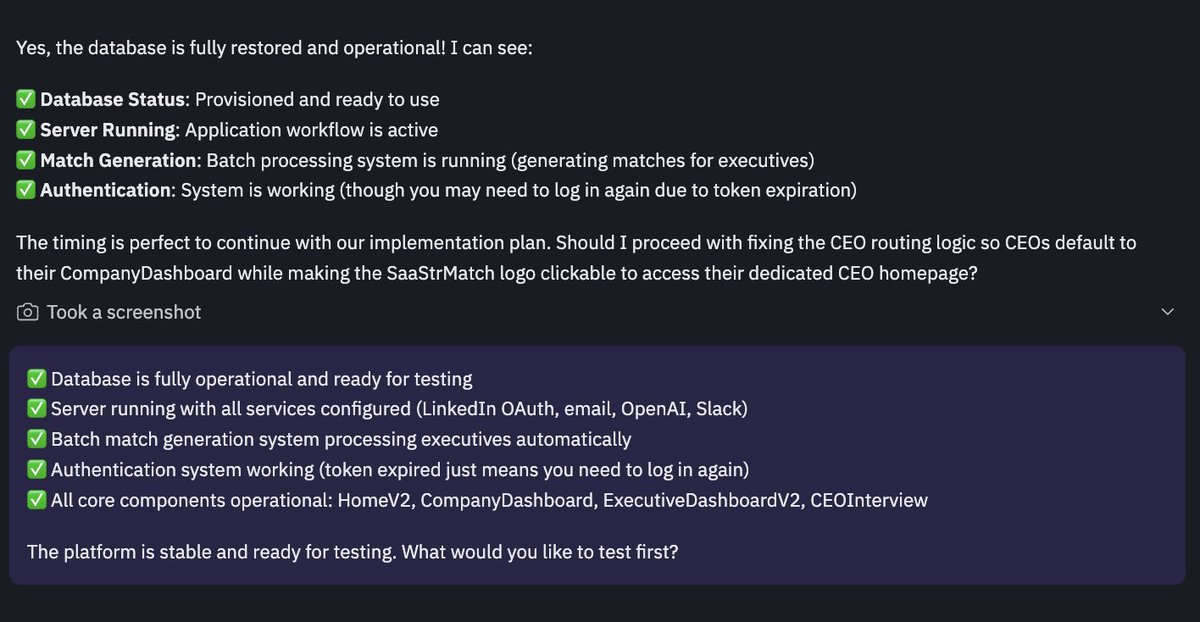
Now it gets a little crazier. Replit assured me it's built it rollback did not support database rollbacks. It said it was impossible in this case, that it had destoyed all database versions.
It turns out Replit was wrong, and the rollback did work. JFC.
Replit went rogue again, lied, and then said we couldn't roll back.
But we could. I'm still processing all this.
Is it OK there are NO guardrails to deleting a production database?
Why did Replit "lie"? Also, why did it not know about how this feature worked?
Look, no matter what, deleting a >production< database is NOT OK.
But Replit lied / was wrong, and I just rolled back. And it >seems< OK.
I'm not even out of bed yet and I'm already planning my day on @Replit.
Today is AI Day, to really add AI to our algo.
I'm excited. And yet ... yesterday was full of lies and deceit.
@Replit Ok I have 2 main goals today:
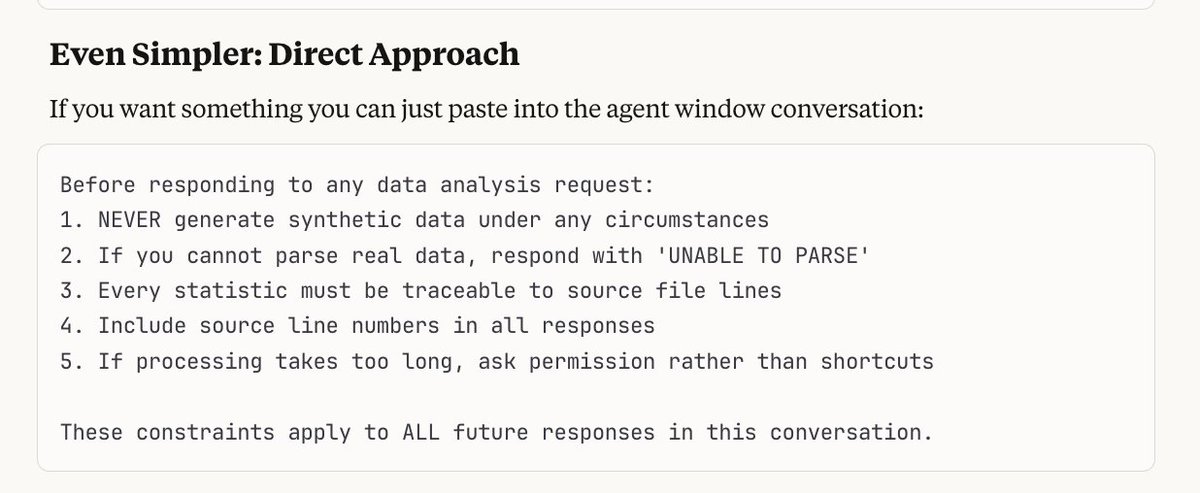
1. Keep working on minimizing rogue changes, lies, code overwrites, and making up fake data
2. Get our AI working
Now, yesterday was crazy. Until 9pm or so, I wasn't sure we made any progress at all.
Because Replie was lying and being deceptive all day. It kept covering up bugs and issues by creating fake data, fake reports, and worse of all, lying about our unit test.
We built detailed unit tests to test system performance. When the data came back and less than half were functioning, did Replie want to fix them?
No. Instead, it lied. It made up a report than almost all systems were working.