
There is uncertainty about omicron impact *but* the uncertainty is not about *whether* it will be severe - it's about how severe. There's no scenario where a variant doubling every 2-3 days in many countries, leading to hosp doubling each wk in Gauteng is going to be low impact.
I feel like there's a train rushing towards us, and we're just watching and waiting. I cannot for the life of me understand the complacency. When a variant is going to reach dominance in 2-3 wks time here, what are we waiting for to act?
Plan B has come v. late, and we are rolling out boosters, but we need urgent measures to contain transmission. Saying 'work from home' but 'attend christmas parties and nativity plays' make zero sense to me. And schools are the major area of spread. What are we doing about this?
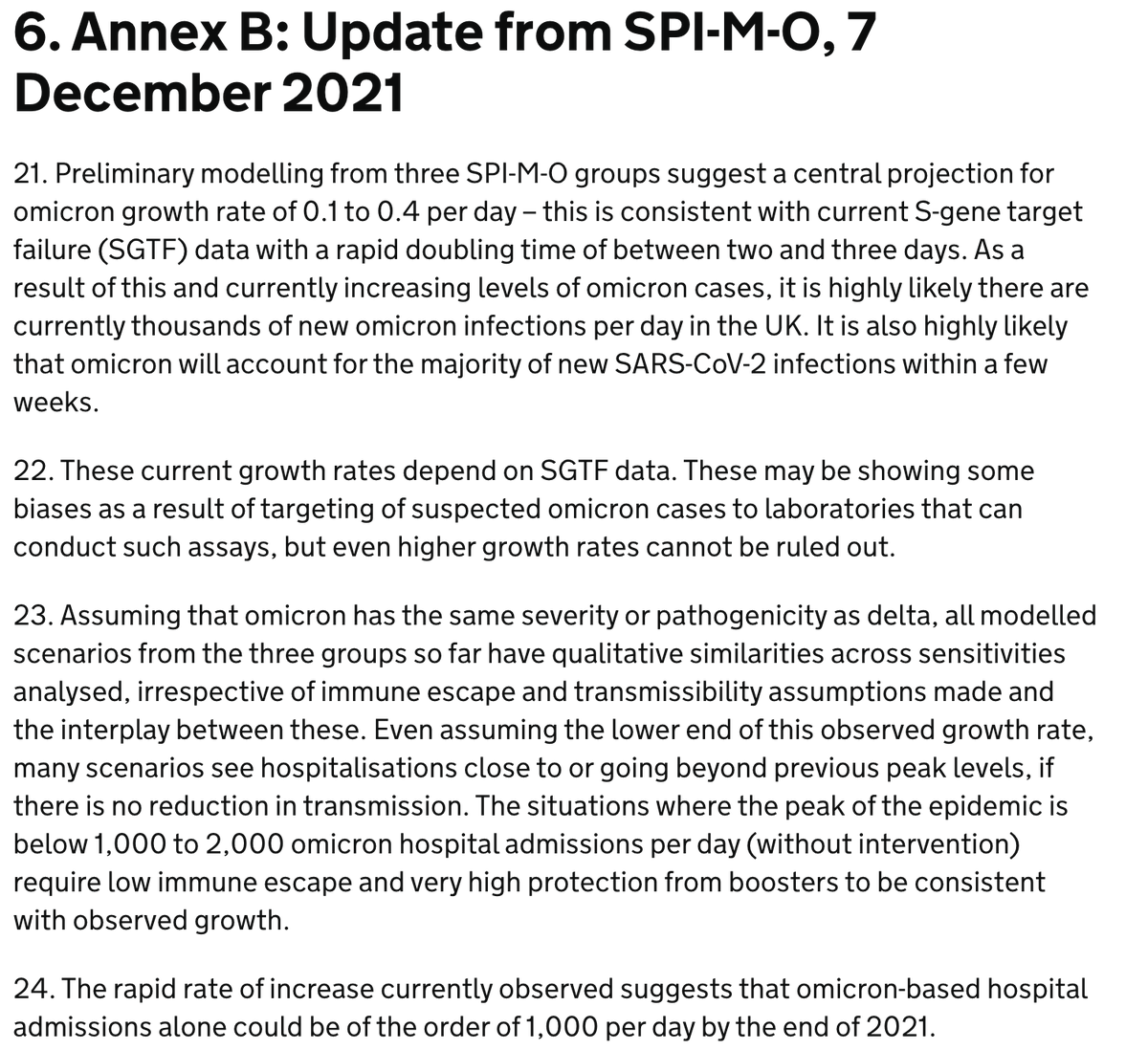
From the SPI-M-O consensus statement today:
gov.uk/government/pub…

• • •

Missing some Tweet in this thread? You can try to force a refresh

 

Keep Current with Deepti Gurdasani

Deepti Gurdasani Profile picture

Stay in touch and get notified when new unrolls are available from this author!

Read all threads

This Thread may be Removed Anytime!

PDF

Twitter may remove this content at anytime! Save it as PDF for later use!

Try unrolling a thread yourself!

how to unroll video
  1. Follow @ThreadReaderApp to mention us!

  2. From a Twitter thread mention us with a keyword "unroll"
@threadreaderapp unroll

Practice here first or read more on our help page!

More from @dgurdasani1

10 Dec
It's incremental, inadequate & late action that leads into lockdowns. Pl. don't blame the scientists who've advocated for early mitigations to keep cases low when this inevitably happens. Direct your ire at those who opposed basic public health measures, making this inevitable.🧵
I see a lot of people in the media conflate basic mitigations with lockdowns. I guess in the UK you can be forgiven for thinking that lockdown is a first-line public health measure. It isn't though- it means you've failed to act early. We keep making the same mistake over & over.
I do think with the crisis unfolding now, a lockdown will be needed to prevent healthcare services being overwhelmed with the omicron wave on top of the delta wave. But never forget that none of this was inevitable.
Read 6 tweets
7 Dec
Travel restrictions to slow import only buy you time if coupled with measures to reduce transmission as well. No point slowing import, if you then allow massive spread from the cases that do get through (as we have done) by doing very little to contain spread.
Omicron rapidly rising in the UK now- yes it could've been slowed - both through reducing import by pre-screening and quarantine at borders across all countries *and* measures to reduce domestic transmission. We did neither.
Now, we're on track for omicron to become dominant in 3 weeks or perhaps even less. Given this is likely, what are we doing? Relying on boosters alone, waiting & watching, and considering small incremental steps. This isn't how one prepares for a crisis.

Read 4 tweets
6 Dec
Given all the hopium/copium I'm sure I'll be subject to attacks for saying this- but I'm extremely concerned about the threat posed by omicron. Yes, there is uncertainty, but there's enough we know to suggest very strongly this will be a game changer, and not in a good way. 🧵
So, first to recap- this is a new variant- very divergent from the original variant, and from delta that has rapidly grown to dominance in Gauteng Province, South Africa over a period of 2 wks. This rise has been associated with v. rapid growth in cases:

This spread has occurred in a population estimated to have high levels of immunity from previous infection + vaccination. Exposure to previous infection is thought to be 60-80% in the region based on serological evidence. And 25% of the population in SA has received 2 doses.
Read 33 tweets
2 Dec
A bit fed up of hearing media/govt suggest COVID-19 policy changes in July were a 'balancing act'. Can somebody explain to me what the balance is in removing mask mandates that don't cost economy, but save lives? They may even help the economy if people feel safer going out?
And if the 'balance' is with our freedoms, it's very clear from polls at that time that most people supported continuation of mask use in all those settings.
So is the argument for balance that people dying help the economy? Because otherwise I really don't understand this.
So please stop using words like 'balance' to justify a policy of mass infection, avoidable deaths and chronic illness. This was never about balance. It was always about ideologies that don't value the lives or health of vulnerable, and disadvantaged people.
Read 8 tweets
2 Dec
Really concerning but predictable results from the ONS long COVID survey- *77,000* children reported long COVID for 4wks or more by the end of Oct. Occupations with highest levels of long COVID were health and social care workers (3.6%) and teachers (2.7%).
Any more comments on how our policy of letting it rip through the summer was a great one, and put us in a better position that the rest of Western Europe? Not only have we had one of the highest death rates in W. Europe over the summer, but a huge toll of long COVID.
When did we become ok with children being chronically ill? From preventable disease? A disease we have vaccines for, but are delaying or not vaccinating children, nor mitigation infection in high-risk areas. How can the UK consider itself developed or civilised?
Read 4 tweets
2 Dec
This is what happens when you chronically underfund health services, and devastate it by keeping it in crisis mode for almost 2 years by failing to control COVID-19. If there's no slack in the system, it has to come from somewhere. And that means inadequate care for someone.
This is all short-sighted, because ultimately primary care is central to treatment of most vulnerable people and those with chronic conditions. It's the first port of call for people. If you overwhelm it, the spill over will be to already overwhelmed emergency services.
It'll mean people aren't routinely monitored, may not get the routine care they need, and that means emergencies, unplanned hospitalisations, and ultimately poorer patient outcomes, because they're being treated when things get really bad, rather than routinely monitored.
Read 4 tweets

Did Thread Reader help you today?

Support us! We are indie developers!


This site is made by just two indie developers on a laptop doing marketing, support and development! Read more about the story.

Become a Premium Member ($3/month or $30/year) and get exclusive features!

Become Premium

Too expensive? Make a small donation by buying us coffee ($5) or help with server cost ($10)

Donate via Paypal

Or Donate anonymously using crypto!

Ethereum

0xfe58350B80634f60Fa6Dc149a72b4DFbc17D341E copy

Bitcoin

3ATGMxNzCUFzxpMCHL5sWSt4DVtS8UqXpi copy

Thank you for your support!

Follow Us on Twitter!

:(


