Terry Smith is often referred to as "the English Warren Buffett".
He runs Fundsmith which has a fund size of £27.9bn.
Despite the size, Fundsmith did a CAGR of 18.4%.
In his book Investing for Growth, he explains his investing philosophy.
Here's a breakdown:
He runs Fundsmith which has a fund size of £27.9bn.
Despite the size, Fundsmith did a CAGR of 18.4%.
In his book Investing for Growth, he explains his investing philosophy.
Here's a breakdown:

1. Fundsmith's winning formula
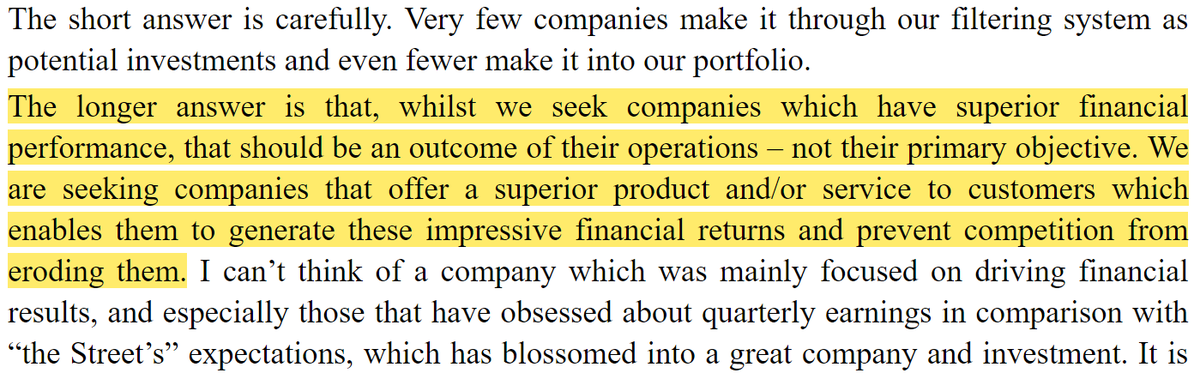
Find companies that focus on delivering value.
Not those who are looking to pacify Wall Street with short-term results.
Find companies that focus on delivering value.
Not those who are looking to pacify Wall Street with short-term results.
2. Avoiding "cheap" companies?
Low multiples are not a reason to buy a company.
A ship will continue to sink if it has a hole in it.
"A stock may have a low valuation but an even lower intrinsic value. Buying such a stock is not a recipe for investment success."
Low multiples are not a reason to buy a company.
A ship will continue to sink if it has a hole in it.
"A stock may have a low valuation but an even lower intrinsic value. Buying such a stock is not a recipe for investment success."

3. Getting quality right
For long-term investors, getting the quality of the business is more important than the valuation.
“An investor could have paid 281 times earnings for L’Oréal, 156 times for Colgate, and 147 times for Brown-Forman and still beat the market.”
For long-term investors, getting the quality of the business is more important than the valuation.
“An investor could have paid 281 times earnings for L’Oréal, 156 times for Colgate, and 147 times for Brown-Forman and still beat the market.”

4. "Unprofitable" companies could be good investments
Many of the best companies don't show earnings today.
But that's because they're heavily reinvesting for the future.
It's just that the earnings hasn't show up.
Many of the best companies don't show earnings today.
But that's because they're heavily reinvesting for the future.
It's just that the earnings hasn't show up.

5. Not all growth are good
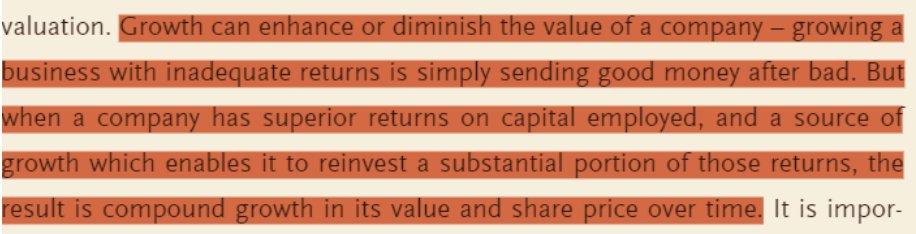
Growth is good only when the return on invested capital (ROIC) exceeds the cost of capital (COC).
If COC > ROIC, the company destroys value as it grows.
Growth is good only when the return on invested capital (ROIC) exceeds the cost of capital (COC).
If COC > ROIC, the company destroys value as it grows.
6. On share buybacks
A repurchase only creates value if the shares are trading below intrinsic value and there is no better use for the cash.
A repurchase only creates value if the shares are trading below intrinsic value and there is no better use for the cash.

7. On price anchoring
Often times investors hold back from buying because they "missed the boat".
Or they're waiting for it to "retrace back".
If it's a good company and within your buy range, just buy it.
Often times investors hold back from buying because they "missed the boat".
Or they're waiting for it to "retrace back".
If it's a good company and within your buy range, just buy it.

8. 10 advice for retail investors
-If you don't fully understand it, don't invest
-Don't try to time the market
-Minimize fees
-Deal as infrequently as possible
-Don't over-diversify
-If you don't fully understand it, don't invest
-Don't try to time the market
-Minimize fees
-Deal as infrequently as possible
-Don't over-diversify
-Never invest just to avoid tax
-Never invest in poor-quality companies
-Buy shares in a business which can be run by an idiot
-Don't engage in "greater fool theory"
-If you don't like what's happening to your shares, switch off the screen
-Never invest in poor-quality companies
-Buy shares in a business which can be run by an idiot
-Don't engage in "greater fool theory"
-If you don't like what's happening to your shares, switch off the screen
If you like this, follow me here @steadycompound
I write about investment concepts, business breakdowns and growth philosophies.
I write about investment concepts, business breakdowns and growth philosophies.
If you have enjoyed this thread, you're gonna love my newsletter where I curate 3 ideas on investing and growth philosophies.
Every week.
steadycompounding.com
Every week.
steadycompounding.com
• • •
Missing some Tweet in this thread? You can try to
force a refresh