This is Mme. Pauline Lumumba on 19 January 1961. With a small group of supporters she had just marched to the United Nations headquarters in Leopoldville, demanding UN help for the return of the body of her murdered husband, Patrice Lumumba.
Short thread on Pauline Lumumba. 1/
Short thread on Pauline Lumumba. 1/
2/
On 17 Jan. Lumumba--arrested by Gen. Mobutu--was famously handed over to secessionists in Katanga & their Belgian backers, who murdered him.
On hearing her husband's fate, Mme. Lumumba marched to the UN headquarters--baring her breasts--to demand help & recognition.
On 17 Jan. Lumumba--arrested by Gen. Mobutu--was famously handed over to secessionists in Katanga & their Belgian backers, who murdered him.
On hearing her husband's fate, Mme. Lumumba marched to the UN headquarters--baring her breasts--to demand help & recognition.


3/
Fearing for her life, Pauline went into exile in Egypt.
Here's a @Reuters clip of their children--Patrice, Julienne, and Francois--with friends in Cairo.
Fearing for her life, Pauline went into exile in Egypt.
Here's a @Reuters clip of their children--Patrice, Julienne, and Francois--with friends in Cairo.
@Reuters 4/
Mme. Lumumba returned to the Congo in September 1968--7 years after her husband's murder. She was made into a heroine by Mobutu's government.
Here's the occasion at the Parc de la Revolution when she ceremonially came out of mourning. At her side were Pres. and Madame Mobutu.
Mme. Lumumba returned to the Congo in September 1968--7 years after her husband's murder. She was made into a heroine by Mobutu's government.
Here's the occasion at the Parc de la Revolution when she ceremonially came out of mourning. At her side were Pres. and Madame Mobutu.
@Reuters 5/
Here's a rather extraordinary @Reuters clip: Pres. Mobutu & members of his ruling Movement of the Popular Revolution on a cruise along the Congo River.
At 1:41 Pauline Lumumba is carried aloft in a palanquin, following Mobutu.
Here's a rather extraordinary @Reuters clip: Pres. Mobutu & members of his ruling Movement of the Popular Revolution on a cruise along the Congo River.
At 1:41 Pauline Lumumba is carried aloft in a palanquin, following Mobutu.
@Reuters 6/
Here's Mme. Lumumba at a gala for the 'Anamongo Tribal Association' in Kinshasa in 1968.
The leaders of the association announced that they had made Mobutu their 'great chief' in honor of all he had done to honor the murdered Patrice Lumumba.
Here's Mme. Lumumba at a gala for the 'Anamongo Tribal Association' in Kinshasa in 1968.
The leaders of the association announced that they had made Mobutu their 'great chief' in honor of all he had done to honor the murdered Patrice Lumumba.
@Reuters 7/
In short: Mobutu sought to claim Patrice Lumumba's charismatic popularity by elevating his memory--after Lumumba himself was safely dead.
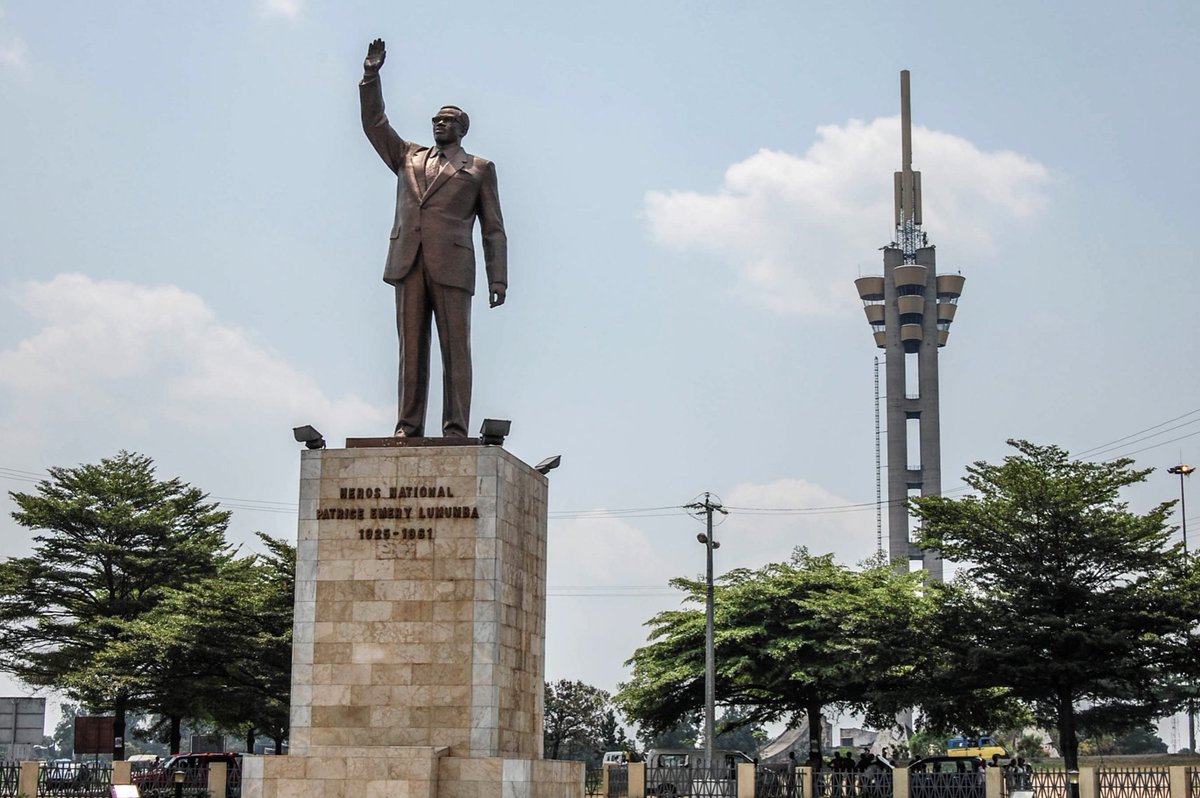
The statue that honors Lumumba--located at the center of Kinshasa--was erected by Mobutu himself, in Mme. Lumumba's presence.
In short: Mobutu sought to claim Patrice Lumumba's charismatic popularity by elevating his memory--after Lumumba himself was safely dead.
The statue that honors Lumumba--located at the center of Kinshasa--was erected by Mobutu himself, in Mme. Lumumba's presence.
@Reuters 8/
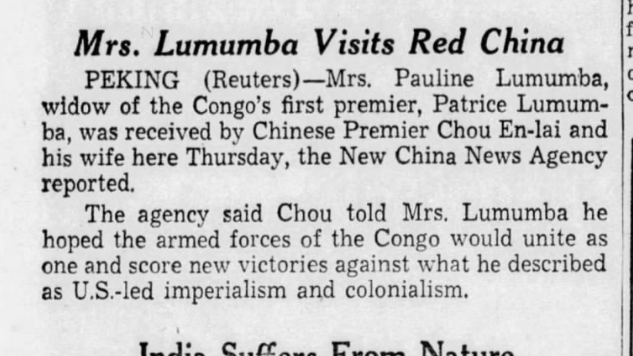
What did Mme. Lumumba make of all of this? She was a living symbol of her husband's martyrdom, and many sought to claim his legacy. Here's a report on her 1965 visit to Mao's China.
What did Mme. Lumumba make of all of this? She was a living symbol of her husband's martyrdom, and many sought to claim his legacy. Here's a report on her 1965 visit to Mao's China.
@Reuters 9/
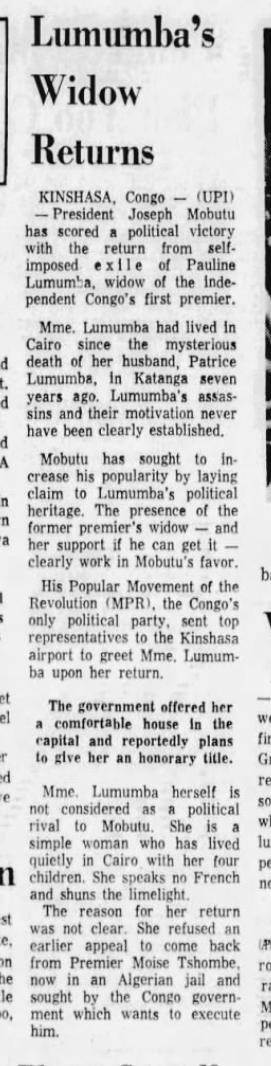
But the politics of Mme. Lumumba herself remain unclear. Mobutu thought her politically 'safe', so much that he gilded his own power by her presence at state functions--as this report suggests.
But the politics of Mme. Lumumba herself remain unclear. Mobutu thought her politically 'safe', so much that he gilded his own power by her presence at state functions--as this report suggests.
• • •
Missing some Tweet in this thread? You can try to
force a refresh