Right so: some thoughts on what Gove has announced and is set to announce later (details courtesy of @JSimpsonjourno).
Some good. Some bad. Some potentially ugly (thread)
insidehousing.co.uk/insight/goves-…
Some good. Some bad. Some potentially ugly (thread)
insidehousing.co.uk/insight/goves-…
What is Gove proposing? For those who haven't seen the news over the weekend, he is saying the current £5.1bn of cladding funding will be extended by £4bn, to cover remediation costs in buildings between 11m and 18.5m.
But it will not come from new govt funding. Instead Gove wants to get the construction industry into a room, threaten them with tough legislation and make them pay up apparently voluntarily. There are some problems with this and a major cavaet we will get to in the 'ugly' section
So, the good. First of all - the government is committing to fund (by some means) the remediation of buildings below 18m. This is something which has previously been categorically ruled out and represents an incredible win for campaigners
Potentially millions of people in buildings at this height have been in complete limbo for months (some for years). The loans scheme previously considered was unworkable and unfair. This announcement is really the first chink of light that there might be a way through this.
Will all of these buildings get all of the money they need to release people from the position they're in and draw a line under this crisis? Well, we'll come to the bad later in the thread. But this (like the decision in 2020 to fund non-ACM) is a major turning point.
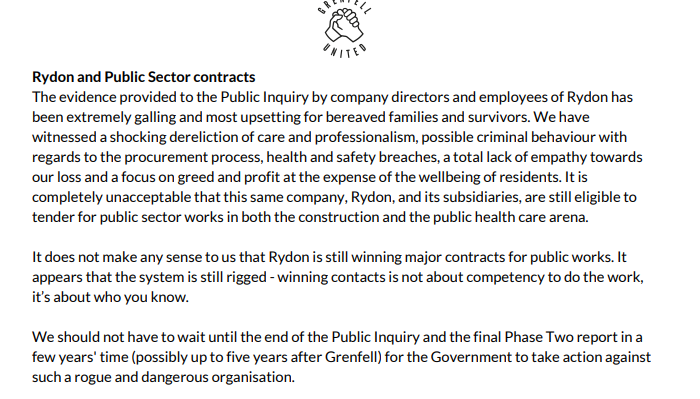
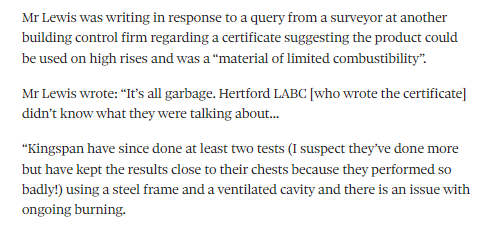
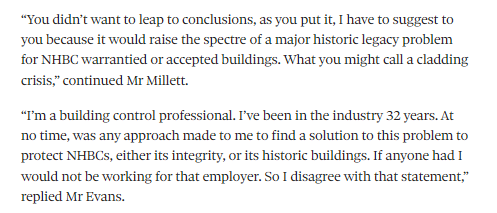
Also (very) good: the focus on product manufacturers as wrongdoers as well as 'building owners' or 'developers'. It appears we finally have a secretary of state who has been following the Grenfell Tower Inquiry, not just the flawed Hackitt Review.
The stick here (potential government funding bans) is quite a sharp one, with billions of public money likely to go into retrofit/eco funding in the coming years.
Also good: indemnifying building assessors. Gove will announce that those assessing buildings under new guidance will have government-backed indemnity to encourage them to take a less risk averse approach. This may help what has been a huge problem but has some obvious downsides
Also good: measures to allow shared owners sublet, protection against eviction and forfeiture for those who can't pay cladding bills, additional money to switch waking watches to fire alarms (very overdue and still too small - but more is good)
And so, the bad: A big elephant in the room (as it has been from the start) is non-cladding funding. Like the building safety fund, this £4bn is only going to cover the cladding removal. That leaves (in some cases) very substantial bills still with the leaseholder
Also, there is still a height threshold. There are blocks below 11m where remediation requests are being made. Wherever you draw that line, there are going to be losers.
Which leads onto the fact that we still don't have a means of determining blocks that really do need remediation from those where fire alarms and sprinklers might do. The government is encouraging industry to be less risk conscious, but it isn't leading.
It hopes new guidance (PAS-9980), which will be published in final form imminently, will result in more sensible decision making (especially when combined with indemnity for assessors). But this feels like fairly wishful thinking.
We have already seen blocks below 18m being ordered to have remediation based on the draft PAS guidance. Assessors, lenders and surveyors are still going to find buildings with faults because there are lots of faults.
The government is essentially asking them to turn a blind eye to those faults, even as the official guidance doesn't. This could get messy. Indemnity could also backfire if it results in a free for all (there are some pretty nefarious players in this space already)
And indemnity only goes so far. What the assessor says is only relevant as far as the lender trusts it. Will banks lend on an assessment which says 'there are missing fire breaks and combustible insulation but I am going to overlook them because I am legally clear'?
If not, well, you've got lots of blocks that will be failing these assessments, £4bn will be spent pretty fast and those below 11m will be the new below 18m (all blocks with communal parts will get PAS-9980 assessments as part of risk assessments)
And so another bad (leading to an ugly): do we really expect Gove to walk into a series of roundtables with Britain's biggest builders over the next few weeks and walk out with a cheque for £4bn?
Because if you do, I have bridge to sell you, made of combustible cladding. The best I think we can really hope for is loose agreements to fund those they are responsible for (but they may have quite limited views of what that means) and...
... an increase to the current levy which will yield £2bn over 10 years. But money over 10 years isn't what Gove needs. It's money now. So what is going to happen? This is where we get to the (potentially) ugly.
As reported by @lewis_goodall and Newsnight, the backstop for the £4bn is DLUHC's own funding. DLUHC is not a department with £4bn down the back of the couch. Lots of its spending programmes are loan based.
What isn't? The £8.5bn promised for social and affordable housing over the next decade. There is precedent for this being diverted to cladding remediation. It's what Theresa May did back in May 2018, the first ever piece of UK govt cash to go to the building safety crisis
But that was a much smaller sum (£400m). If the balance of the £4bn (after Gove shakes down the builders) comes out of affordable housing budgets, this is a very different story. Note the Treasury language: safety is more important than supply.
Gove says he is putting builders 'on notice' that they will get forced to pay through legislation if they don't cough up. But it is hard to see this as no different from the "we rule nothing out" rhetoric which has been delivered since late 2017 with no action...
Which leads to a very cynical where Operation Apex is sound and fury to mask a major cut to social housing budgets. I hope I'm wrong about that and he does get more money out of the people who really should be paying, but right now it feels the most likely
I'd also note: all of this is very long term. Getting the money, setting up the funding critera, applying, allocating, starting the work. From now to completion, a decade is not an unreasonable assumption - considering how long the ACM process has taken.
People need protection and relief now. Nothing Gove has announced today substitutes the need for protection for leaseholders from these charges being put on a legislative footing. That gives them (and future buyers) a guarantee. This gives them a lot of maybes.
And finally. I've been following this since there wasn't a penny for cladding remediation. Each new announcement has been incremental and insufficient and each time the government has said 'that's your lot'
The fact that it hasn't been is down to a truly tireless bunch of campaigners and volunteers, almost all of whom are actively living the nightmare of being in one of these blocks. At times it's been kept alive by less than half a dozen active campaigners.
They know who they are and they deserve an enormous amount of credit for the work they've done forcing a consistently reluctant government to take at least responsibility for cleaning up this mess (ends)
• • •
Missing some Tweet in this thread? You can try to
force a refresh