chris keefer Profile picture
Jan 10, 2022 22 tweets 18 min read Read on X
Is a “Just Transition” away from fossil fuels towards a decarbonized energy system technology specific? The basket of available & scalable technologies: Wind, Solar & Nuclear each come with characteristics that determine wages, levels of unionization & security of employment.🧵1/
When #GreenNewDealers imagine the jobs of a clean energy transition, they often nostalgically harken back to the post war era when generations of blue collar workers could support families on a single income in a unionized workplace & afford to send their kids to college. 2/
This was the reality of many blue collar jobs before the neoliberal era crushed the labour movement. As a result, much of Western manufacturing was offshored, leading to a cut throat race to the bottom for wages & working conditions. 3/
With the availability of new hydroelectric and geothermal sites limited by geography, we are left with wind, solar & nuclear as the potentially scalable tools for a clean energy transition. We must examine their characteristics & potential of delivering a just transition. 4/
New Left thinkers, like @SethDKlein, imagine a return to world war two levels of western manufacturing & production, to churn out the millions of solar panels & hundreds of thousands of wind turbines needed to achieve a net zero future. 5/
The reality is that there is no significant Western manufacturing sector for wind & solar. Despite our best efforts, we have been unable to compete with countries like China and Vietnam precisely because of their low labour standards & dirt cheap coal powered electricity. 6/
Wind & solar jobs in North America largely consist of low skilled labour, installing foreign made solar panels to frames & erecting “offshored” wind turbines. The jobs consist almost entirely of installation and decommissioning every 20-30 years. 7/
Employment is therefore not tied to a local community. Workers instead move from one facility to another unable to anchor their families in a stable community. There are no parking lots outside of a wind or solar farm. These are the energy worker equivalent of “Carnie” jobs. 8/
Progressives can fantasize all they like, but low skilled, transient labour with a foreign supply chain cannot negotiate itself the dignified wages and secure employment that they aspire to as part of a just transition. 9/
The union movement wins concessions through the threat of withholding its labour. Workerless facilities like wind & solar farms do not offer that opportunity. Unfortunately, a transition to wind & solar is just another race to the bottom for western energy workers. 10/
In addition, as progressives that purport to care about international human rights, we should be concerned about a just transition for workers internationally. There are credible allegations of forced labour within the solar supply chain. 11/
Forty percent of the world's polysilicon, the base ingredient for solar panels, comes from western China where a dystopian security state imprisons & exploits the labour of a significant portion of the Uyghur ethnic majority. 12/
In contrast, where I live in Canada. CANDU nuclear with its proven track record of deep decarbonisation, is from uranium mine to power plant 96% made in Canada mostly by unionized labour. 13/
As a society, every dollar we spend on CANDU stays within the Canadian economy supporting permanent, intergenerational jobs tied to prosperous local communities. 14/
In contrast to wind & solar facilities, nuclear plants provide high paying, intergenerational skilled jobs rooted in a local community. Nuclear jobs are one of the last bastions of industrial work the Green New Dealers allude to in their call for a #justtransition. 15/
Because nuclear requires large local workforces of highly skilled labour for construction and operation it is not vulnerable to offshoring. Supply chains are localized and money invested in the sector remains in country and helps local communities to prosper. 16/
In Canada, nuclear workers provided 90% of the energy required for the Ontario coal phaseout, North America’s greatest greenhouse gas reduction. Ccoal workers were seamlessly transitioned into high quality jobs in nuclear facilities, a textbook template for a just transition.17/
It's time that Green New Dealers re-examine their allegiance to the 300 billion/year largely privatized wind & solar industry & reconsider publicly owned nuclear as the deep decarbonization technology that offers fossil fuel workers the best opportunity for just transition. 18/

• • •

Missing some Tweet in this thread? You can try to force a refresh

 

Keep Current with chris keefer

chris keefer Profile picture

Stay in touch and get notified when new unrolls are available from this author!

Read all threads

This Thread may be Removed Anytime!

PDF

Twitter may remove this content at anytime! Save it as PDF for later use!

Try unrolling a thread yourself!

how to unroll video
  1. Follow @ThreadReaderApp to mention us!

  2. From a Twitter thread mention us with a keyword "unroll"
@threadreaderapp unroll

Practice here first or read more on our help page!

More from @Dr_Keefer

Feb 26
Nuclear Fuel Is The Swiss Watch of Energy and The Most Sophisticated Industrial Product You've Never Heard About.

Buckle up for a mega-🧵

There is a peculiarity at the heart of nuclear energy that rarely gets the attention it deserves. Every other thermal power plant in history destroys its fuel.

Coal goes in as a black rock and comes out as CO2, water vapor, and ash. Natural gas barely leaves a trace at all, just heat and gaseous combustion products dispersed into the atmosphere.

The fuel is gone, irreversibly transformed, its chemical identity obliterated in the furnace.

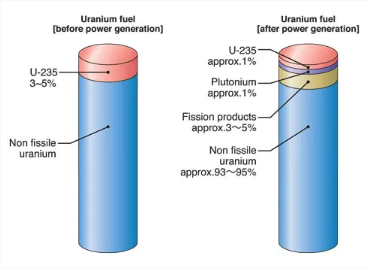
Nuclear fuel does almost none of that. The fuel elements that go into a reactor and the fuel elements that come out are, to a first approximation, the same material in the same geometry, sitting in the same place.

A spent fuel assembly pulled from a reactor after six years of operation looks nearly identical to the fresh one that went in.

The mass has changed by a tiny fraction of a percent, nuclear alchemy has occurred in which half the periodic table has been generated in the form of fission products within the ceramic pellets but the volume and geometry is essentially identical.

This one fact, that nuclear fuel must be preserved rather than destroyed, that the job of every layer of every system surrounding the core is to maintain the integrity of a material through years of radiation bombardment and extreme temperature gradients, shapes much of nuclear engineering.

It explains the cladding materials, the obsessive quality control in fabrication facilities, and the decades of slow, painstaking improvement that have transformed a fleet that routinely operated with failed fuel elements into one where a single leaker triggers a formal investigation.

I spent a long conversation with Michael Seely, the @AtomicBlenderYT, a nuclear enginner with a focus on fuel, going through what nuclear fuel actually is, how it is made, why it fails, and how the industry learned to prevent those failures.

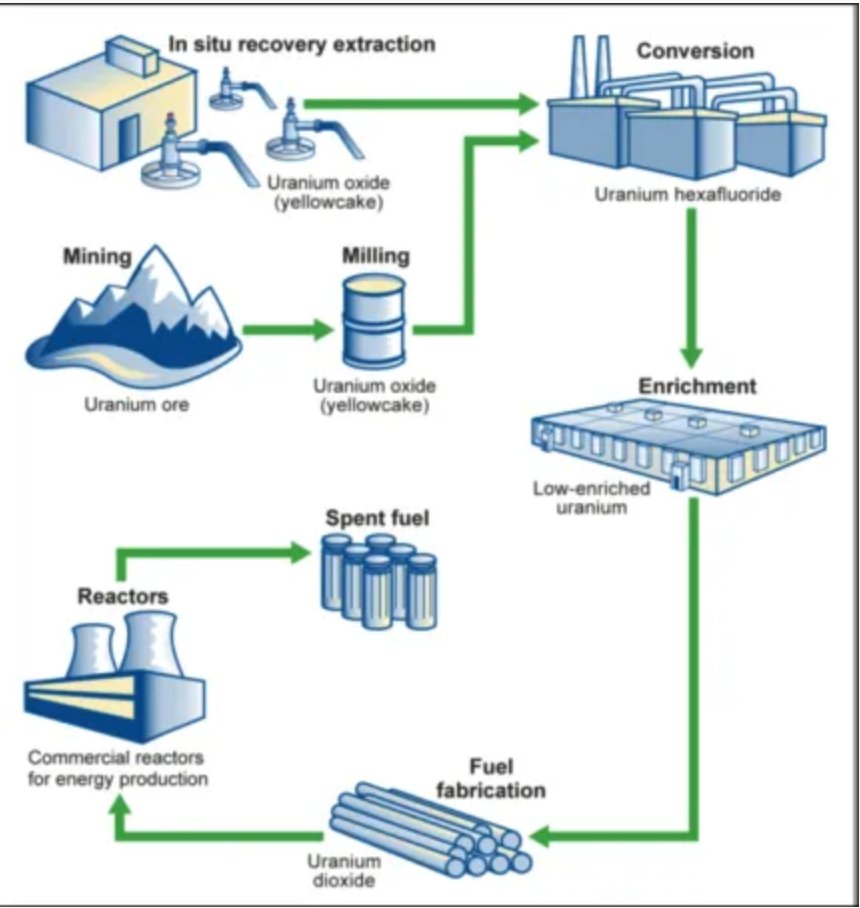
What follows is my attempt to synthesize that conversation into something useful for anyone who wants to understand nuclear from the inside out.Image
What the Fuel Actually Is

The commercial nuclear fuel cycle, in its conventional form, converges on a single material: uranium dioxide, or UO2.

Regardless of reactor type, whether you are talking about a pressurized water reactor in France, a boiling water reactor in Japan, or a CANDU in Ontario, the fuel pellet sitting at the centre of the fuel rod is almost certainly a dense ceramic cylinder of uranium dioxide roughly the size of a fingertip.Image
UO2 ended up in this position for reasons that are easier to appreciate once you understand what you are asking a fuel material to do.

You need something that can withstand centerline temperatures of 1,200-1,600 degrees Celsius under normal operating conditions, while the coolant immediately outside the cladding sits at around 300 degrees, a gradient of nearly a thousand degrees across a pellet roughly a centimetre in diameter.

You need something that will not chemically react with zirconium cladding or the pressurized water flowing over it.

You need something that will trap the fission products, the gases and solids generated as uranium atoms split, inside its crystalline matrix rather than releasing them into the coolant.

And you need something that can be manufactured reliably, in quantity, at a cost that keeps nuclear electricity commercially competitive. In fact the key differentiator between nuclear and fossil power generation is that despite its complexity nuclear fuel remains a relatively very small contributor to operating expenses.

Uranium dioxide satisfies all of these requirements tolerably well, which is distinct from satisfying any of them perfectly.

It is a ceramic, which means it has an extremely high melting point, around 2,800 degrees Celsius, providing enormous safety margin even under severe accident conditions.

Its crystalline grain structure traps fission products reasonably effectively: the krypton, xenon, and iodine gasses generated by fission mostly stay embedded in the UO2 matrix rather than migrating into the gap between pellet and cladding.

And the manufacturing process, while technically demanding, has been refined over seven decades into something industrial routine.Image
Read 15 tweets
Mar 10, 2025
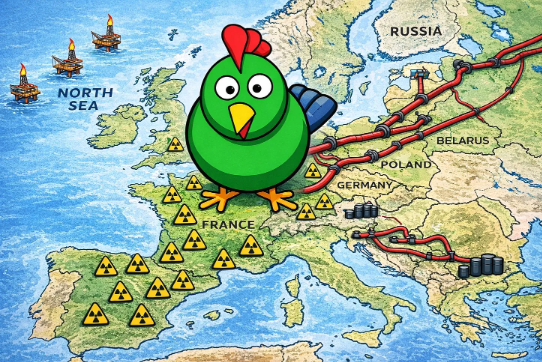
1/ Energy, industry, and sovereignty are inseparable. If Europe wants to be a truly independent pole in an emerging multipolar world, it must reindustrialize—not deindustrialize. That starts with reversing nuclear phaseouts. 🧵 Image
2/ Germany, the industrial powerhouse of the EU, built its economic might on two things:
⚡ Cheap nuclear power
🔥 Cheap Russian gas
Now that Russian gas is gone, nuclear must return. Image
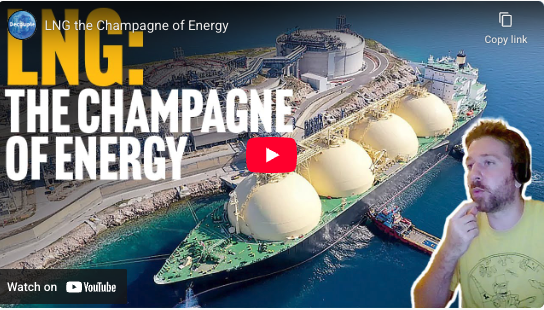
3/ Instead of securing its own energy future, Germany is swapping one dependency for another—replacing Russian gas with expensive American LNG. Image
Read 9 tweets
Jan 28, 2025
Why is China electrifying its economy at such dizzying speeds?

3 words

Straits of Malacca.

While the US leans into its hydrocarbon advantage, China is decoupling from severe oil dependence & geographical vulnerability. a 🧵based on @DecoupleMedia w @pretentiouswhat Image
When Western climate analysts look toward China, in some sense they see the future, where fantasies of large-scale renewables deployment and EV adoption are playing out.

But far more than climate considerations, the geopolitics of oil dependence are shaping China's energy future. With 80% of its oil imports flowing through the narrow Strait of Malacca, China faces an existential vulnerability.Image
This maritime chokepoint, flanked by Indonesia and Malaysia, could easily be blockaded in a conflict. The ring of U.S.-aligned nations and military bases encircling China's eastern seaboard only heightens these anxieties.

Major crude oil trade flows in the South China Sea (2011), illustrating the importance of the Strait of Malacca and the vulnerability it creates. Source: US Energy Information Agency.Image
Read 7 tweets
Feb 22, 2023
WE’VE GOT TO TALK ABOUT FUKUSHIMA TRITIUM RELEASES.

TL:DR the fear is misplaced.

Tritium is an isotope of hydrogen It binds H and O to make HTO, tritiated water.

It is created naturally by cosmic rays in the upper atmosphere as well as in nuclear power plants.
Tritiated water behaves just like H2O and is excreted from the body quickly with a biological half life of 3.5 days. For this reason it doesn’t bioaccumulate up the food chain and diffuses and dilutes rapidly in lakes and oceans.
It may come as a shock to some journalists but the natural world, including our lakes and oceans, are naturally radioactive thanks to cosmic rays and the decay of naturally occurring radionuclides like Potassium 40.
Read 10 tweets
Feb 20, 2023
Its all doom and gloom for Nuclear in @BentFlyvbjerg's new book "How Big Things Get Done"

But did he miss some nuance when conflating the Korean/UAE collaboration which will have delivered four 1400MW reactors in 12 yrs with the unfolding fiasco of Vogtle 1/ Image
In the book @BentFlyvbjerg and @dgardner contrast the Guggenheim museum and the Sydney Opera house to draw important lessons from two very cutting edge buildings. 2/ Image
The Guggenheim is the product of meticulous iterative planning by a mature dreamteam of architects & engineers who routinely pull off complex projects on budget/on time, the Opera House a couple of sketches by an inexperienced architect which balooned into a budgetary fiasco 3/ Image
Read 14 tweets
Oct 27, 2022
NUCLEAR WASTE IS INCREDIBLY DANGEROUS!

Unshielded & fresh out of the reactor exposure for seconds would result in certain death.

But somehow there has not been a single documented death from storing civilian nuclear waste. Ever.

Here's what you need to know: a 🧵
We make dangerous things, like nuclear waste, safe.

Consider civil aviation.

In 2019, 4.5 billion passengers took 42 million flights worldwide flying 900km/hr at 30,000 feet in thin skinned, pressurized aircraft often over vast oceans.

There were only 289 fatalities.
The truth is that it's a lot easier to handle and store nuclear waste than to meticulously maintain an airliner which has over 10,000 mission critical moving parts. Image
Read 10 tweets

Did Thread Reader help you today?

Support us! We are indie developers!


This site is made by just two indie developers on a laptop doing marketing, support and development! Read more about the story.

Become a Premium Member ($3/month or $30/year) and get exclusive features!

Become Premium

Don't want to be a Premium member but still want to support us?

Make a small donation by buying us coffee ($5) or help with server cost ($10)

Donate via Paypal

Or Donate anonymously using crypto!

Ethereum

0xfe58350B80634f60Fa6Dc149a72b4DFbc17D341E copy

Bitcoin

3ATGMxNzCUFzxpMCHL5sWSt4DVtS8UqXpi copy

Thank you for your support!

Follow Us!

:(