BREAKING: @uscensusbureau says it is delaying changes to the monthly Current Population Survey data release that would have affected the Atlanta Fed’s wage tracker and other key measures. census.gov/content/dam/Ce…
"Given the historical circumstances presented by the COVID-19
pandemic and its impact on the economy, combined with the urgent need for workforce data, the
Census Bureau has decided to defer the introduction of updated confidentiality protections."
"New protections will be introduced in a
phased approach beginning later this year that will preserve the CPS time series and better prepare data users for the changes."
Note that Census is still planning to start rounding hourly/weekly earnings data and suppressing certain geographic data, although not clear exactly when that will start ("later this year").
The release doesn't say directly whether this phase-in will avoid breaking the year-over-year links that are key to the Atlanta wage tracker (and other research). But my sense is that it will.
This is what the release says:
"The 2022 CPS PUF will retain characteristics of the 2021 CPS PUF that enable data users to conduct year-over-year time series analysis and other research activities ... specifically the public-use file household identifier."
(I have asked census to clarify this. Not sure I'll hear anything back on the Friday evening before a long weekend, though.)
Note: I have now confirmed that the longitudinal links will be maintained permanently. So while the other changes will be phased in, they’ll be done in a way that preserve the longitudinal linkages.
• • •
Missing some Tweet in this thread? You can try to
force a refresh

A refresher: In 1971, with inflation running around 6% a year, Richard Nixon imposed a 90-day freeze on most prices and wages. Price controls, in various and ever-shifting forms, stayed in place until 1974.
It worked! Briefly. Inflation cooled, but then returned with a vengeance as soon as the controls were eased. And they resulted in shortages and other disruptions. The overwhelming consensus among economists ever since is that they were a failure.
Consumer prices rose 0.8% in November, and were up 6.8% from a year earlier. That's the fastest year-over-year rate of inflation in 39 years.
Excluding food and energy, prices were up 0.5% from October and 4.9% from a year earlier. nytimes.com/live/2021/12/1…
Overall consumer prices rose 6.8% in November from a year ago. That's the fastest rate of inflation since June 1982. Helpful to see this in some historical perspective, however:
On a month-to-month basis, price gains cooled slightly in November (+0.8%, vs +0.9% in October). But we're not seeing the quick return to normal that many forecasters were expecting just a few months ago. (Of course, that's true for many things in the economy right now.)
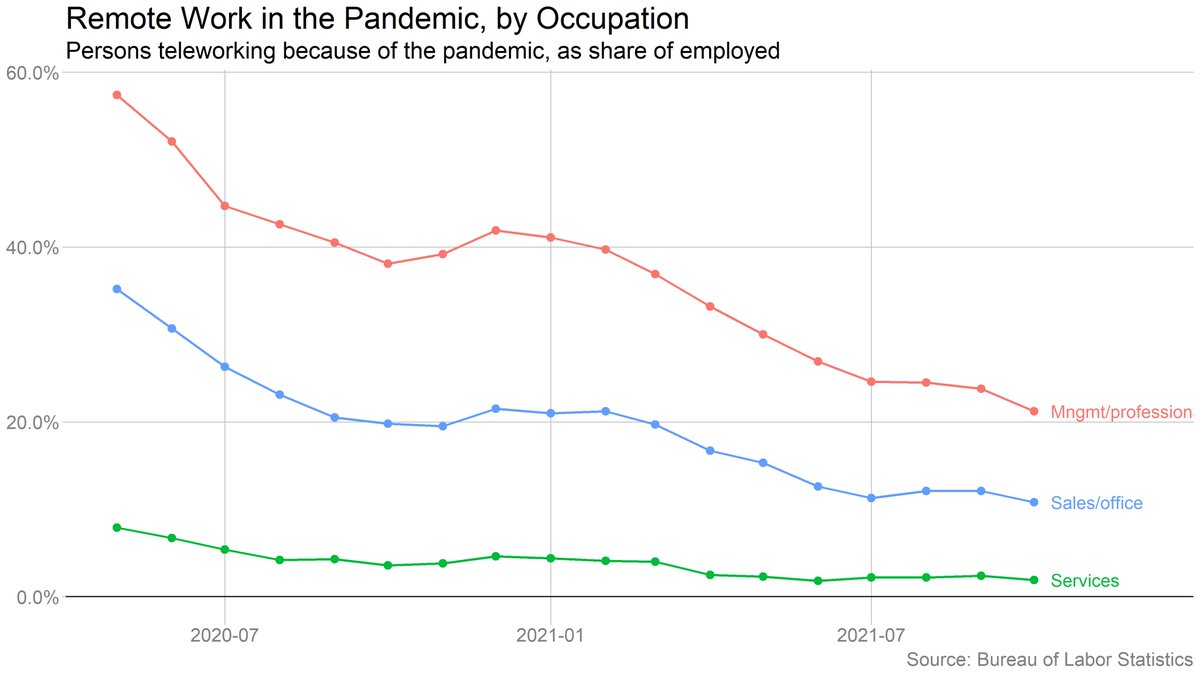
Want a sign that the economy is edging back toward normal? The share of people working from home because of Covid fell to a pandemic low of 11.6% in October. Resumed its decline after stalling out during the Delta wave.
Notable drop in work-from-home among professional workers. Which is a good place to note that I'm tweeting this from the office.
What I teach my students @newmarkjschool is that the data should determine the anecdotes, not the other way on. So if the data says older workers are retiring early, we should go find people retiring early and talk to them about why.
Where possible, we should disaggregate the data -- is the increase in early retirements being driven by college-educated workers? By women? By Black people? There are limits to this in practice, but we should aim to have our anecdotes be as representative as possible.
We should also be clear that even representative anecdotes are still anecdotes. "Real people" in stories provide nuance and color, and can help readers understand a trend. But they aren't evidence of a trend or what is causing it.
Income/spending/inflation data for September:
Personal income (nominal): -1%
Consumer spending (nominal): +0.6%
Consumer prices: +0.3% m/m, +4.4% y/y
Core consumer prices: +0.2% m/m, +3.6% y/y bea.gov/news/2021/pers…
September Employment Cost Index, *three month* change:
Total compensation: +1.3% (vs 0.7% in June)
Wages and salaries: +1.5% (0.9% June)
Leisure & hosp. wages/salaries: +2.6% (2.8% June) bls.gov/news.release/e…
The drop in income in September was driven by the end of expanded federal unemployment benefits. Wage and salary income actually rose faster in Sept. than in August.