

1/ Video games have become a hugely popular form of entertainment over the past 50 years, and adoption shows little sign of slowing down.
Underpinned by #blockchains and #NFTs, play-to-earn models offer a new way to distribute gaming value.
A thread explaining #PlayToEarn 🧵👇
Underpinned by #blockchains and #NFTs, play-to-earn models offer a new way to distribute gaming value.
A thread explaining #PlayToEarn 🧵👇
2/ Play-to-earn games offer built-in ownership of in-game currency & items in the form of cryptocurrencies & NFTs.
These digital assets hold a direct connection to a larger, interconnected digital economy with real-world value through blockchains.
But why is this important?
These digital assets hold a direct connection to a larger, interconnected digital economy with real-world value through blockchains.
But why is this important?
3/ In-game value, or value assigned to in-game items and related digital goods, is commonplace within many games.
This can be seen in existing third-party Counter-Strike: Global Offensive (CS:GO) markets, community-run MMORPG marketplaces, and many similar markets.
This can be seen in existing third-party Counter-Strike: Global Offensive (CS:GO) markets, community-run MMORPG marketplaces, and many similar markets.
4/ Play-to-earn games formalize and unlock these often-stifled economies by placing control over in-game value into the hands of players rather than video game developers, with markets facilitated by blockchains and digital asset ownership in the form of NFTs. 
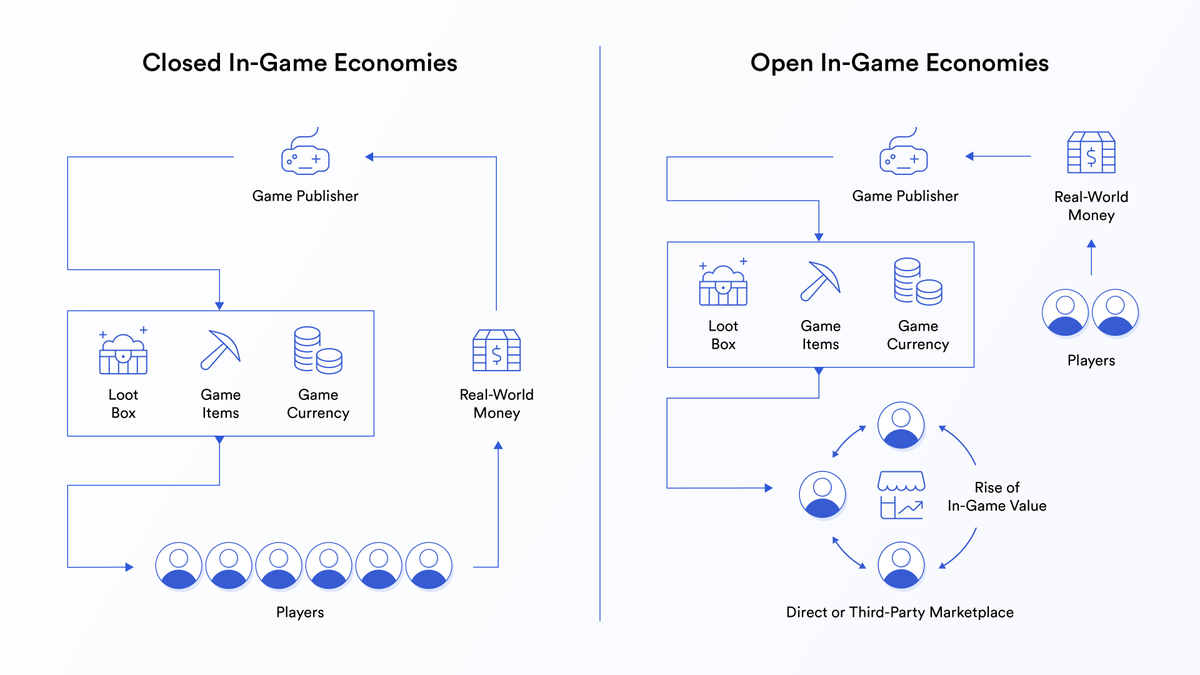
5/ This empowers players on a fundamental level by giving them an unprecedented level of autonomy and ownership.
Since the advent of video games, players have driven adoption and in-game value through collective engagement. Now, they can be tangibly rewarded for their efforts.
Since the advent of video games, players have driven adoption and in-game value through collective engagement. Now, they can be tangibly rewarded for their efforts.
6/ In this new environment, players are inherently rewarded for their contributions, as every in-game item has real-world value through a connection to the larger economy, supported by blockchains. This is the play-to-earn model.
7/ #Chainlink provides the key off-chain data and computation services that play-to-earn games require to function in a secure, seamless, and fair manner, from verifiable randomness to smart contract automation to robust price data feeds.
8/ Play-to-earn gaming is just getting started, but the most fundamental benefit of this paradigm shift is giving control over in-game value to the most important stakeholders—the players.
Learn more: blog.chain.link/what-is-play-t…
Learn more: blog.chain.link/what-is-play-t…
• • •
Missing some Tweet in this thread? You can try to
force a refresh



