Almost 2 years since our low-HIT (herd immunity threshold) preprint was released the paper has been peer reviewed and accepted for publication in a scientific journal (specific details soon).

The accepted version features #COVID19 in England/Scotland: medrxiv.org/content/10.110…
Following the initial preprint submitted to medRxiv in April 2020 the theory that individual variation in susceptibility and exposure (frailty variation) to infection lowers HIT and epidemic final size was featured in many news and science outlets, eg:
Since then, @CorderRM @jessicaagking @caesoma @rjaaguas @ChikinaLab @WesPegden Marcelo Ferreira, Carlos Penha-Goncalves, Guilherme Goncalves and I, have been developing specific methods to efficiently apply the frailty variation theory to the COVID-19 pandemic.
For England/Scotland we estimate HIT in the range 25-29% for the original virus (wild type), 30-34% for the alpha variant, and 36-41% for delta. The study just accepted after peer review was conducted prior to omicron so we don't have estimates for that variant yet.
When comparing modelled epidemic curves to those obtained with no or less heterogeneity (such as in other modelling studies), our epidemics tend to be considerably smaller and conform better with data which is more evident in the long run.

• • •

Missing some Tweet in this thread? You can try to force a refresh

 

Keep Current with M Gabriela M Gomes

M Gabriela M Gomes Profile picture

Stay in touch and get notified when new unrolls are available from this author!

Read all threads

This Thread may be Removed Anytime!

PDF

Twitter may remove this content at anytime! Save it as PDF for later use!

Try unrolling a thread yourself!

how to unroll video
  1. Follow @ThreadReaderApp to mention us!

  2. From a Twitter thread mention us with a keyword "unroll"
@threadreaderapp unroll

Practice here first or read more on our help page!

More from @mgmgomes1

Jan 2
Case fatality rate em PT e UK desde que PT atingiu 85% da população vacinada com 2 doses (UK tinha 65%):
Percentagem com 2 doses em PT e UK:
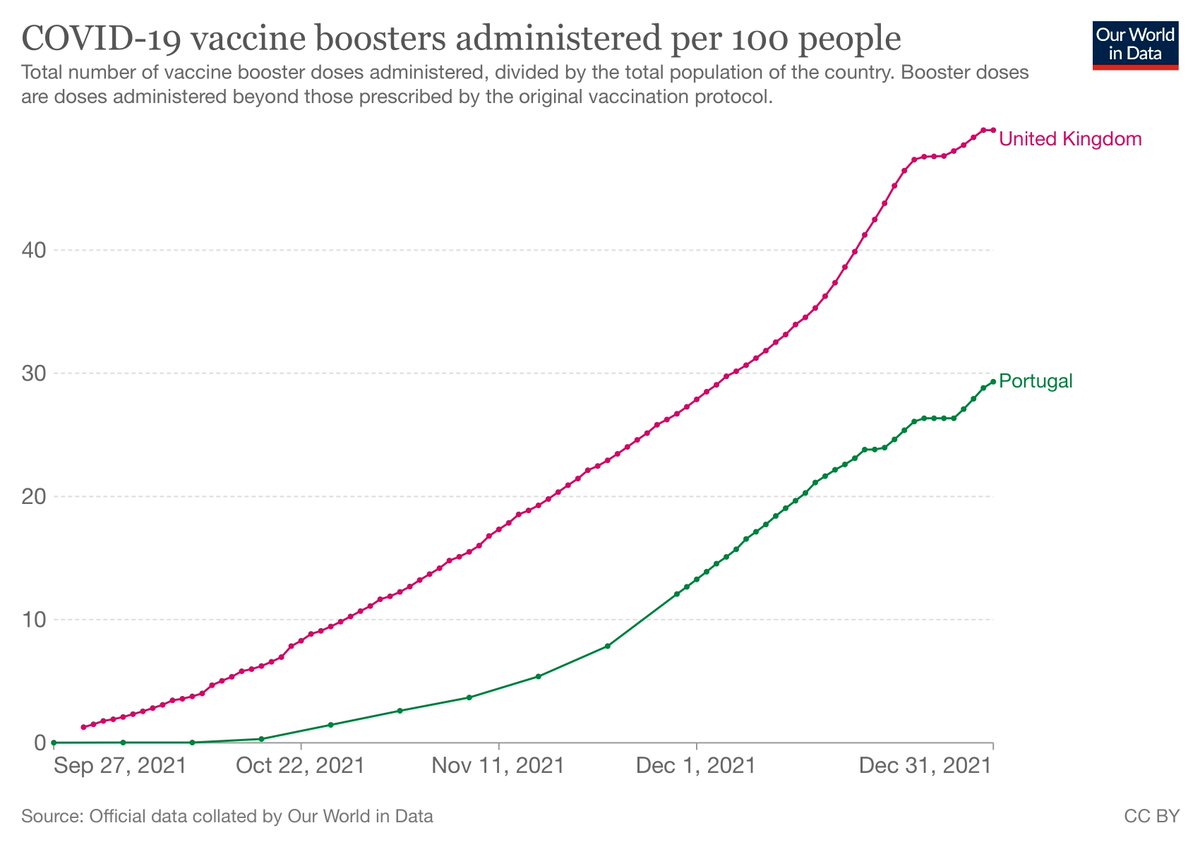
Percentagem com dose de reforço em PT e UK:
Read 5 tweets
Jan 2
New Year's resolution for me: No more thinking about COVID-19. Research objectives fulfilled, time for new topics.

Still polishing final writings but worthwhile thinking has been completed

Early conclusions (first released 27 April 2020) remain unchanged
medrxiv.org/content/10.110…
Two years ago had privilege to be: offered/accepting Global Talent Research Professorship at Strathclyde University @StrathMathStat; awarded Habilitation from Porto University. Both in recognition for research/teaching variation/selection in epidemiology/ecology/evolution.
Then pandemic emerged and took all time/attention. A lot has been sacrificed but I believe for good causes: research-wise immediately; policy-wise may take longer.

Happy to finally move on!
Read 4 tweets
Dec 20, 2021
Dreaming about death; got up to make coffee

Then decided to write thread about what's killing me. Not depressing (on contrary). It's my duty to make the world understand this +ve thing before I die [not that I think I'll die soon; that was just in dream]

PLEASE READ IF YOU CAN!
For more than 10 years I've been researching with collaborators (including @mlipsitch @GrahamMedley) why epidemic models tend to exaggerate epidemic sizes and overestimate intervention impacts (particularly vaccines but also NPIs):
journals.plos.org/plospathogens/…
Here a wider perspective:
arxiv.org/abs/2009.01354
Read 25 tweets
Dec 18, 2021
1/ Many times I have been asked why communication around herd immunity threshold (HIT) was so confusing in this pandemic. I have even been asked whether experts really understand it. Here is my answer:
2/ The concept is well understood among mathematical epidemiologists. In my view what went terribly wrong was the politicised way in which the HIT was used in this pandemic.
3/ The HIT is the percentage of the population that needs to be immune (prior to vaccination immunity was a natural outcome of recovery from infection) before the epidemic peaks and subsides.
Read 14 tweets
Dec 17, 2021
Last year, prominent modelling groups dismissed our Covid work (known for incorporating individual variation in susceptibility and exposure, and estimating low herd immunity thresholds) by claiming our stylised contact-reduction profile (Rc) wasn't close to government NPIs..
England and Scotland (with our latest stylised Rc):
This week, I had a few moments to spare and implemented the same model and fittings with the stringency index that tracks government response. The results are almost identical...
Read 7 tweets
Dec 16, 2021
No inicio da pandemia convidaram-me para integrar um daqueles grupos que fazem modelos Covid para o governo Portugues. Eu disse que nao porque queria testar um novo conceito de modelos e queria estar a vontade para fazer ciencia pura e comunicar a vontade.
Comecei a ser contatada por jornalistas que me faziam perguntas as quais eu respondia avisando sempre que os meus modelos eram diferentes dos clássicos.
Talvez nao seja surpreendente que os modelos demorem a ser aceites na especialidade embora eu tivesse alguma esperança que neste caso fosse mais rápido. Mas enfim, abordagens novas demoram a ser processadas.
Read 5 tweets

Did Thread Reader help you today?

Support us! We are indie developers!


This site is made by just two indie developers on a laptop doing marketing, support and development! Read more about the story.

Become a Premium Member ($3/month or $30/year) and get exclusive features!

Become Premium

Don't want to be a Premium member but still want to support us?

Make a small donation by buying us coffee ($5) or help with server cost ($10)

Donate via Paypal

Or Donate anonymously using crypto!

Ethereum

0xfe58350B80634f60Fa6Dc149a72b4DFbc17D341E copy

Bitcoin

3ATGMxNzCUFzxpMCHL5sWSt4DVtS8UqXpi copy

Thank you for your support!

:(