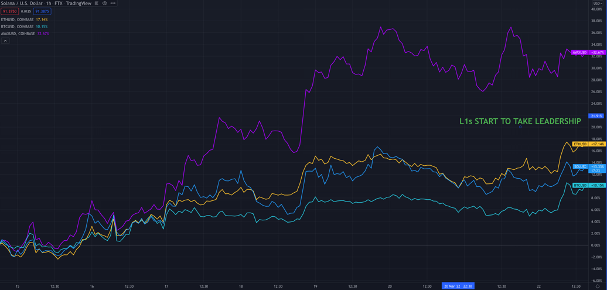
0/ Is today’s move in BTC the start of a breakout, or are we getting faked out?
ETH seems to be stealing the show with ETH/BTC confirming a breakout of a downtrend since early Dec.
Don’t miss this week’s Crypto Roundup to filter the noise & hone in the signal 🧵👇
1/ 43k is a minor level in #btc the big hurdle to break is around 46k. Obvious chart resistance this also lines up with short term holder cost basis as per @WClementeIII latest newsletterhttps://twitter.com/WClementeIII/status/1504842948135034882?s=20&t=i1YZlMRU56qNPasZuY79sA
2/ Interesting perspective from @woonomic on the death of the 4Y cycle in BTC, shorter cycles have been observed since 2019.
3/ ETH finally waking up as ETH/BTC breaks above downtrend and L1s take the baton this week. AVAX leads the way ahead of Barcelona Summit.
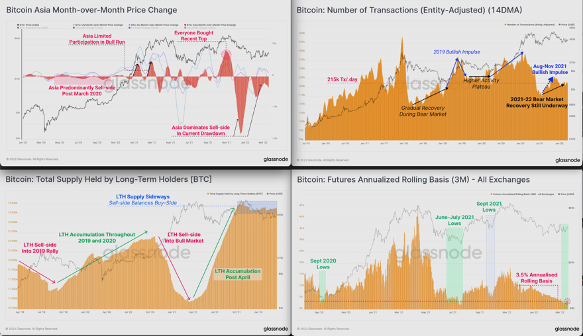
4/ Key takeaways from @glassnode this week:
Asia prominent on the sell side since late last year, Transaction count stable but not rising, LTH balances relatively high so less liquid supply if beta chase kicks in, Quarterly futures basis very low suggests are people well hedged
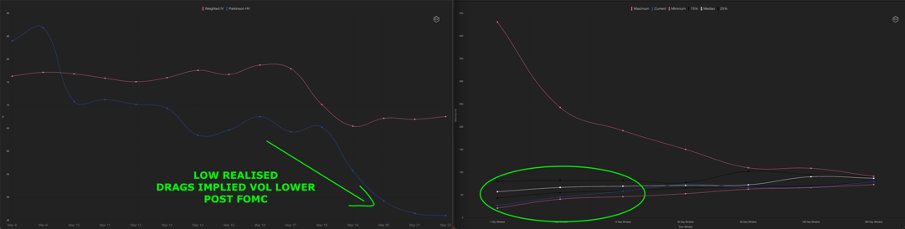
5/ Crypto realised vol collapsed taking implied with it post-FOMC. IV-RV spread still high though as front caught a bid on potential upside break.
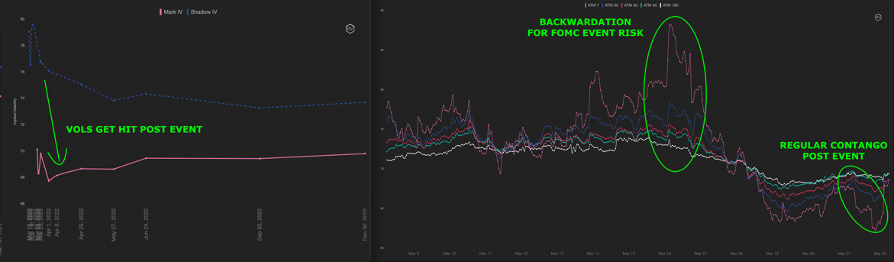
6/ Standard IV crush taking curve from inverted to contango post events last week. Realised needs to tick up, otherwise contango will get much steeper into Easter I suspect. DOV flows will keep coming regardless.
7/ ETH vs BTC implied vol spread got very tight providing opportunity for RV trades. Personally I like owning ETH calls vs BTC calls naked in Apr 20 delta space.
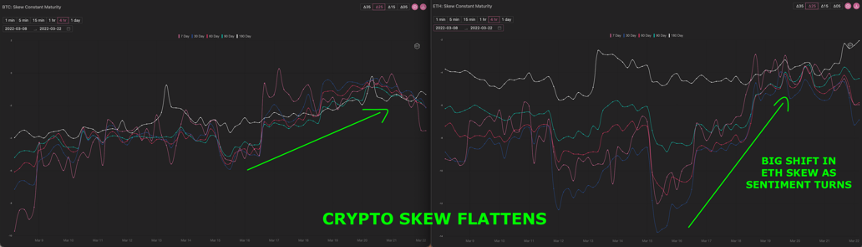
8/ Skew flattened back sharply, especially in ETH which had been the favoured protection asset. This type of shift in skew can often lead a move as sentiment shifts.
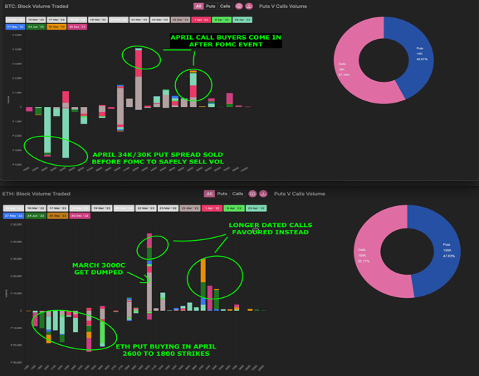
9/ In option flows, Mar ETH calls dumped in favour of longer dated, BTC Apr 34k/30k put spread sold ahead of FOMC, worked amazingly, April call buyers 42k-50k strikes for breakout participation. ETH Apr downside still active.
10/ Thanks to @PelionCap@fb_gravitysucks@QCPCapital and @GenesisVol for helping me stay on top of things and be sure to check out the new CRYPTO INSIGHT video that drops Thursday. Link to last week
11/ If you like this thread pls RT and be sure to try out our community by joining our FREE Discord group chat (discord.com/invite/dsnhDWS…) to join the conversation and get info like this & more in real-time.
We also have a FREE crypto option webinar (link in profile)
• • •
Missing some Tweet in this thread? You can try to
force a refresh

For those of you who follow the SPX Vol surface, you will know that SKEW is quite pumped right now. It's still around the 80th percentile after getting hit yesterday.
So does that make it a sell still?
Not necessarily. Because there is a reason why SKEW is expensive. And that reason is that people are willing to pay for VANNA.
So, what the hell is VANNA? Explainer🧵
1/ Vanna is a second-order Greek that represents two things at once. It represents how your VEGA position changes when the underlying spot moves. But it also represents how your DELTA changes when implied volatility moves.
I like to think of it as your realised skew exposure, just like gamma is your realised volatility exposure.
2/ Let's take an example where you have a Vanna position of $100k of Vega per 1% spot change. And you are long downside puts and short upside calls.
You will therefore also have a delta change per implied vol change of $10 million DELTA per 1% vol change.
As the market goes down, you will get longer Vega. If the market goes up, you will get shorter Vega.
And as implied vol goes up, you will get shorter delta. And if implied vol goes down, you will get longer delta.
I saw a reddit post about dispersion today written by a quant. It was pretty good but I feel like the target audience was vol professionals and most people wouldn't have a clue what he was on about.
So here goes....the Options Insight explanation of the famous Dispersion Trade explained in plain English...
Let's imagine the stock market is a choir🧵
1/ The Index (SPX) is the whole choir singing together.
The stocks are the individual singers.
Dispersion trading is about betting on how in-sync the singers are with each other.
2/
If every singer hits the same note perfectly → the choir sounds loud and clear → the SPX moves a lot.
If everyone sings their own tune → the choir sounds softer, even if each singer is loud → SPX goes nowhere.
Perfect sync = high correlation
Everyone doing their own thing = low correlation/high dispersion
Why do YOU need our daily SPX fixed strike vol monitor?
1/ There are so many GEX models out there, saying different things, with different embedded assumptions. For example, @t1alpha suggest that SPX dealers have just flipped short gamma...
2/ But GS see a very different profile, which seems to include a lot of very short dated local gamma supply. This means dealers lose gamma in both directions.
3/ And finally Nomura's well followed @CharlieMcEllig1 and team said recently that the setup is the complete reverse with dealers short upside around the 5000 strike.
Let's dive into last week's options trading insights! Remember, the full details are included in our site weekly blog post (check my profile's linktree).
1/ We saw signs that SPX buying flows might slow down after Friday's OPEX. SPX hasn't dipped, likely buoyed by these Jan OPEX positions, especailly in Mag7 names.
Protecting your US index exposure with Feb24 or Mar24 put spreads makes sense. Post-Jan OPEX, expect less market support due to the fading effect of CHARM and buyback blackouts for earnings.
This creates a chance for tactical shorts in the coming weeks. Our evidence suggests that SPX's end-of-day buying is due to dealers hedging DELTA on Jan24 long GAMMA positions.
According to GS, dealer GAMMA has collapsed, making the markets less stable as we head into mega-cap tech earnings...
2/ We also think it's time to consider VIX call spreads.
Why? The chances of a volatility spike seem higher now. There's been a surge in Feb24 17 calls, pushing VVIX up. This aligns with our observation of increased equity vol. Investors are hedging risks, a sign of market nervousness.
19Jan24 fixed strike vol dropped, but Feb24 and Mar24 firmed up. This indicates dealers covering short-term VEGA from VIX trades.
Even if SPX tests 5000, VIX is unlikely to drop < 12. as VIX beta drops on the way up.
We're buying VIX call spreads to capitalize on the potential vol spike. This approach offers leverage while controlling THETA bleed.
1/ As SPX rips back to its highs, we see breadth deteriorating as the Mag7 are leading the charge once again.
2/ The options flows also back up this move as lots of calls were bought in the Mag7 names, which went deeply in the money and the CHARM effect of these options becoming 100 delta leads to more stock buying. Here is $MSFT 19Jan open interest, but looks the same for $NVDA, $AMZN, etc.
Are options really that risky? Or do you just not know how to size them properly?
This is a common pushback I get from people about options, saying they are way too risky and you can lose all you money trading them.
A thread...
1/ The truth is, yes they can be risky if you don’t know what you’re doing.
If you know how to size them appropriately, then options can seriously enhance you risk-adjusted return profile and allow you to profit from multiple scenarios.
2/ Example 1 - How not to do it - YOLO
You want to speculate on a stock going up because it has a strong trend and the Santa rally is coming. So you buy a 1-week OTM call with 10% of your account capital.