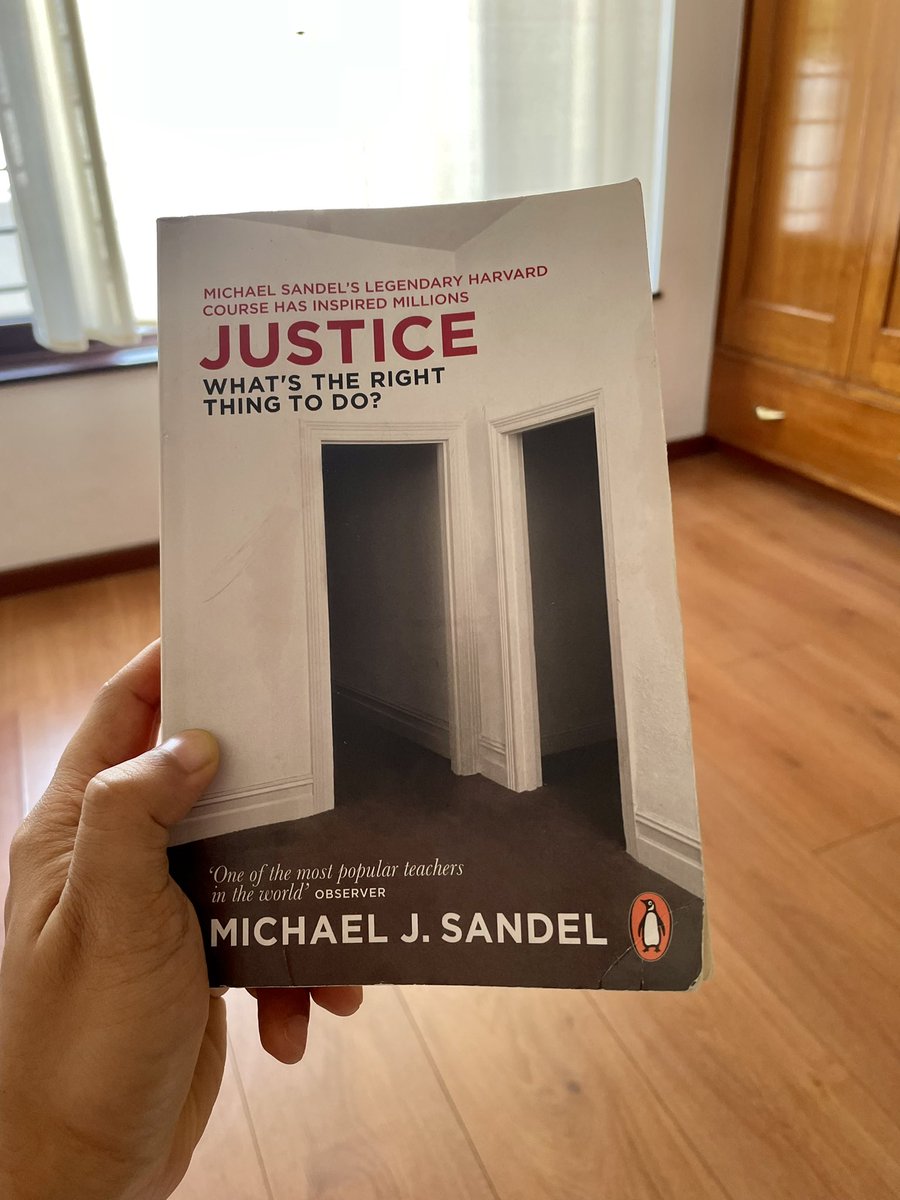
1/ The topic of the book is what is the right thing to do.
This seems like perhaps the most subjective question ever.
How can someone answer it for you?
This seems like perhaps the most subjective question ever.
How can someone answer it for you?
2/ The author does an excellent job of not giving answers, but rather tease out implications of different schools of moral thought.
Primarily he explores three moral traditions.
Primarily he explores three moral traditions.
3/
- Maximising welfare (utilitarianism)
- Respecting individual freedom (libertarianism)
- Promotive virtues (conservatism?)
- Maximising welfare (utilitarianism)
- Respecting individual freedom (libertarianism)
- Promotive virtues (conservatism?)
4/ Maximising welfare, as the name says, is doing things that maximise pleasure for most number of people.
The issue with maximising welfare blindly is evident right way.
Would you torture one person if it guaranteed pleasure for hundred other people?
The issue with maximising welfare blindly is evident right way.
Would you torture one person if it guaranteed pleasure for hundred other people?
5/ This isn’t just a theoretical exercise.
The cigarette company Philip Morris once commissioned a study that argued that government should promote cigarette smoking because smokers die early and hence save money to the taxpayer.
The cigarette company Philip Morris once commissioned a study that argued that government should promote cigarette smoking because smokers die early and hence save money to the taxpayer.
6/ We feel disgusted at such blind maximisation of utility because we intuitively feel nothing ever justifies inflicting pain on an individual for the benefit of someone else.
And that brings to the second type of morality the book explores: respecting individual freedom.
And that brings to the second type of morality the book explores: respecting individual freedom.
7/ This philosophy says that the right thing is to leave individuals to do whatever they want to do (as long as they don’t harm anyone else).
8/ It implies a minimal role of government. Mostly for enforcing contracts, and providing military defence.
Anything else is seen as an intrusion on liberty.
Anything else is seen as an intrusion on liberty.
9/ Such a philosophy is the moral justification of free-markets and capitalism.
Markets are wonderful - they create incentive for innovation and let people satisfy their individual desires but they’re not without their flaws.
Markets are wonderful - they create incentive for innovation and let people satisfy their individual desires but they’re not without their flaws.
10/ The major flaw in markets (and libertarian philosophy) is the role of luck.
If you’re born with special talents, or have a family that provides nurturing environment, you’re at an advantage compared to those whose genetics or nurturing wasn’t at par.
If you’re born with special talents, or have a family that provides nurturing environment, you’re at an advantage compared to those whose genetics or nurturing wasn’t at par.
11/ So, in that sense, the book argues - is Michael Jordan really deserving of a much better life than a homeless person?
Sure, Jordan practiced hard but that can also be attributed to the support structure he found himself growing in. Plus of course he’s blessed with good genes
Sure, Jordan practiced hard but that can also be attributed to the support structure he found himself growing in. Plus of course he’s blessed with good genes
12/ On top of it, he’s lucky that society values throwing balls in a hoop at the moment.
If he was born in a different era where society valued different things, his skills + genes might have not given him an edge.
If he was born in a different era where society valued different things, his skills + genes might have not given him an edge.
13/ The author dedicates another entire book questioning how fair is meritocracy.
I made notes from it earlier.
I made notes from it earlier.
https://twitter.com/paraschopra/status/1438166666374901762
14/ So respecting individual freedom really doesn’t work for people who are born unlucky because it removes all obligation of society to help them in anyway.
That is, only the lucky see taxes as a violation of liberty.
That is, only the lucky see taxes as a violation of liberty.
15/ So is the answer forced equality?
No, the world is indeed better when people who are good at certain things are allowed to master those things.
We wouldn’t enjoy seeing an unathletic person play a basket ball. Michael Jordan must be allowed to play it.
No, the world is indeed better when people who are good at certain things are allowed to master those things.
We wouldn’t enjoy seeing an unathletic person play a basket ball. Michael Jordan must be allowed to play it.
16/ The author argues that while individuals should do what they’re best at doing, the benefits of those should belong to the entire community (and not just the individual).
17/ In other words, let Michael Jordan play basketball because he is #1 but the money he makes from it should belong to the entire community (via taxes).
After all, it takes a village to raise a child.
After all, it takes a village to raise a child.
18/ Ok, but won’t that kill motivation?
Why would people become doctors, invent medicines and so on if they know their money will be taken away from them?
Why would people become doctors, invent medicines and so on if they know their money will be taken away from them?
19/ Here’s where the author introduces the John Rawl’s “veil of ignorance”.
This principle says that the society should allow only the actions that make the worst-off people better off than before.
This principle says that the society should allow only the actions that make the worst-off people better off than before.
20/ So if high taxation causes doctors to quit and ill people to suffer, reduce taxes for doctors.
But if high taxes causes Michael Jordan to not play basket ball, that’s ok because it doesn’t impact the worst off.
But if high taxes causes Michael Jordan to not play basket ball, that’s ok because it doesn’t impact the worst off.
21/ This is a beautiful principle but in reality we care a lot more for people close to us than the worst off.
That’s where the author introduces the third and final moral philosophy: promoting virtue.
That’s where the author introduces the third and final moral philosophy: promoting virtue.
23/ According to it (which was first introduced by Aristotle), the government’s job is to make its citizens virtuous.
What’s virtue?
I feel here’s where author for the first time reveals his preferences for morality.
What’s virtue?
I feel here’s where author for the first time reveals his preferences for morality.
24/ For him, virtue is paying respect to the web of identities you find yourself bound with.
You’re a citizen of a country, a family member, an employee of an organisation, a resident of a locality.
Being loyal to those identities is what virtue is for the author.
You’re a citizen of a country, a family member, an employee of an organisation, a resident of a locality.
Being loyal to those identities is what virtue is for the author.
25/ This loyalty to a group creates solidarity obligations that don’t require consent and are different from:
a) voluntary obligations in a free market (require consent)
b) natural obligations of not harming anyone in libertarianism (don’t require consent)
a) voluntary obligations in a free market (require consent)
b) natural obligations of not harming anyone in libertarianism (don’t require consent)
26/ Which means that if you adopt this philosophy, you immediately also adopt obligations towards your community (such as patriotism).
This is why countries like Israel accept and help Jews all over the world because they feel an obligation towards them.
This is why countries like Israel accept and help Jews all over the world because they feel an obligation towards them.
27/ To recap, three types of morality:
- maximising welfare
- respecting liberty
- promoting virtuous behaviour (towards one’s community)
Which one is right?
- maximising welfare
- respecting liberty
- promoting virtuous behaviour (towards one’s community)
Which one is right?
28/ None are objectively right but the book gives immense food for thought to help an individual derive one’s own moral framework.
Here’s mine: invertedpassion.com/my-moral-code/
Here’s mine: invertedpassion.com/my-moral-code/
29/ I highly recommend you to read the book and sit down and write your own conception of what’s the right thing to do.
Having a moral compass helps one to be more intentional in life, instead of simply drifting from one impulse to another.
That’s it. Hope you liked the notes.
Having a moral compass helps one to be more intentional in life, instead of simply drifting from one impulse to another.
That’s it. Hope you liked the notes.
• • •
Missing some Tweet in this thread? You can try to
force a refresh