Adam Rodman Profile picture
May 12 15 tweets 8 min read
Why are medical podcasts like @thecurbsiders, @BehindTheKnife, @emcrit, and @AFPpodcast so popular for learning? And who is making them? And can they be trusted?

We listened to (and coded) the top 100 podcasts on the Apple podcasts US medicine chart to find out!

A 🧵⬇️ Image
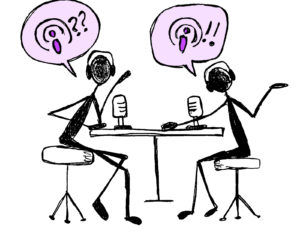
There were 2⃣ inspirations for this study.

@ShreyaTrivediMD and I at @iMedEducation think that what makes digital education unique from eg an uploaded lecture on YouTube is that that it is produced as part of a virtual community of practice and not traditional institutions. Image
So we had a hypothesis: the most popular medical podcasts would *not* be produced by medical schools, residency programs, or other large institutions, but rather by individuals (or separate companies/nonprofits).
The second question was inspired by @sargsyanz and @HollandKaplan in this great article in @JournalofGME: ncbi.nlm.nih.gov/pmc/articles/P….

Medical podcasts are basically like lectures WITHOUT the visuals, yet people listen to HOURS of them a week. What possibly makes people do that??
How do we even identify the top podcasts?? (it's a real methodological problem since podcasts are pre-Web2.0 and don't share download data). In order to do this we partnered with @ChartableDotCom and @dzohrob to calculate the top 100 podcasts in medicine in the US over 28 months.
After that, @nicolastrad, Ellen Zhang, and I painstakingly validated a code book looking at didactic method, creators, audience, advertisers, citations/references and more! Then we sat down and listened to, and coded *500* podcast eps!
It took a long time (don't worry, we didn't listen to ENTIRE episodes -- but we each listened to ~14 hours of audio each). @rwcorty is the type of person who unwinds with some large data sets and R, and he set about analyzing the data.
The TL;DR -- our hypotheses were right.

2/3 of podcasts are created by individuals or companies. Less than 10% are created by traditional institutions.

@sargsyanz et al were right too -- popular podcasts DO actually use more active learning/adult learning theory. Image
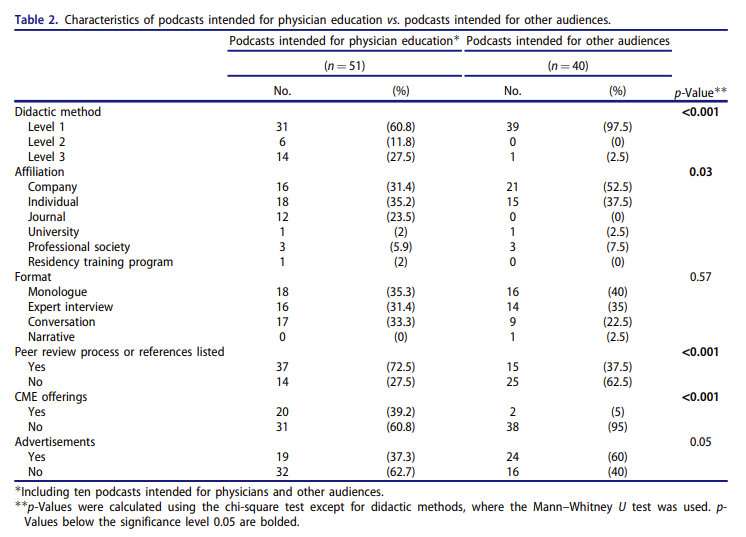
Other interesting findings: inclusion of references is common (73%); 37% of medical podcasts for physicians have advertising; most podcasts target a broad audience of learners from students to attendings.
There were also significant differences in how podcasts intended for physicians taught from those intended for other health professions (or the general public).
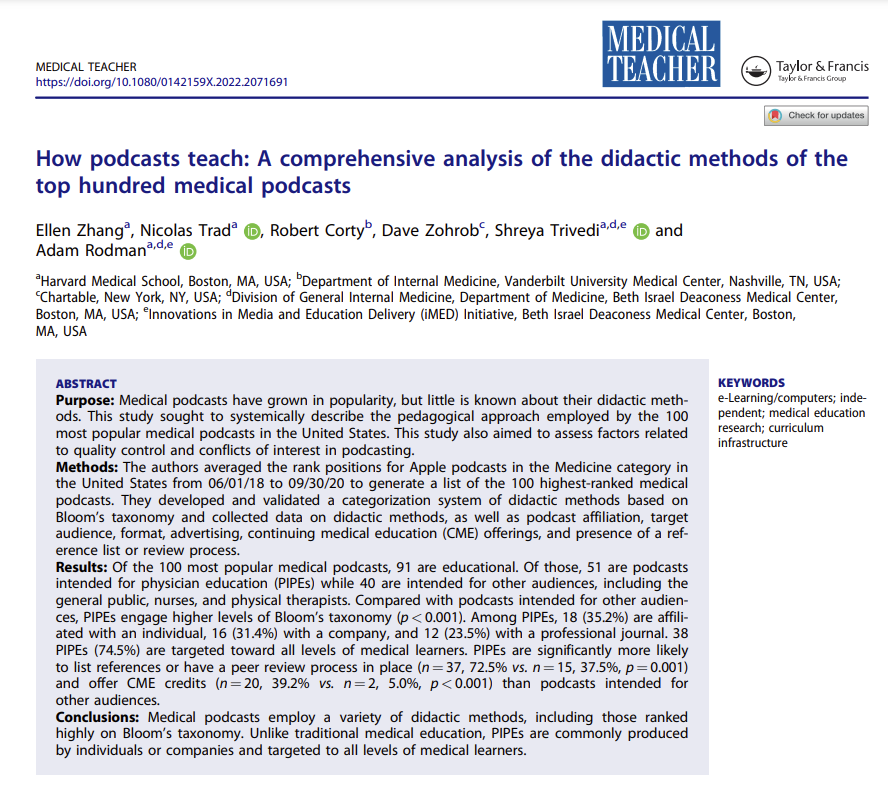
If you want to dig through the data yourself, you can access our study at @MedTeachJournal: pubmed.ncbi.nlm.nih.gov/35531609/ Image
There are *lots* of limitations to our study (I won't belabor them in a Twitter thread). But I think it's an important contribution to digital education literature because:

1⃣ It seeks to COMPREHENSIVELY look at the top podcasts using a data-driven approach
2⃣ It lends credence towards many of the theoretical arguments that @ShreyaTrivediMD and I make about what makes digital education different and special

3⃣ It gives signals about future directions of this sort of research -- especially investigating review processes and ads
That's it for the thread! I genuinely enjoyed working on this study, and couldn't have done with without a great team, especially students/co-first authors/podcast-listener-coders Ellen Zhang and @nicolastrad.
And if this gets you excited about digital education, then get even more excited -- because the annual @iMedEducation national meeting will be back on October 7-8. Details will be coming soon!

• • •

Missing some Tweet in this thread? You can try to force a refresh

 

Keep Current with Adam Rodman

Adam Rodman Profile picture

Stay in touch and get notified when new unrolls are available from this author!

Read all threads

This Thread may be Removed Anytime!

PDF

Twitter may remove this content at anytime! Save it as PDF for later use!

Try unrolling a thread yourself!

how to unroll video
  1. Follow @ThreadReaderApp to mention us!

  2. From a Twitter thread mention us with a keyword "unroll"
@threadreaderapp unroll

Practice here first or read more on our help page!

More from @AdamRodmanMD

Aug 24, 2021
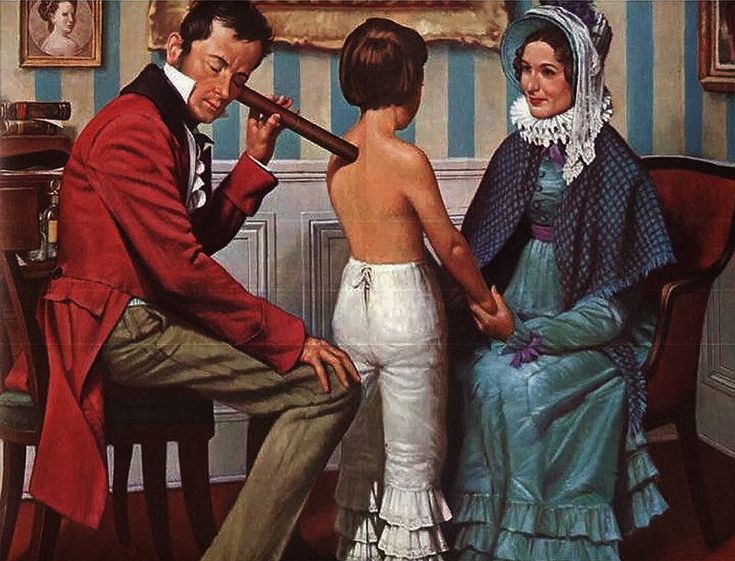
Almost exactly a year ago, I had a modestly controversial tweet about routine daily physical exams -- and about how we should probably spend more time actually talking to our patients daily rather than pretending to examine then.

Well, now that angry tweet is a point-counterpoint-rebuttal series in @JHospMedicine!

The first piece is by me and @ShaneWarnockMD, and I cut right to the point: Routine daily physical exams in hospitalized patients are a waste of time.

🧵⬇️

or
journalofhospitalmedicine.com/jhospmed/artic…
1⃣: the exam was historically developed as a DIAGNOSTIC test. And it remains an incredibly great diagnostic test in many instances, with innumerable examples validated through both physician experience, and more recently epidemiological studies (think McGee and Rat Clin Exam)
Read 25 tweets
Jul 17, 2021
My (preaching to the choir) 🔥 take: digital educational skills -- whether teaching on #MedTwitter, podcasting, or making videos -- are essential #meded skills for the 21st century. And we can teach these to future educators.

A Tweetorial🧵:
Last year, @ShreyaTrivediMD @StaciSaundersMD and I at @iMedEducation started a curriculum to teach digital educational skills to our @BIDMC_IM residents.

We just published this article going over our curriculum and providing tips for you to do it too: pubmed.ncbi.nlm.nih.gov/34013623/
We ended up integrating our curriculum into a pre-existing one-to-two week Senior Teacher rotation, which had two great benefits:

1⃣MUCH easier to get off the ground
2⃣Stressed that traditional educational principles are transferable for teaching digitally
Read 10 tweets
Dec 17, 2020
A proposal!

Are you:

✅A listener of @BedsideRounds?
✅A medical student at a US or Canadian medical school?
✅Interested in medical history, philosophy, and epistemology?

And then question 2:

✅Do you want to collaborate on a research project?

If so, 🧵⬇️ Image
First, some details! Over the past six years, I've made a lot of podcasts (some of them better than others), and I know they're being used for teaching at medical schools across the country.
The subjects that I cover -- history, epistemology, diagnostic reasoning, philosophy -- are generally not part of medical school curricula, or are only briefly touched (though there are amazing electives).
Read 10 tweets
Aug 14, 2020
Why do we use godawful blue-background-with-bright-yellow-text for medical school lectures?

A 🧵on magic lanterns, darkrooms, path dependence, and “things we do for no reason”

👇 Image
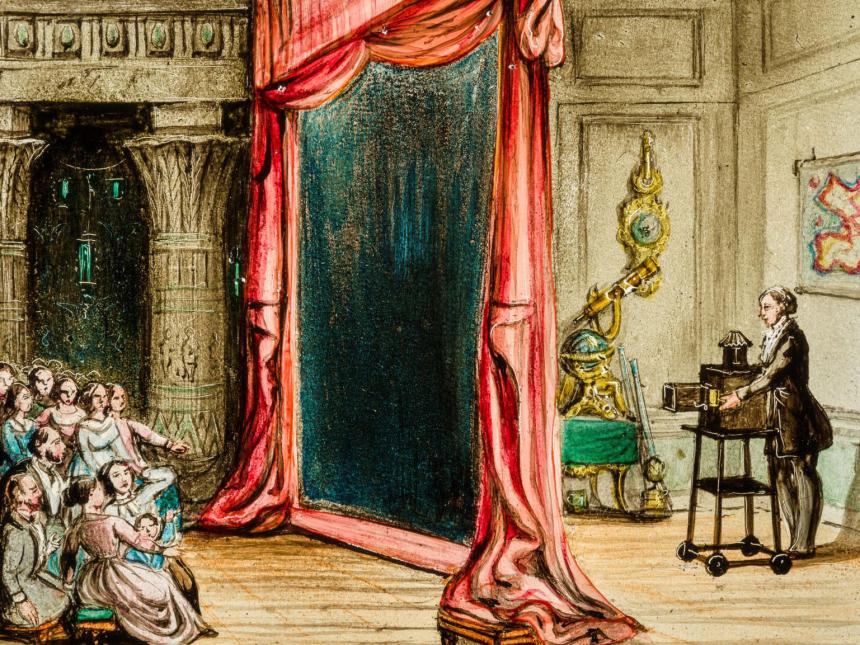
Projecting images is quite old, dating back to the 18th century with images painted directly on glass plates -- a magic lantern. During the Spanish Flu, the Surgeon General toured with a magic lantern with information on the pandemic. Image
As an aside, the @mfaboston had an amazing exhibit pre-pandemic called Phantasmagoria, showcasing magic lanterns and horror shows in particular. This demonstration (not a magic lantern BTW) on animalcules in the Thames was my favorite

Image
Read 26 tweets
May 30, 2020
@COREIMpodcast Interesting thread, though some very common misconceptions about "primum non nocere" are present here. First do no harm is not in the Hippocratic Oath at all, and the "non-malfeasance" present in oath would likely make most modern doctors squeamish.
@COREIMpodcast It has diktats against performing abortion, and against physician-assisted suicide. Even the commonly cited "do not cut for stone" isn't because of preventing harm, but suggesting that a lithotomist do it.

(good translation here: nlm.nih.gov/hmd/greek/gree…)
@COREIMpodcast The closest quote comes from Epidemics I:

"The physician must ... have two special objects in view with regard to disease, namely, to do good or to do no harm"

(source: perseus.uchicago.edu/perseus-cgi/ci…)
Read 9 tweets
May 13, 2019
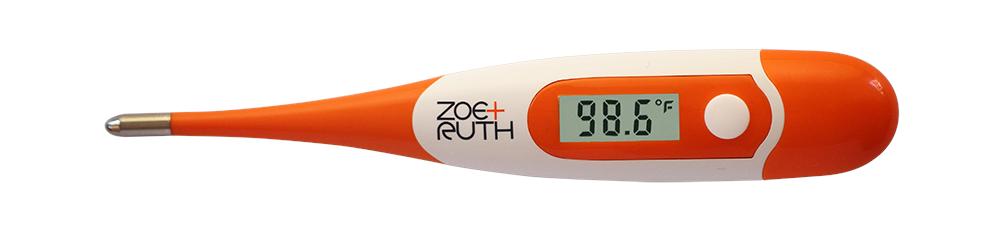
It’s time for another #histmed Tweetorial -- this time I'm going to talk about the pesky definition of a fever, and where the 98.6 F average body temp came from!

Full disclosure: will use C AND F for temp, but no K or R.
FYI this is a complementary Tweetorial to @tony_breu's amazing one on why we have night sweats
Let’s start with a case!

A 29 year-old woman presents with a week of cough, myalgias, and chills. Her temperature is 99.9 F (37.7C). She tells you, “This is a fever for me because I run low.”
Read 31 tweets

Did Thread Reader help you today?

Support us! We are indie developers!


This site is made by just two indie developers on a laptop doing marketing, support and development! Read more about the story.

Become a Premium Member ($3/month or $30/year) and get exclusive features!

Become Premium

Don't want to be a Premium member but still want to support us?

Make a small donation by buying us coffee ($5) or help with server cost ($10)

Donate via Paypal

Or Donate anonymously using crypto!

Ethereum

0xfe58350B80634f60Fa6Dc149a72b4DFbc17D341E copy

Bitcoin

3ATGMxNzCUFzxpMCHL5sWSt4DVtS8UqXpi copy

Thank you for your support!

Follow Us on Twitter!

:(