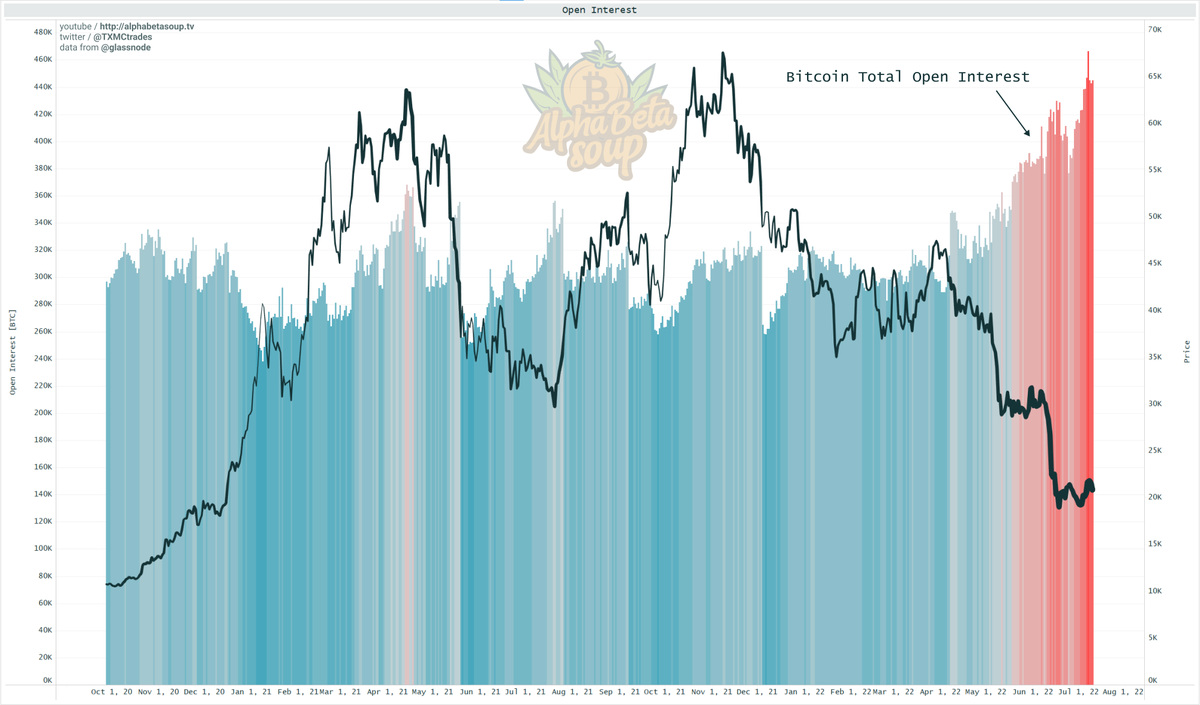
#BTC futures open interest has expanded mightily at the lows.
As an annoyingly curious guy by nature, I took a look.
My findings led me to OKX. Let me show off some charts.π§΅
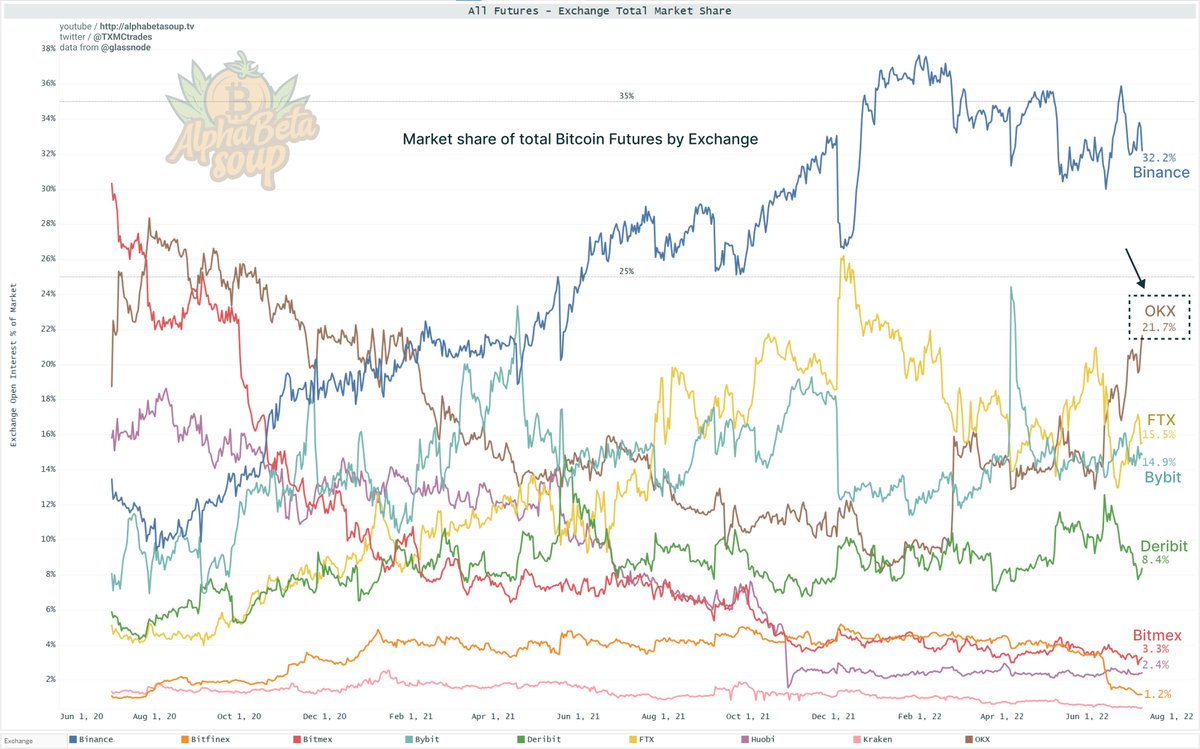
π€OKX's star has been rising of late.
OKX's total market share of #BTC futures recently surpassed π‘FTX for the #2 spot, trailing only the king dog π΅Binance.
Their pie slice has grown from 12.9% to 21.7% since June 6th. Most other exchanges are roughly the same in that span.
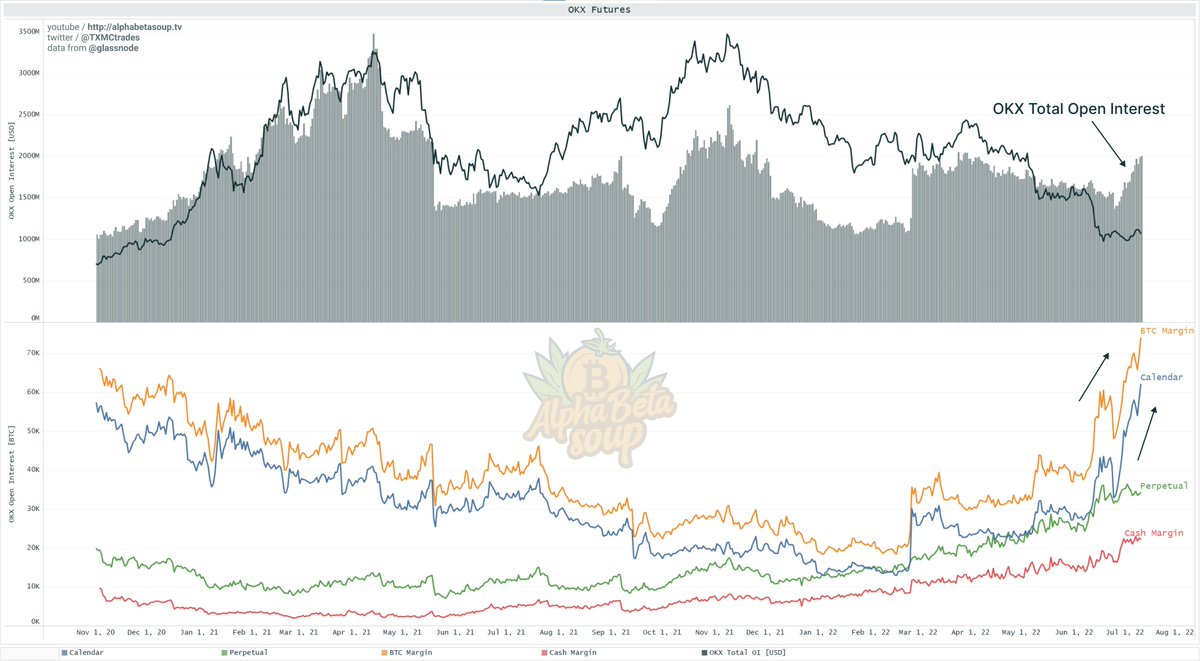
Futures comes in two varieties and two margin types:
π’Perpetuals
π΅Calendars
π΄Cash margin
π BTC margin
As you can see, the expansion of Open Interest for OKX has been all BTC backed calendar futures, rivaling 2020 levels of dominance.
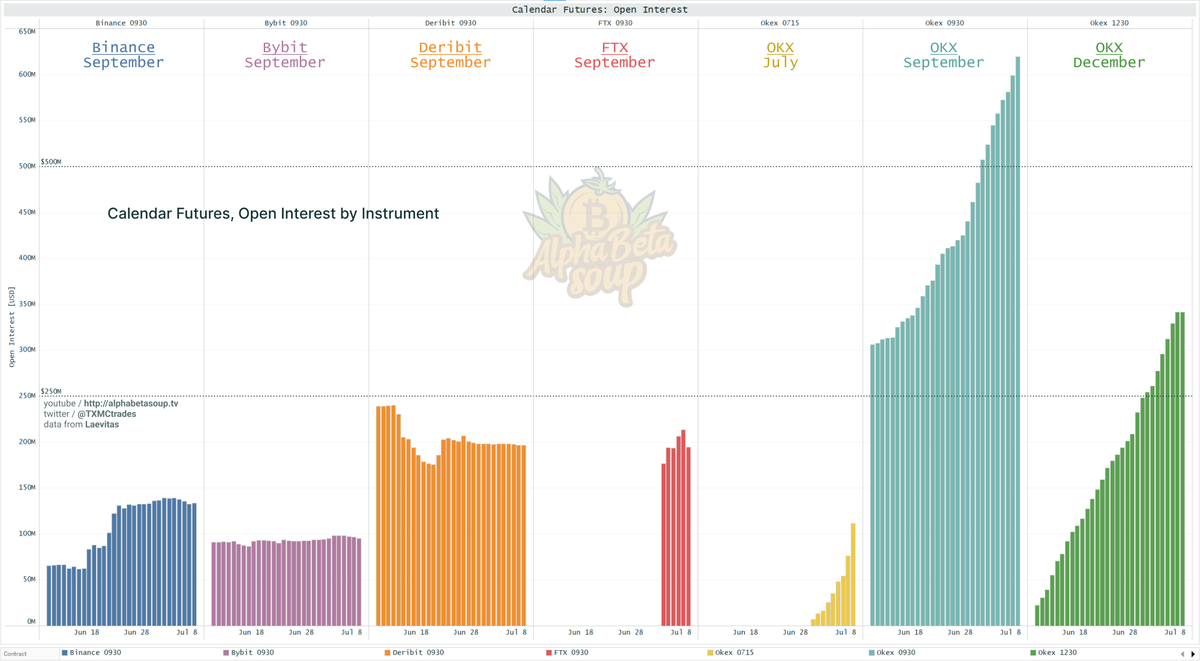
So which contracts are involved?
The sky high majority of flows are going to the Sept contract on OKX, and a lesser degree December.
Nothing else in this corner of the market even comes close. But why?
I can't say with certainty, but one thing to note- OKX has had the best annualized basis among calendar offerings since late June, currently at around 2.2%.
Everything is a yield game, and OKX is a decent choice in the current environment.
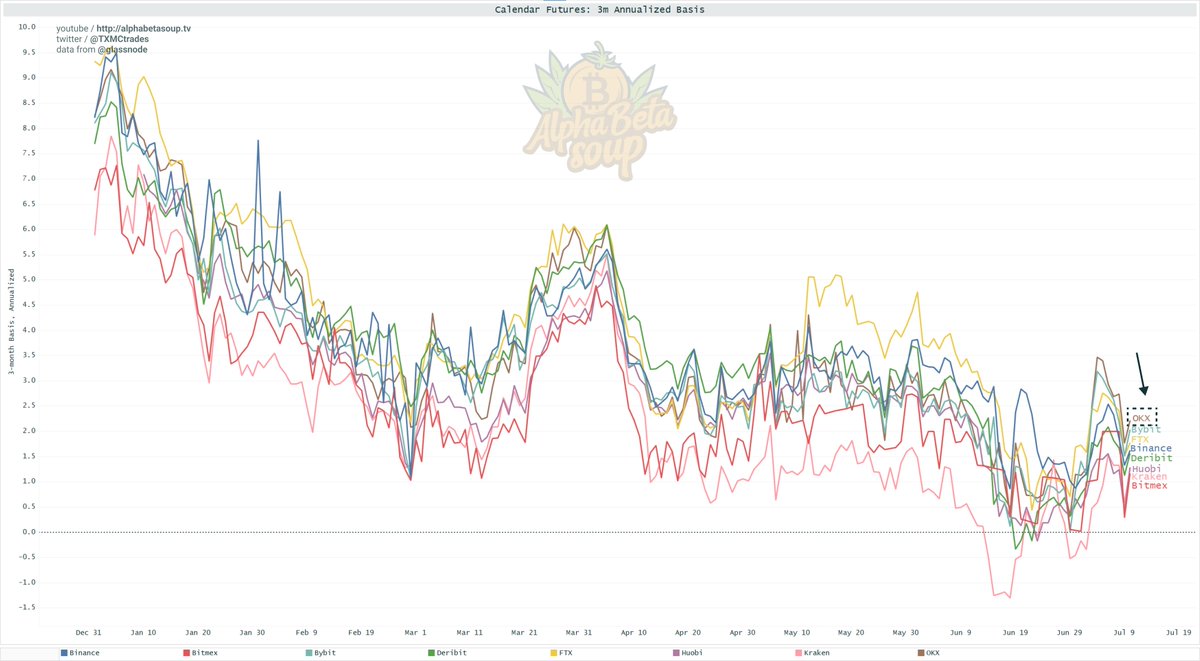
Perhaps this is part of a larger position across instruments- hard to know. One thing is for certain- other exchanges are not seeing the same flows.
I'd love to hear from traders in those markets: why the sudden return of OKX calendar dominance?
Anyways, have a good MondayβοΈ
β’ β’ β’
Missing some Tweet in this thread? You can try to
force a refresh

ππ§
"Turns in the bond market occur infrequently, only once every several decades, and when this moment arrives most experts are taken by surprise.
In 1899, the President of Equitable Life solicited opinions from respected American financiers on the future course of long-term interest rates. At this date bond yields had been falling for decades. The sages of Wall Street assumed this trend would continue. Of the 69 responses received by Equitable Life, not one anticipated any change. Treasury Secretary Lyman Gage held the view that interest rates were headed "permanently downwards".
Gage was wrong. The bond bull market had already ended, and over the following decades Treasury yields rose.
The bear market in bonds that commenced at the end of the 19th century coincided with the reversal of globalization. The bond bear market that started in 1945 followed a period when US interest rates had been kept at artificially low levels and Federal Reserve banks lent directly to the American government to finance the war effort. Inflation returned with a vengeance after the war and Treasury yields rose for the next three and a half decades. It's not hard to draw parallels between these periods and the Covid conjuncture.
As globalization reverses and China's workforce declines, inflation is likely to pick up and interest rates will have to rise to contain it. Claudio Borio's "epoch defining seismic rupture" - a toxic mixture of high inflation, financial and trade protectionism and stagnation - no longer seems such a distant prospect."
When we look back in a few months, it is likely this week will have marked narrative inflections for Peak Disinflation and Peak Soft Landing.
These shifts will coax markets higher even as the underlying economic structure softens and we enter the sweet spot of recession odds.
As immaculate disinflation gives way to The Economy Can Handle 5% rates (it can't really), the lags of monetary policy will follow.
Recall that 12 months ago, Powell had only hiked 150bps of the 525bps so far. This lag is misunderstood and widely mis-priced by investors today.
Cyclical areas of the economy have already responded to tightening. Industrial Production topped months ago. Real Retail Sales and Real Manufacturing Sales are still below their 2022 peaks despite inflation having been cut by more than half.
This isn't just a matter of gig workers hidden from unemployed, or marginally attached failing to apply for jobs or respond to surveys. Those things occur but they don't change this story.
This is a secular dynamic at the species level that was fully exposed by pandemic shocks.
As a result of these factors, now might be the worst time in American history for the Fed to be targeting labor softness in an effort to slow the economy.
Like trying to create slack in a rope you're actively hanging from. It won't loosen unless it snaps completely.
With risk higher, folks are asking me a) if I've changed my bias or b) if macro looks better.
a) No.
b) It does not.
The peak inflation, imminent pivot, China re-open trade is driving a strong rally, but continued deterioration is still extremely underpriced by risk assets.
A cyclical downturn is a roller coaster and the pathway is non-linear- a phrase I stress often.
Dislocations can be driven by positioning, narratives, and short term imbalances- all of which culminated in Q4 to spur a technical reversal from the doomy depths.