USA 326 (2022-009A) was launched on February 2 this year and is believed to be a new generation of electro-optical reconnaissance satellite: sattrackcam.blogspot.com/2022/02/the-up…
It is in a 97.4 deg inclined, 518 x 488 km orbit.
The Russian launch today was indeed at 20:25 UTC, right at the moment the USA 326 orbital plane passed over Plesetsk (i.e. the launch was into the orbital plane of USA 326): interfax.ru/russia/854824
It appears that the object has been catalogued under number 53324 in a 97.25 degree inclined 284 x 425 km orbit, in the same orbital plane as USA 326 but a somewhat lower initial orbital altitude.
Will be interesting to see what it will do the coming weeks & what USA 326 will do
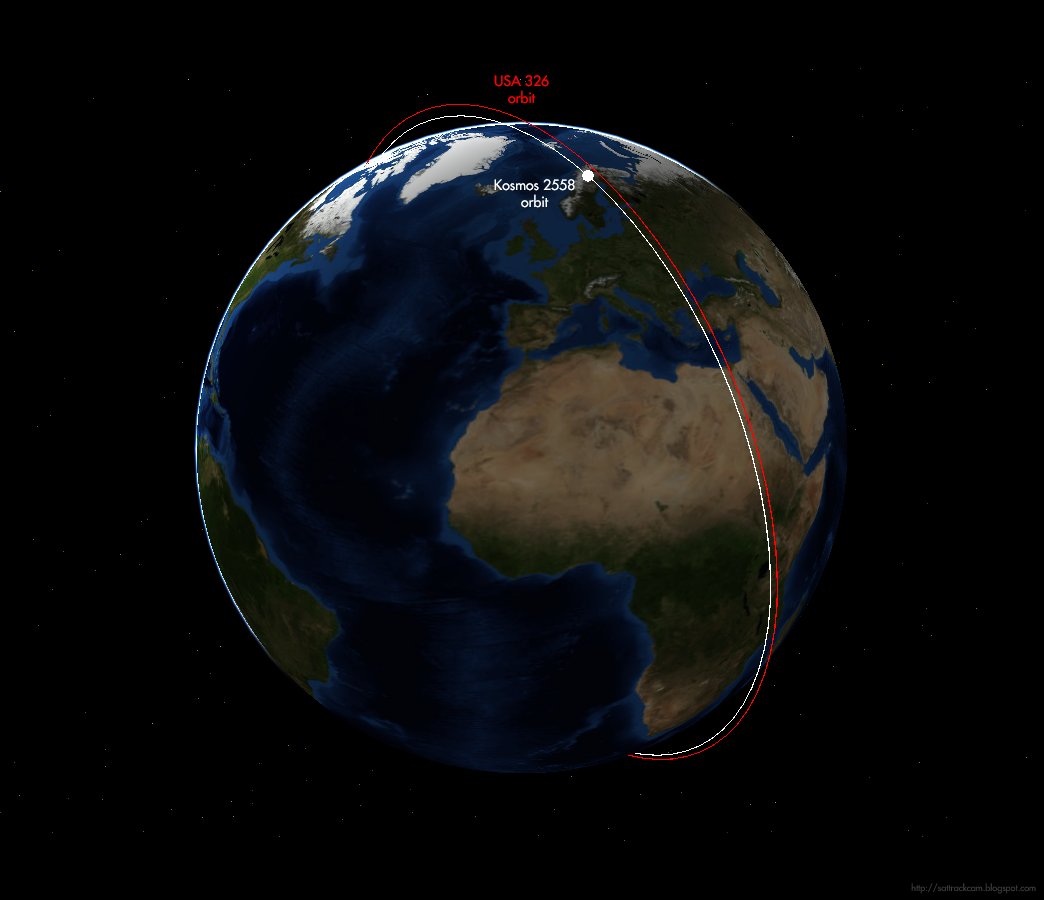
The orbit is still preliminary but compared to USA 326, RAAN differs by only 0.08 deg, inclination by 0.14 deg, apogee by ~92 km, perigee by ~205 km, Mean Motion by about 0.5 revolution/day.
If the suspicions hold, I expect it to manoeuvre to raise perigee and apogee
It turns out that the first object catalogued, 53324, is actually the rocket booster.
Payload now also catalogued as object 53323 in a 97.25 degree inclined, 435 x 452 km orbit even closer to the USA 326 orbit (differences: RAAN 0.04 deg, perigee 53 km, apogee 65 km)
• • •
Missing some Tweet in this thread? You can try to
force a refresh

So, I did some simulations with GMAT.
Assumptions:
- For totally arbitrary drag area of 1 m^2;
- Near-orbital speed at disintegration;
- disintegration at 148 km;
labels are mass in kg of fragment.
@planet4589 @DJSnM @Ian_Benecken
2/x additional info: no mass loss due to ablation upon reentry (this is important: if they do loose mass 9and they will), they come down earlier than in the map)
3/x Nevertheless: they appear to be surviving a lot further downrange than I actually had anticipated.
1/x The very successful @AETUDelft-built 3U cubesat Delfi-C3, launched 15 yrs ago, is near the end of its life. It will probably reenter into the atmosphere next month.
Yesterday evening, I managed to image it with my tracking camera from Leiden, the Netherlands:
2/x Here is the video footage (it is very faint, being a 3U cubesat, i.e. 10 x 10 x 30 cm large). Footage was shot at 25 fps with a WATEC 902H2 Supreme and Samyang 2.0/135 mm lens.
3/x Over the past months, the cubesat has been coming down increasingly fast. Currently it is in a 351 x 365 km orbit (when launched in 2008, it was at 615 x 635 km)
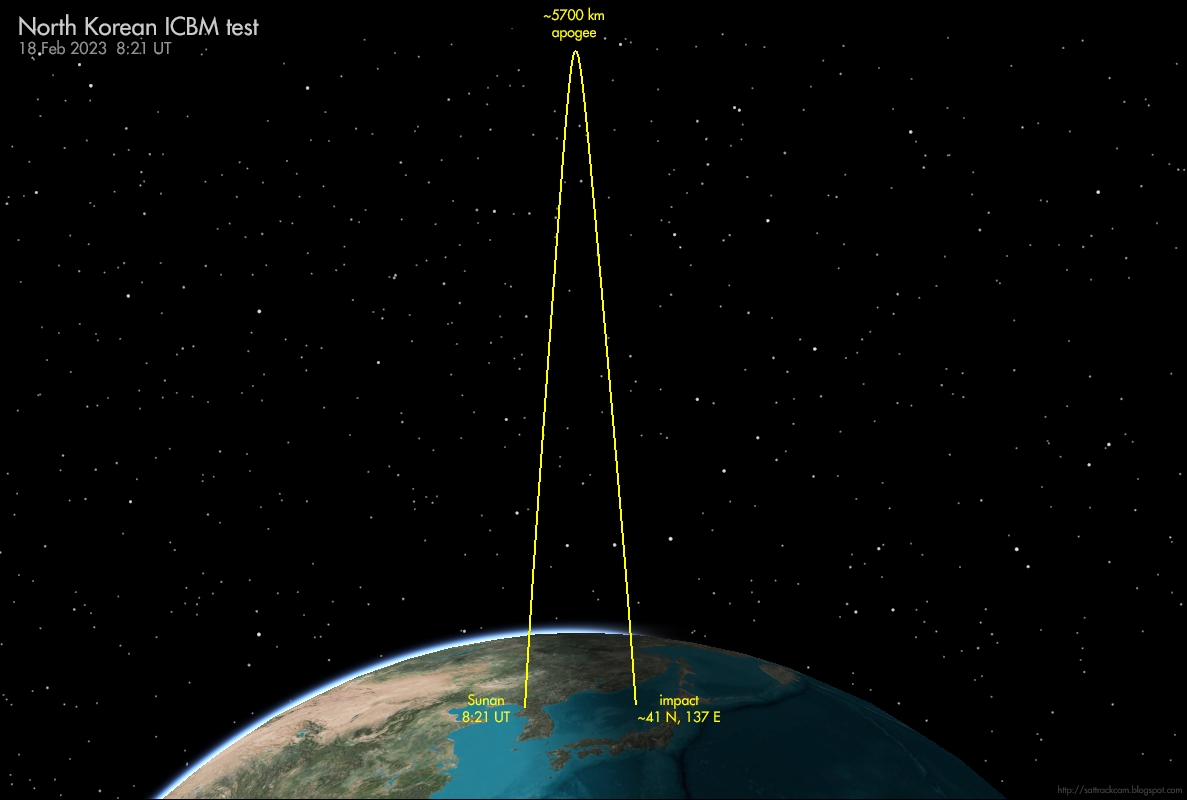
Approximate trajectory flown by the #ICBM that #NorthKorea tested today. A highly lofted trajectory.
(reconstruction based on Japanese DoD info).
When launched on a 'normal', non-lofted trajectory, the range would be 18000+ km, i.e. capable of reaching any place on Earth
Trajectory is based on rough information on apogee, range, and map with approximate impact point provided by Japanese DoD here: mod.go.jp/j/press/news/2…
It will be interesting to see what missile it concerns when Northg Korea publishes their propaganda photo's. Hwasong-17? Something new?
2/x To be clear (as such suggestions always arrise):
This has *nothing* to do with the Ukraine crisis. Tests like these are scheduled months in advance.
They are regular tests to ascertain the readiness and training of missile crews.
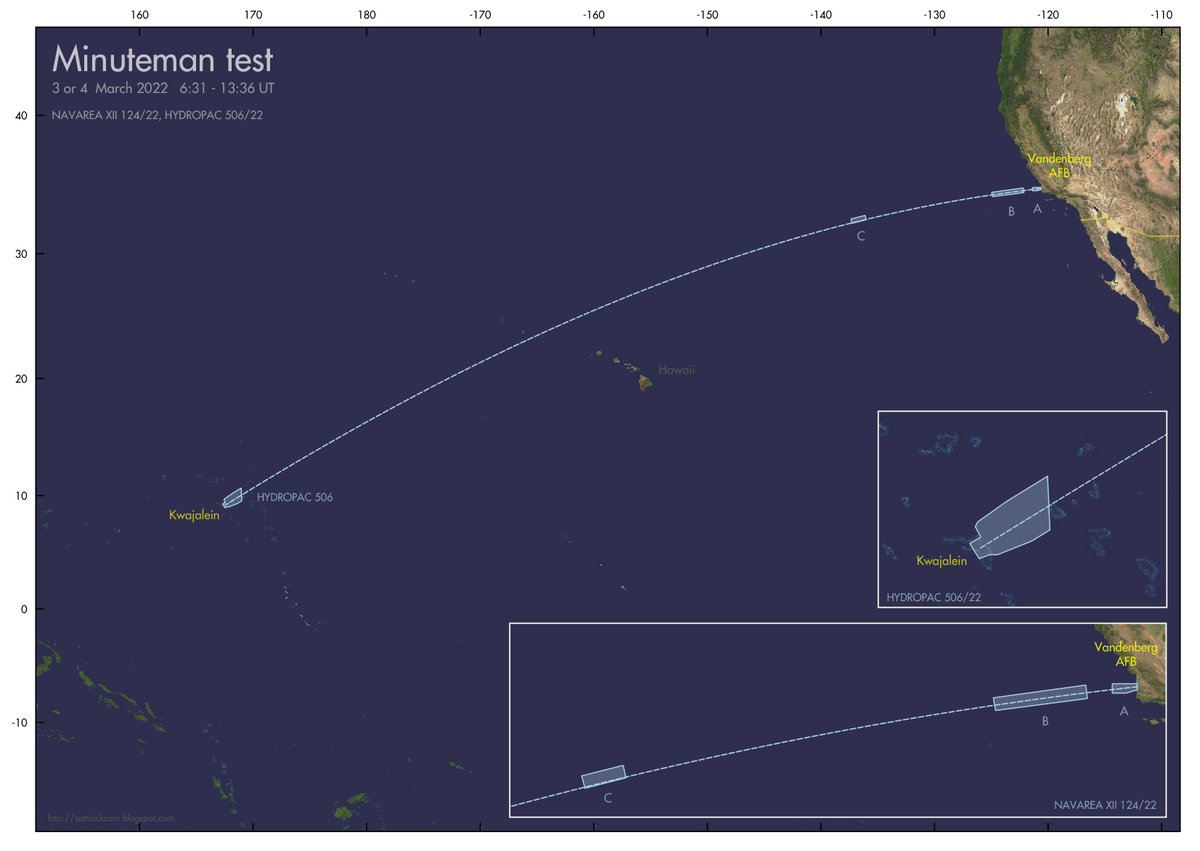
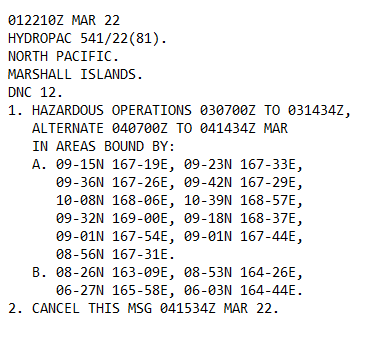
3/x As I expected, another Navigational Warning has appeared, adding an extra hazard area west of Kwajalein.
Updated map for this upcoming #Minuteman III test (probably GT240GM):
2/x ...maar worden echt in een baan om de aarde gebracht, zoals een satelliet. Waarna op een gegeven moment met een deorbit burn door een retroraket, de lading weer omlaag wordt gebracht, boven het doelwit.
Welnu: waarom zou je dit zo doen in plaats van een normale ICBM lanceren?
3/x Het voordeel van FOBS is dat het je toestaat toe te slaan vanuit richtingen die met gewone ICBM's niet worden verwacht. Via een traject over de zuidpool bijvoorbeeld. Dan benader je de VS (het doelwit) vanuit het zuiden (gele lijn), terwijl
1/x It is with great pleasure that I can announce that the Working Group on Small Body Nomenclature of @IAU_org has decided that asteroid (563318) will henceforth be named:
(563318) ten Kate
After the Dutch @UniUtrecht astrobiologist/planetary scientist Dr @ingeloes ten Kate
2/x The naming citation for (563318) ten Kate was published yesterday in IAU-WGSBN Bulletin vol 1. nr 10, p 7: wgsbn-iau.org/files/Bulletin…
3/x Dr Inge Loes ten Kate is a well know researcher into the processes that brought carbon to Mars, through Carbonaceous meteorites and their degradation in the Martian environment, with a focus on the potential creation of Martian environments suitable for (simple) life.