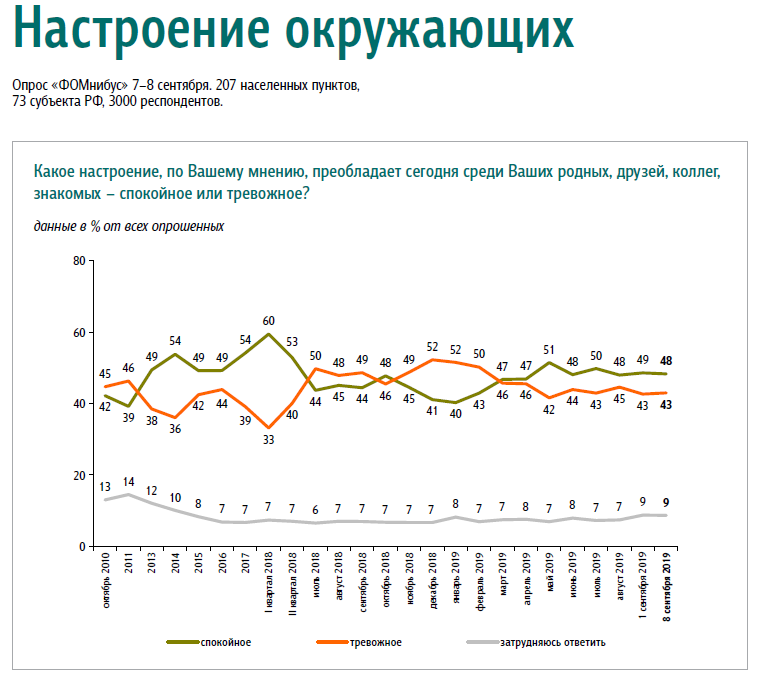
Wow. Newest data by Russian pollster FOM on sentiment of Russians:
How do your relatives, friends, colleagues, acquaintances feel? Green = calm, orange = anxious.
Quite the impact of Putin's "partial" mobilization on the public mood in Russia.
.@jakluge presumed this shift in public opinion might not be unprecedented. Shifts surely happened before, but the pension reform shock was not as pronounced. In other words: mobilization is likely one of Putin's most worst decisions of the past decade in terms of public mood.
*worst*
• • •
Missing some Tweet in this thread? You can try to
force a refresh

The early resignation of Constitutional Court judge Konstantin Aranovskii is one of the most notable elite defections since Feb 24. It has to be seen as a protest against the annexation of further Ukrainian territories that the CC is going to "approve." bbc.com/russian/featur…
Constitutional Court judges never resign early, they serve until retirement due to age restrictions. Aranovskii was the youngest CC judge appointed by Medvedev in 2010. Aranovskii is systemic: he's a law school buddy of Medvedev, and he approved the annexation of Crimea in 2014.
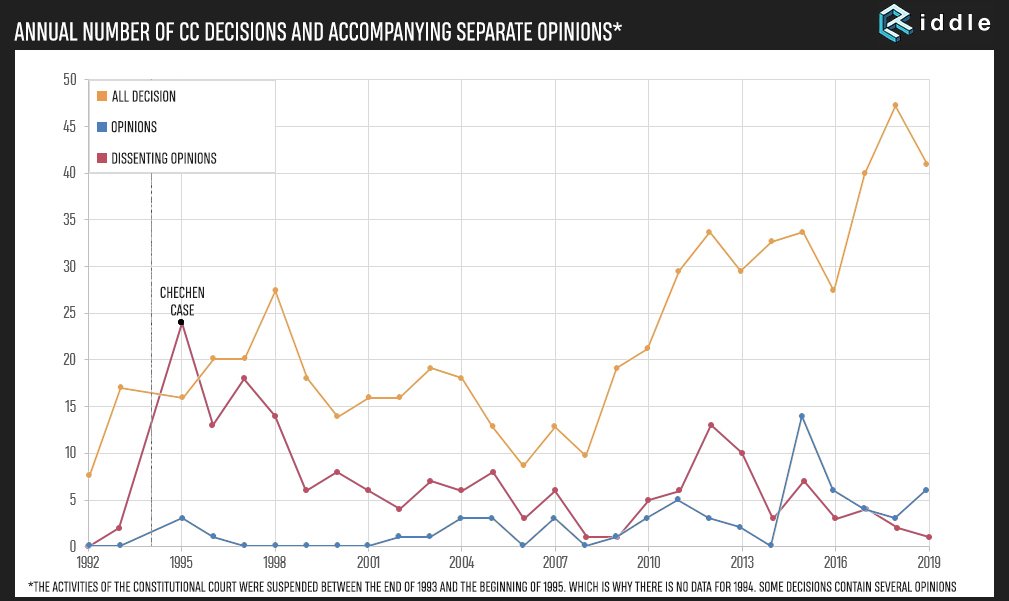
Aranovskii was known for dissenting opinions. I recommend @khalikovayu's @RiddleRussia piece for context: Dissenting opinions were frequent in the 1990s, but under Putin the case load of the Constitutional Court increased, dissent became less frequent. ridl.io/russia-s-censo…
This is an incredibly insightful piece on why Putin started this war against Ukraine written by Roman Anin. The most important insight: It is wrong to assume there are two Putins, a pro-Western Putin before the 2007 Munich speech & an anti-Western after. istories.media/opinions/2022/…
The core characteristic Putin shares with inner circle of "elderly Chekists" (the average age in Russia's Security Council is 65) is a "Versaille syndrome due to the collapse of the Soviet Union." The main conviction they share is not communism (capitalism enabled corruption).
Their core conviction is that the humiliation the West inflicted on Russia with the collapse of the Soviet Union needed to be revenged. And the thirst for revenge grew with rising oil prices. Putin just as these Chekists lives in a world of conspiracy theories and warped reality.
The Kremlin wants to increase control over #Russia's public sector by introducing deputies in ministries, federal executive bodies & state companies directly subordinate to the Presidential Administration's domestic politics department. This neo-Soviet... kommersant.ru/doc/5326305
practice mirrors Soviet party control over the executive. Kirienko has reputation as fan of modern corporate governance as former Rosatom chief (KPIs). But his "Leaders of Russia" competition already had the flavor of the Soviet nomenklatura. Kremlin-controlled deputies in the...
federal executive indicate the Kremlin is wary of lack of loyalty in excutive bodies subordinate to the Prime Minister. Russia has a dual executive with "siloviki" subordinate to the President and all other to the PM. The 2020 constitutional reform... ssoar.info/ssoar/handle/d…
Lots of speculations Russia might introduce martial law on Friday Mar 04 as the Federation Council - the upper chamber of parliament - convenes for an emergency session. Some arguments for the sake of discussion why the rationale for introducing martial law remains unclear 👇
Martial law is introduced by presidential decree. Putin has to inform State Duma & Federation Council immediately. The Federation Council must approve martial law within 48 hours to become effective. I.e. we should see the presidential decree before or on Friday. Historically...
this would be the first martial law in post-Soviet Russia. Even in 1990s, the "state of emergency" was declared only a few times due to territorial conflicts in North Ossetia & Ingushetia. The 2 wars in Chechnya were conducted without state of emergency. The martial law states...
Further evidence that Putin kept most of civilian bureaucracy in Government, Presidential Administration, state companies in the dark: The government made preparations for sanctions after recognition of DNR/LNR, but not for full-scale war against Ukraine. t.me/wwwagentsmedia…
As one interlocutor close to the Kremlin told the journalists: Many are shocked, but officials cannot step down, this would be seen as treason. Resigning from top position now would essentially mean to go straight into prison.
This obviously doesn't mean that they do not bear full responsibility, they do. Moreover, this could be a strategy of blame-shifting to military. Nonetheless, evidence is mounting that the circle of decision-makers was even narrower than with regard to annexation of Crimea 2014.
Deep dive into how #Russia's state bureaucracy sees Putin's decision to got to full-scale war with Ukraine by well-connected @faridaily_ :
tl;dr: Only few were in the loop, there's little public outrage now, but sizable despondence or even discontent. faridaily.substack.com/p/-?utm_source…
This largely squares with sources of @kgaaze and Pertsev as summarized in their podcast, i.e. most didn't have a clue or simply didn't want to believe in war beyond the Donbas. A short summary of their latest podcast by @scharap here:
Who knew about Putin's decision according to Rustamova: MoD Shoigu, General Staff Chief Gerasimov, leadership of counterintelligence (assuming she refers to FSB, Bortnikov). Even the Kremlin's chief of staff Vaino was kept in the dark, also due to a protracted Covid sickness.