I am going to do a very brief update for October 13th. You could call this an update for October 11,12,13, and whatever other days I missed because not much has happened. #ukrdailyupdate
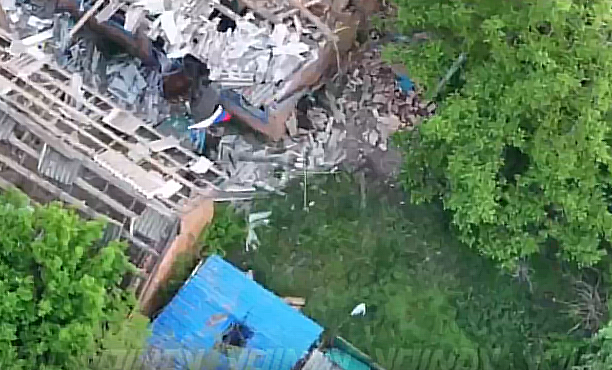
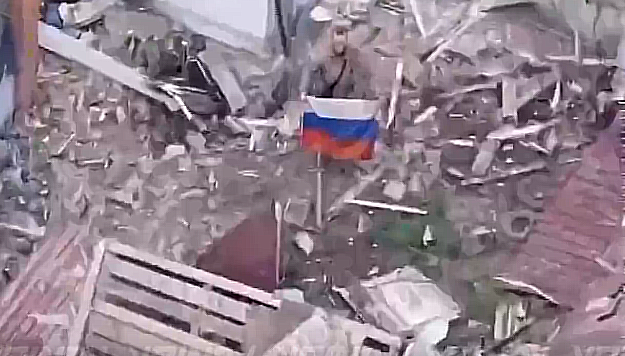
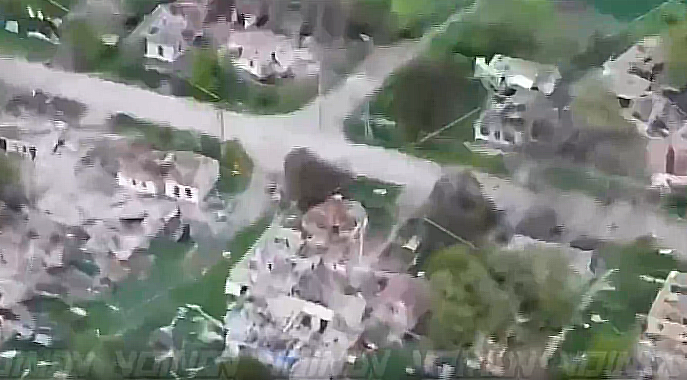
Near Kupyansk, Ukraine moved forward and appear to have liberated Pischane. I have no actual confirmation of this liberation, but Ukrainian troops are east of it and multiple Russian sources claims it is under Ukrainian control so whatever let's roll with it.
Russia has made a lot of blatantly false claims about retaking towns near Kreminna, but their claim today to have retaken Pischane (lol) and Chervonopopivka actually seem to be both reasonable and likely true. They claim to be attacking Terny, it's probably in the *direction of*.
Russians are moving around concrete blocks to build tan traps in Severodonetsk.
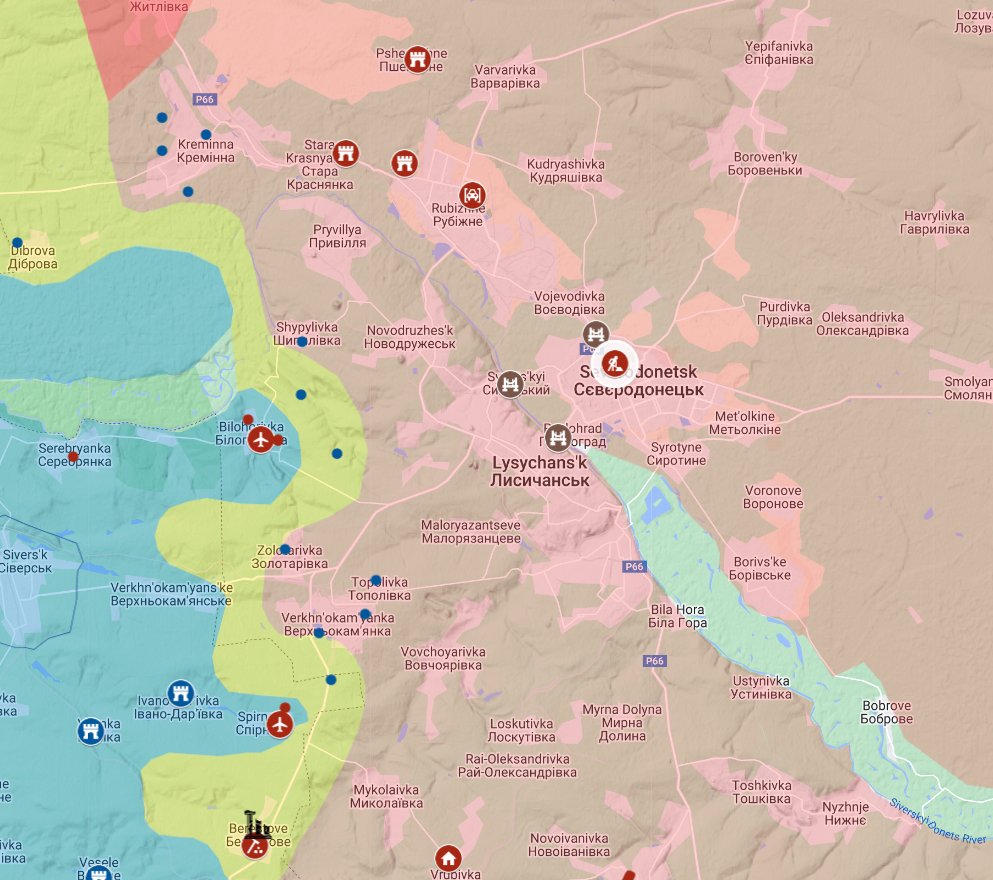
Russians are building a defensive line near Hirske. If you remember, Hirske was a town Russia could not break through and only fell when the entire rest of the line collapsed. So I guess Russia really, really does not want to have to fight for it a second time.
Some action in Kadiivka today. Ukrainian civilians spotted Russian artillery firing from this position to the northeast of the city. Ukraine destroyed hangars Russia used to repair broken vehicles on the missile marker.
In the Bakhmut area, Ukraine controls Ivanhrad and Opytne. I wrote about it here. People are saying Ukraine counter attacked in Opytne, this is not true. Russia never took or contested Opytne. Ukraine counter attacked Ivanhrad.
Otherwise you have your standard attacks in the Bakhmut area without notable change.
In the Donetsk area there is ongoing fighting in all the same areas as usual.
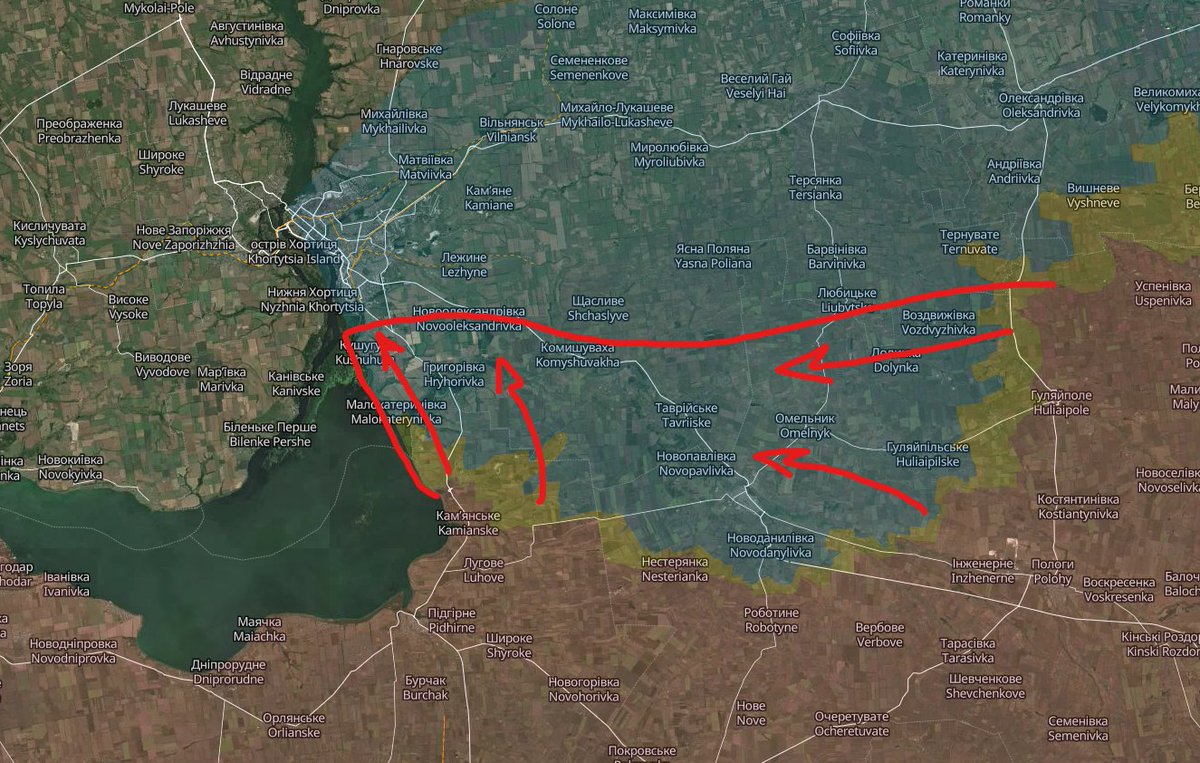
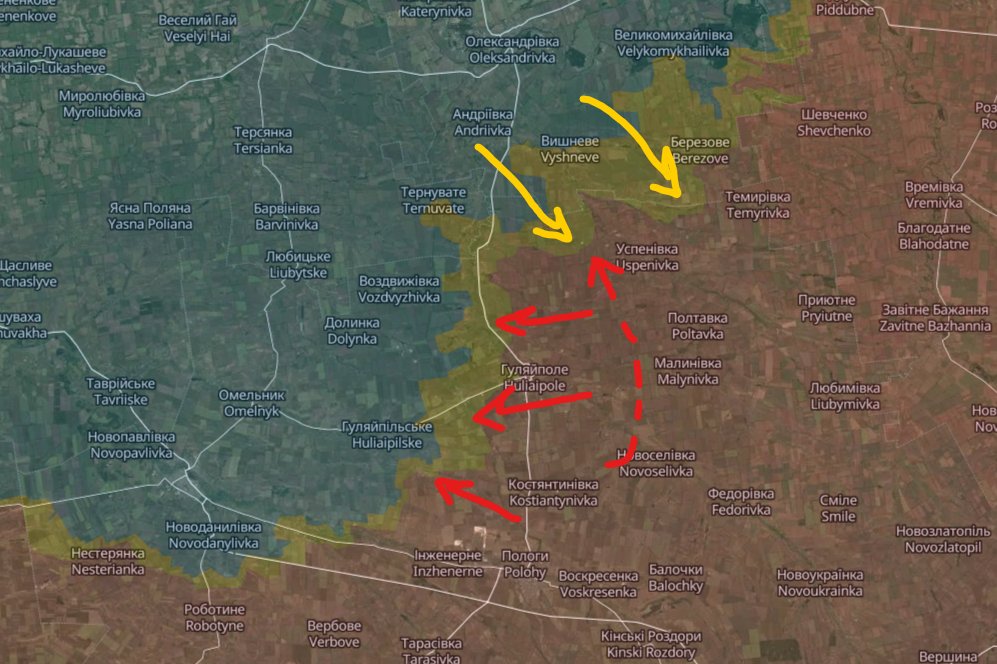
Ukraine is attacking south from both Orikhiv and Hulyaipole. Don't get excited and think this is some major offensive, it isn't.
Ukraine inflicted significant damage on Russian positions in Burchak, Tokmak, Kopani, Kinski Rozdory, and Berdyansk areas. (markers aren't exact). The Berdyansk hit reportedly destroyed four S-300 systems.
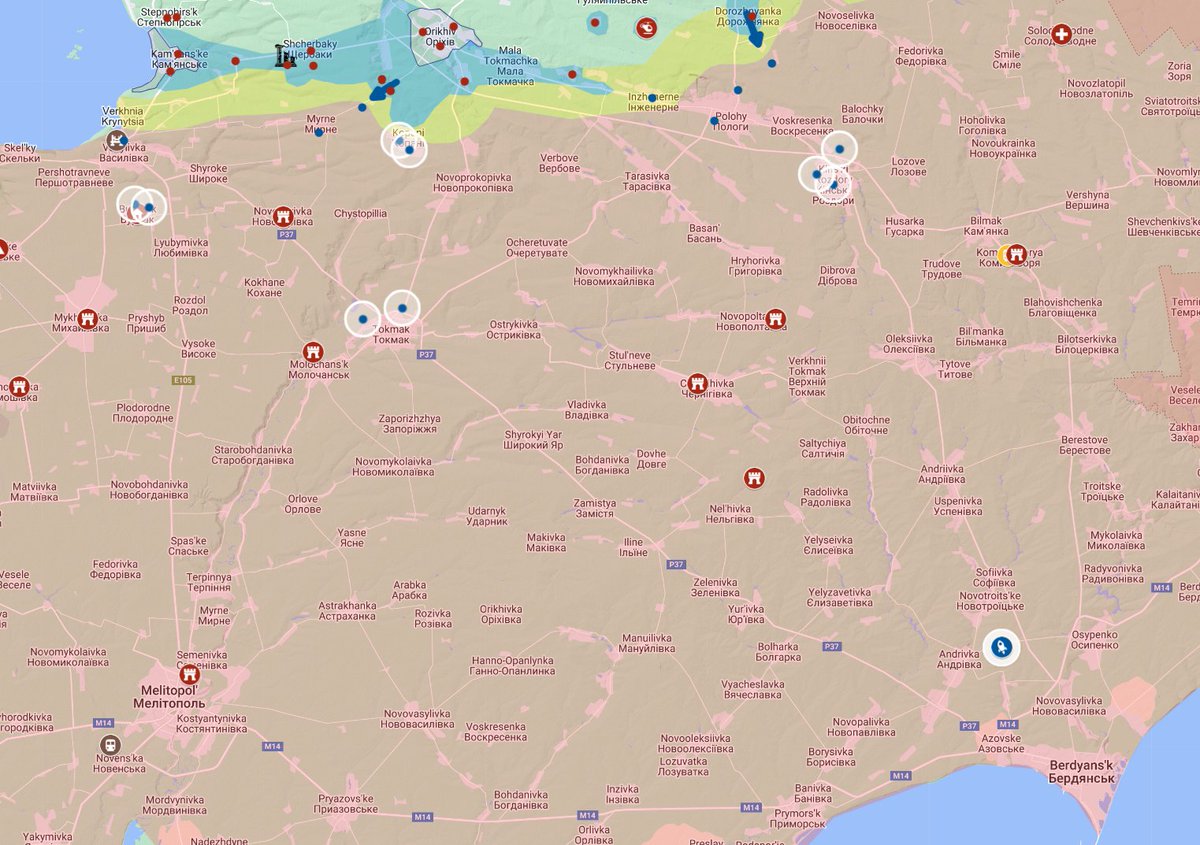
Ukraine had significant artillery strikes on the Antonovskyi Bridge, Nova Kakhovka, Kozatske, and Beryslav areas.
Russia had significant artillery strikes in the Pravdyne, Soldatske, Blahodatne, and more general M14 highway areas.
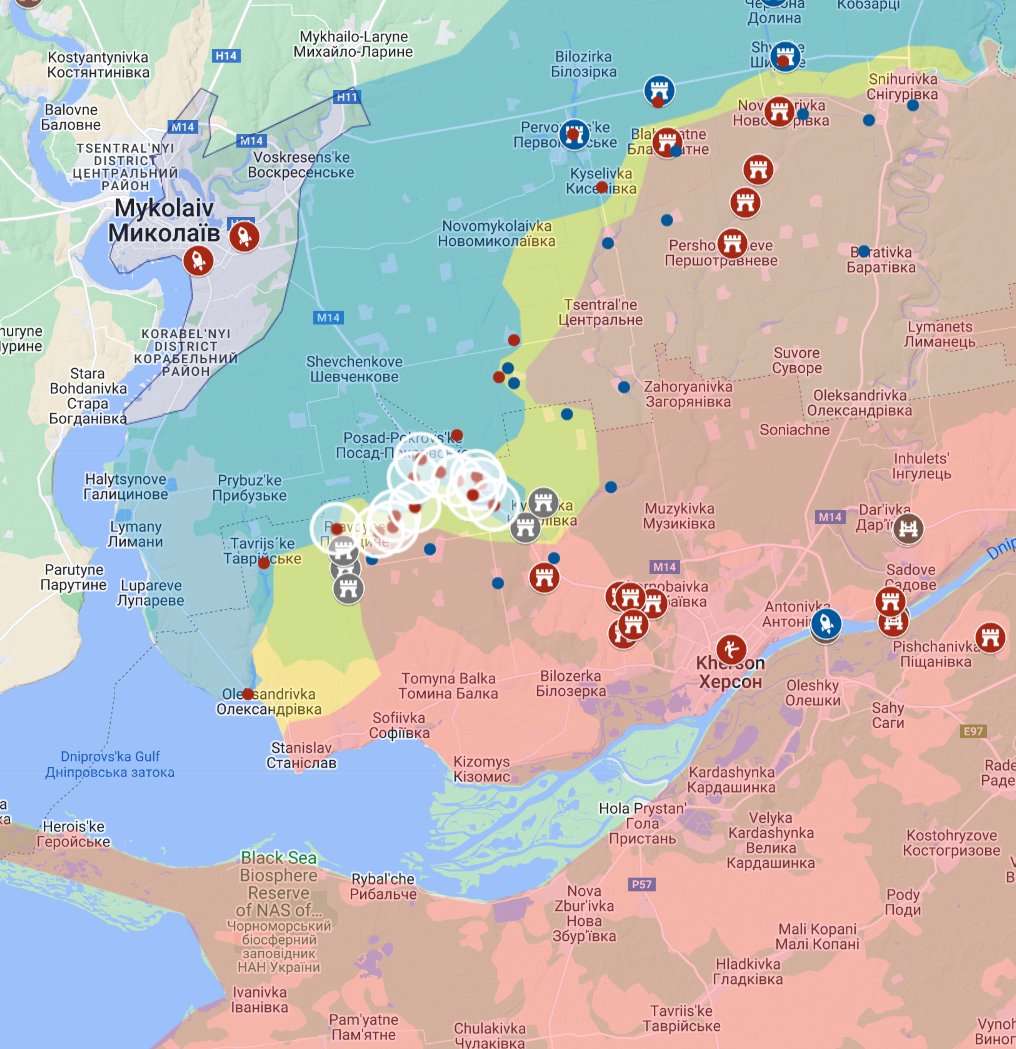
Ukraine attacked Ishchenka and Bruskynske, and Russia sent recon to Sukhyi Stavok.
• • •
Missing some Tweet in this thread? You can try to
force a refresh

Here is translated text from Al Ta about the situation in Ukraine. He is a Russian propagandist, a soviet anti-Putinist who views reviving the full Soviet Union (including Poland) as the primary number one goal of this war. He's also pretty honest about the situation. Its long. (racial slurs and whatnot are removed btw)
Preservation of one’s own forces and resources (including manpower).
On paper, everything looks neat and classical: we strike the enemy at its foundations and core, while we ourselves conserve strength and wait for the right moment for a decisive blow. But in reality, everything is both simpler and more complicated at the same time.
If you think through the basic principles of a classical war of attrition, then at the initial stage, when the enemy’s potential is being destroyed, when strikes are delivered against its economy, communications, and supply routes for raw materials and weapons, the side that holds the initiative should remain on the defensive, abandoning unimportant territories and максимально protecting its soldiers. This attrition is carried out through the remote destruction of the enemy’s potential.
Strictly speaking, the correct strategy in such a war should include:
1. Readiness for total and continuous mobilization.
We remember that this kind of war is one of mobilizing all the strength of the people. Total mobilization is necessary to achieve a manpower advantage, which should allow final military actions to be carried out quickly once the enemy’s ability to resist is completely broken. In addition, prolonged combat, even in a well-organized defense, still leads to losses, which are unavoidable. Therefore, there is a constant need to replenish the front with personnel.
2. Readiness for total destruction and the deaths of the enemy’s civilian population (and your own, if the enemy is not weaker than you).
It is extremely difficult, more likely impossible, to “delicately” destroy a country’s economic foundation. Therefore, a country that begins such a war must be prepared to act decisively and harshly. This is the price of survival.
3. Defense as the foundation of the first phase of such a war.
Preserving soldiers’ lives is the key to a future victorious offensive. It is physically impossible to conserve personnel while conducting offensive operations. Many are familiar with the standard ratios required for an attacking force to outnumber a defending one. Even taking into account more advanced and destructive weapons, the need for such a ratio remains, it will never be 1:1. In essence, the main function of troops (infantry supported by tanks, artillery, and aviation) in such a war is to occupy territories where the enemy can no longer resist. Frontal or stubborn assaults are not characteristic of a war of attrition.
4. Seizing territory in the initial and main stages of such a war is not the primary objective.
Territory should be taken either after the course of the war has been turned and the enemy’s ability to resist has been broken, or through the imposition of postwar conditions.
5. Emphasis on firepower.
The enemy should be subjected to an overwhelming barrage of destructive force using every possible means. Everything available should be directed at the target. Naturally, this places emphasis on highly destructive weapons: artillery and aviation. The nature of the current war has also added UAVs (unmanned systems). We already see strike systems in the air and at sea, and soon ground systems will be added.
The goal is to inflict unacceptable losses on the enemy before you yourself suffer unacceptable losses. If you like, it resembles a boxing match: both sides exchange blows, but in the end the stronger one wins. At the same time, for every artillery shot fired at you, ten should be fired in return; for every drone launched, ten drones should respond. Only this way.
Yet, for example, by the results of March 2026, “so-called Ukraine” surpassed us in the number of drones launched at our territory.
Each of you can compare these principles with what is actually happening at the front. After all, “we haven’t even started yet,” if some leaders are to be believed.
I want to start by saying I don’t have access to official documents or meetings, so I’m piecing together their motivations based on what I observe and logical reasoning. Keep that in mind as you read on.
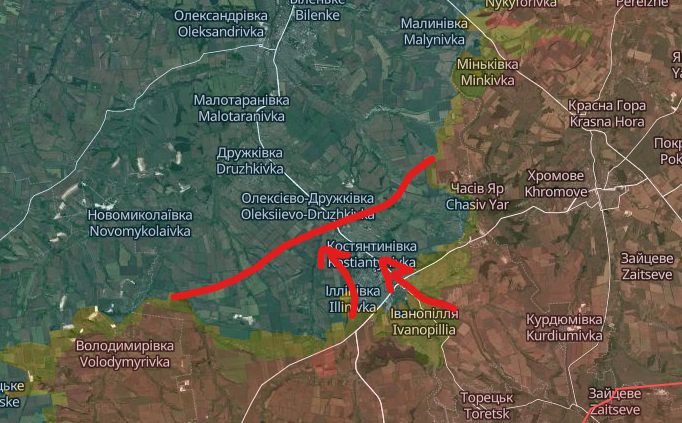
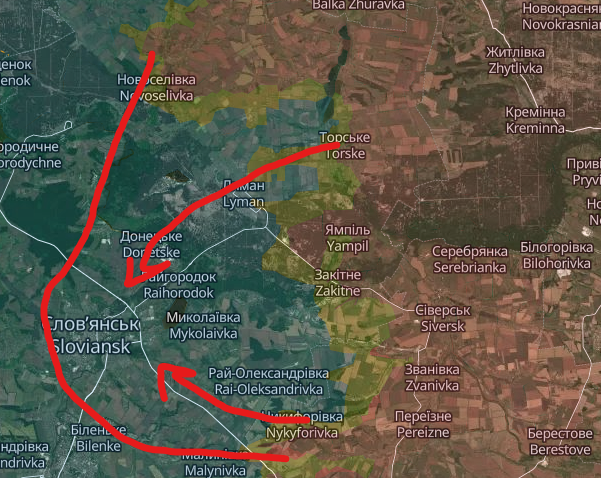
This year, Russia's goals are threefold. First, to capture the eastern bank of the Dnipro River. Second, to capture Kostyantynivka. Third, to capture Slovyansk.
Each of these goals has necessary steps. To capture the bank in Zaporizhzhia, you must first capture Orikhiv. To capture Slovyansk, you must first capture Lyman. You could argue that to capture Kostyantynivka, you must first capture Chasiv Yar.
These goals are very ambitious and, honestly, impossible to fully achieve. So let’s think of them as aspirations and focus instead on how close Russia might get to reaching them.
Ukraine launched several counterattacks in the Verbove and Ternove areas of Zaporizhzhia. They were quite successful, pushing Russia out of several settlements and possibly capturing some. This also threatened Russia’s main supply route to the west. Because of this, Russia has to do two things: divert resources from their main attack to stabilize the area and try to recapture this ground to keep pushing west toward Orikhiv. Meanwhile, Ukraine gains time to strengthen defenses, plan their strategy, and prepare for more counterattacks, something Russia worries about given their timeline.
This has already delayed Russia’s offensive by months, and it will take many more weeks for them to regain their previous position.
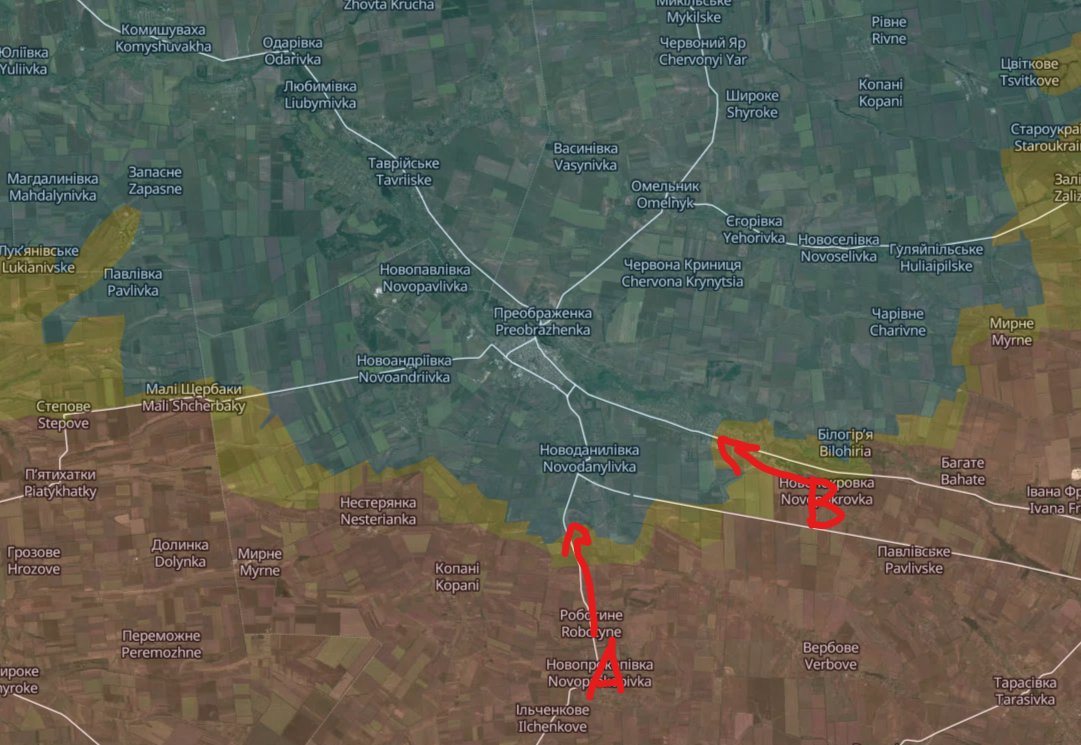
Recently, Russia tried an armored assault on Orikhiv, which failed badly (A). They also tried to advance through Mala Tokmachka (B) before, but that failed too. A direct attack on Orikhiv is unlikely to succeed without heavy losses, so Russia wants to avoid it unless they have no choice. Still, based on past experience, they might end up having to take the town this way.
The military analysis of Iran has been the absolute worst military analysis I have ever seen in my entire life.
There have been times where I listen to some "expert" where almost every word they say in the entire interview is factually wrong. Some of these people are so wrong that I feel like you could have a big box of words and reach in and draw them randomly and it be more factual.
To prove my point, I just asked a LLM to analyze the form of a normal military interview on cable news and using strictly randomly generated words and no access to the actual news please give me a report on what's going on in Ian (unironically, this is what LLMs are good at, probably, just lying about shit):::
From an operational standpoint, the expanding American strike corridor may complicate Iran’s layered coastal defenses, which could scatter missile batteries inland.
At the tactical level, the Iranian drone screen might disrupt a forward U.S. maneuver package, which could stall momentum along the maritime axis.
From the broader battlefield geometry, the concentrated American carrier posture may pressure Iran’s southern command network, which could trigger rapid repositioning of defensive units.
Right now on the ground, the reinforced Iranian coastal belt might absorb the initial U.S. probing attacks, which could slow the opening phase of the campaign.
The main thing that any educated person needs to keep in mind at all times is that realpolitik is fake and everyone who believes in it is typically universally wrong on every single word they ever say.
It is especially funny because realpolitik people are almost never experts in any domain, and they get their info from aggregators. And those aggregators know the realpolitik people use them, and as such present info in a way most likely to influence the realpolitik.
They end up just being unwitting amplifiers of misinformation.
Frankly I think the fastest way to end the war in Ukraine is not by sending tanks or by idiotic peace proposals. The fastest way is to set up factories across europe to produce 1000-2000 long range strike drones per day, and launch hundreds if not thousands of drones into Russia every single day until the country collapses. If they think sending 500 drones into Ukraine is a threat, see how they respond when 3000 drones fly into Russia.
With this many drones you can hammer every single factory, powerplant, substation, oil refinery, and mine in russia relentlessly.
Europe had a million drone program, to supply 1 million fpv drones. Fuck fpv drones. Have a 1 million drone program to supply 1 million strike drones. That's your million drones.
The "stupid westerners, sanctions do not work, we smuggle goods in illegally. muahaha, Russia unstoppable" people tickle me. Sanctions are not for stopping goods entirely, they are for increasing friction because the resources you spend smuggling are resources not spent growing
People fundamentally don't understand the purpose of a sanction. Sanctions are not to stop the war now, although they do damage Russia, the real goal of a sanction is long term economic damage to permanently shrink their economic growth on the timescale of decades.
The sanction is basically saying "okay, you're a threat to me today, and maybe I can't do much about it now, but I will shrink you and outgrow you so in 50-100 years you are no longer a threat to me at all". It is a long term play.