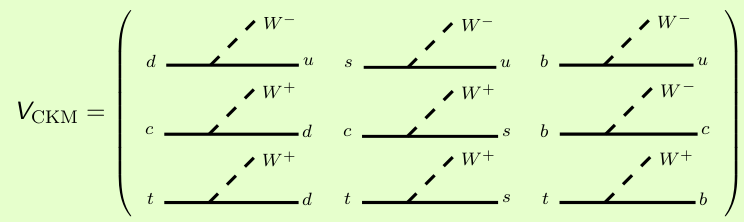
It's been a while since I last wrote about lepton universality. The Standard Model assumes that all charged leptons - electrons, muons, taus - couple identically to all other particles except to the Higgs (that likes mass). Today we revisit that. A #Thread.
[1/21 - so far]
[1/21 - so far]

There are some indications it may not be the case. In processes involving decays of b quarks to one or two muons we see discrepancies with the expectations. (Plots at nikhef.nl/~pkoppenb/anom…).

Today we are looking at B̅ mesons (with a b quark) that proceed to a D meson (with a c quark), an invisible antineutrino ν̅ and a lepton. That can be an electron, a muon or a tau. Electrons are not practical for that purpose so let's concentrate on μ⁻ and τ⁻.

In the Standard Model this process is mediated by a W boson, the mediator of the weak interaction. It's like a radioactive decay, but with b quarks.
In the Standard Model, the W likes all three leptons equally (that's not the case for quarks).
In the Standard Model, the W likes all three leptons equally (that's not the case for quarks).

So B̅→Dν̅μ⁻ and B̅→Dν̅τ⁻ should be equally likely. Not quite. The three leptons have different masses, and there is thus less energy available to produce the heavy τ⁻ than the lighter μ⁻ or electron. Hence there are more B̅→Dν̅μ⁻ than B̅→Dν̅τ⁻, by about a factor 3.
One defines a ratio, called R(D), of the rate of B̅→Dν̅τ⁻ divided by that of B̅→Dν̅μ⁻. Here is a compilation of the three experimental measurements and all Standard Model predictions. The experimental measurements are slightly above the expectation.
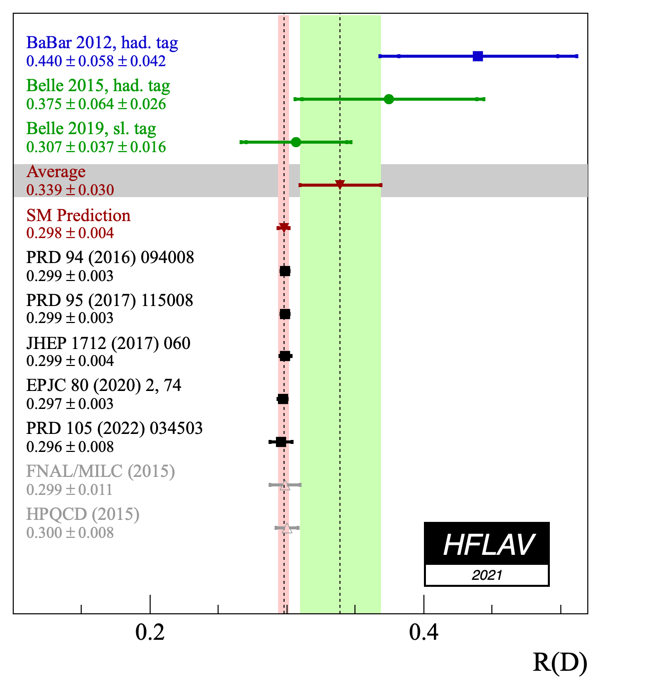
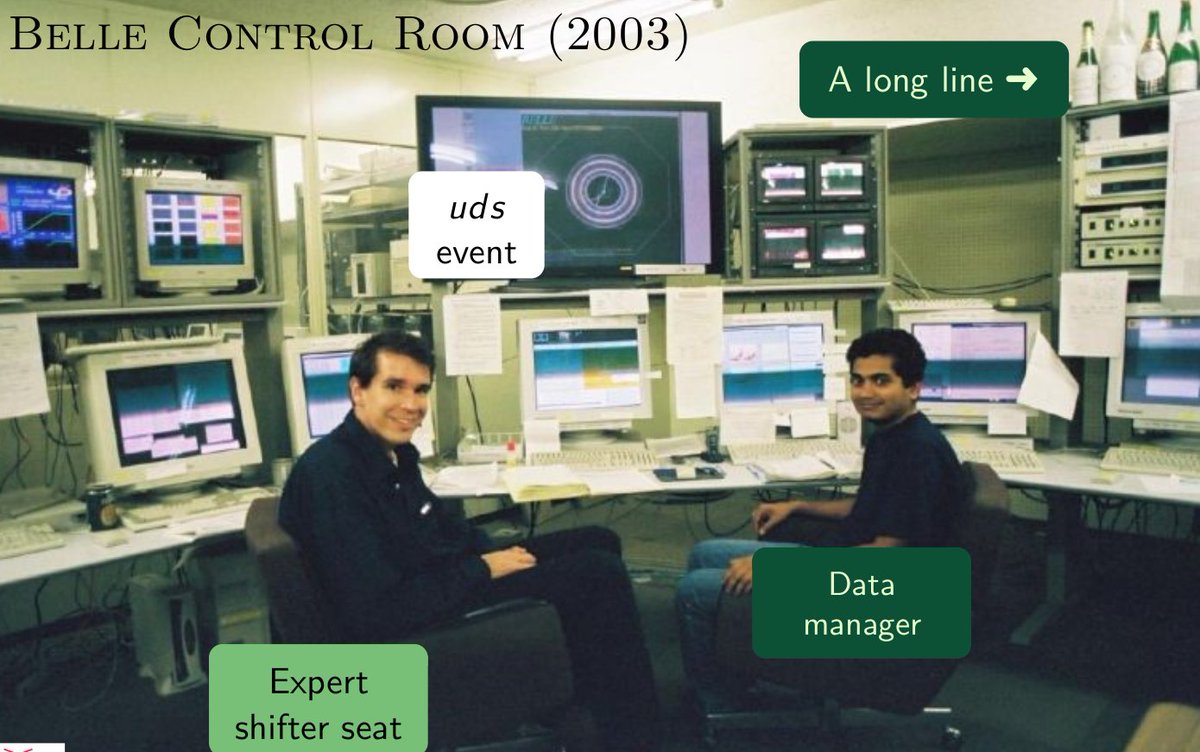
You'll notice that all experimental measurements are from BaBar and Belle, two similar experiments that ran at an electron-positron collider. I was at Belle 20 years ago.
LHCb haven't yet joined the party. We'll fix that today.
LHCb haven't yet joined the party. We'll fix that today.
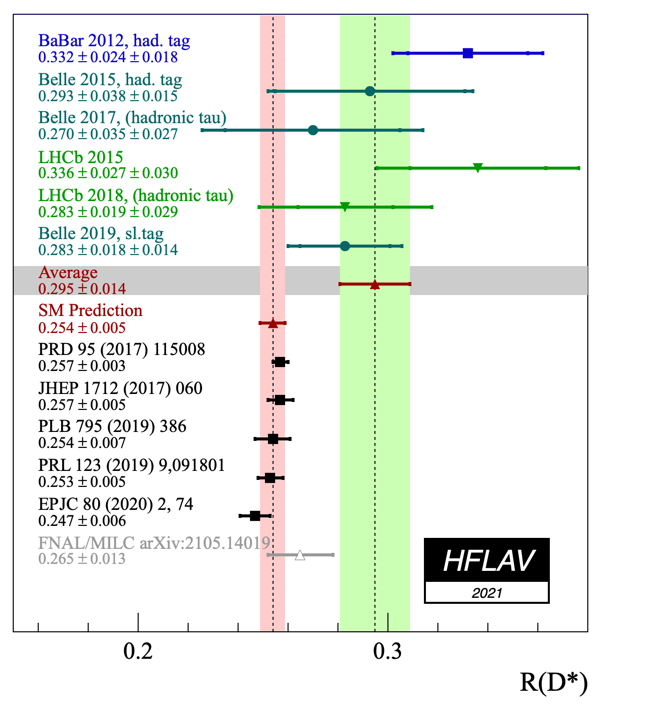
Back to R(D). One can also exploit the excited D*, which has spin 1. It lives for a very short time and proceeds to a D meson and a pion or a photon. In this case the experimental data are more clearly above the expectation.
Let's suppose it's a real effect and not a fluke. What could cause such an effect? Initially these measurements were done to search for charged Higgs bosons. The Higgs couples to mass, and if a charged version exists it would favour tau leptons over muons.

Presently the most popular explanation would be leptoquarks, particles that would connect leptons to quarks directly.
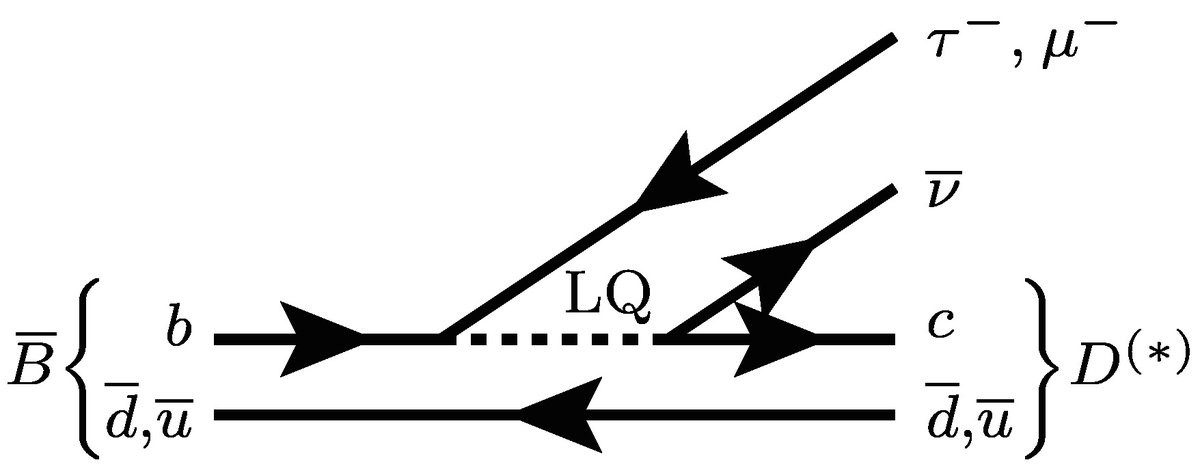
The R(D) and R(D*) ratios are the best way of probing leptoquarks that would be too heavy to be produced directly in LHC collisions. That's why @Gino06004284 calls it the mother of all anomalies.
https://twitter.com/Gino06004284/status/1580088170971996163?s=20&t=_CpPmsNHsWXDl6rjpj71gg
Let's go to experiment. How are R(D) and R(D*) measured?
Neutrinos are a major annoyance (👋 @Claire_Lee). As we don't see them, we don't see the process as a whole. We miss some energy. In the case of B̅→Dν̅μ⁻ we miss one neutrino.
For B̅→Dν̅τ⁻ we miss three, as we also require the τ⁻ to decay to a muon and two neutrinos.
For B̅→Dν̅τ⁻ we miss three, as we also require the τ⁻ to decay to a muon and two neutrinos.
We use that the B comes from the proton-proton collision to infer how much energy we lost and compare the distributions for B̅→Dν̅μ⁻ (blue) and B̅→Dν̅τ⁻ (red) of the missing mass, the energy of the muon and the mass of the muon-neutrino system (q²).
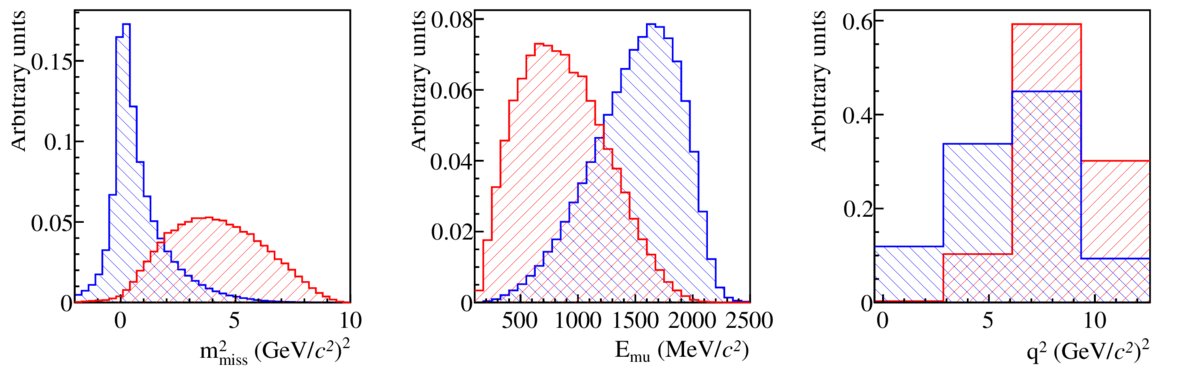
That is simulation. In data we also have lots of backgrounds from excited D mesons (D**) or decays of charmed particles to muons. Just looking at the bin of highest q² we have this.
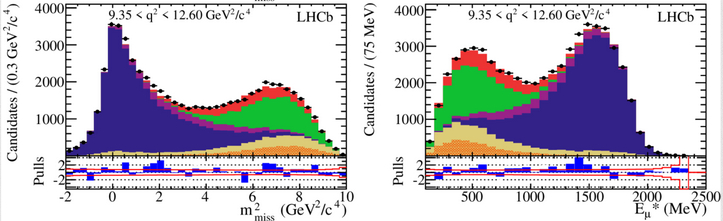
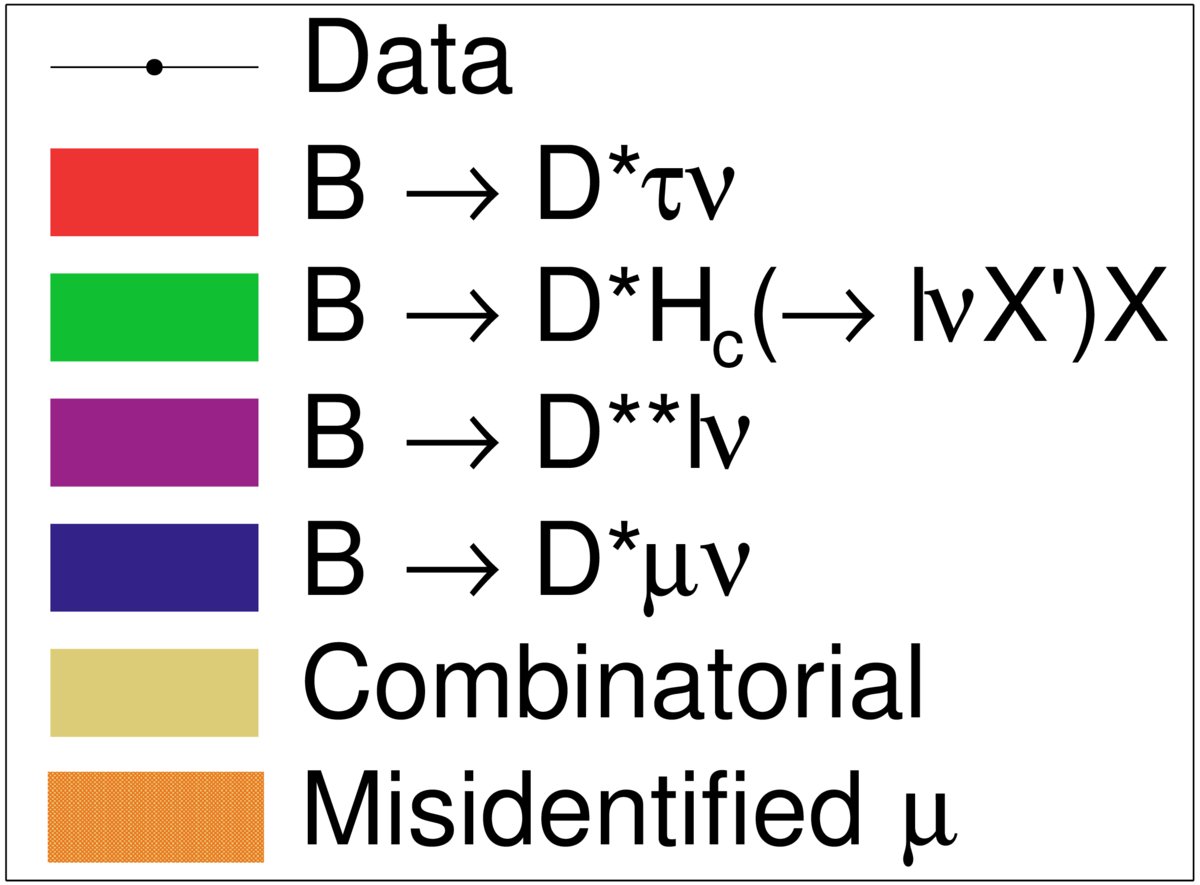
This plot comes from the 2015 paper where we only looked at R(D*). lhcbproject.web.cern.ch/lhcbproject/Pu… . Today we update this result by adding the measurement of R(D).
R(D) is much herder because of backgrounds. But the advantage of doing both is that (1) we often lose the pion or photon from the D* and thus see B̅→Dν̅τ⁻ when measuring B̅→D*ν̅τ⁻. Looking at the D mode thus tells us something about the D* mode.
And (2) B̅→Dν̅τ⁻ and B̅→D*ν̅τ⁻ are a backgrounds of each other. So if we measure one we get a better understanding of the other.
This pulls in a correlation between the measurements of R(D) and R(D*).
This pulls in a correlation between the measurements of R(D) and R(D*).
If we plot both measurements we get an ellipse. Here's the summary of all past measurements. The red ellipse is the world average and is three standard deviations away from the Standard Model expectation (black cross).
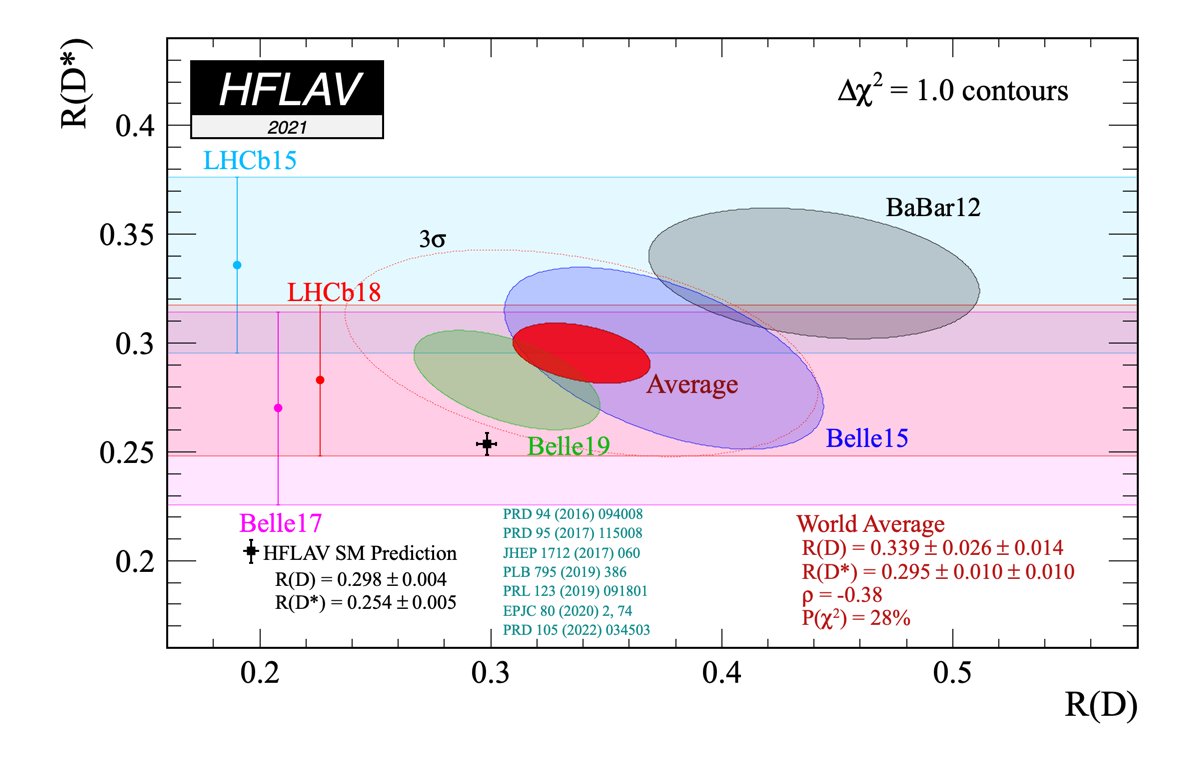
You'll notice that there is no ellipse for LHCb. So far LHCb measured only R(D*), shown in the blue band "LHCb15". There's also a pink band "LHCb18" for which we used the decay of τ⁻ to three pions and a neutrino. lhcbproject.web.cern.ch/lhcbproject/Pu…
At today's @CERN seminar, Greg Ciezarek will show the new result where the blue band is turned into an ellipse. Tune in at 11h CEST. There's a webcast. [TBC]
indico.cern.ch/event/1187939/
indico.cern.ch/event/1187939/
Here's the result
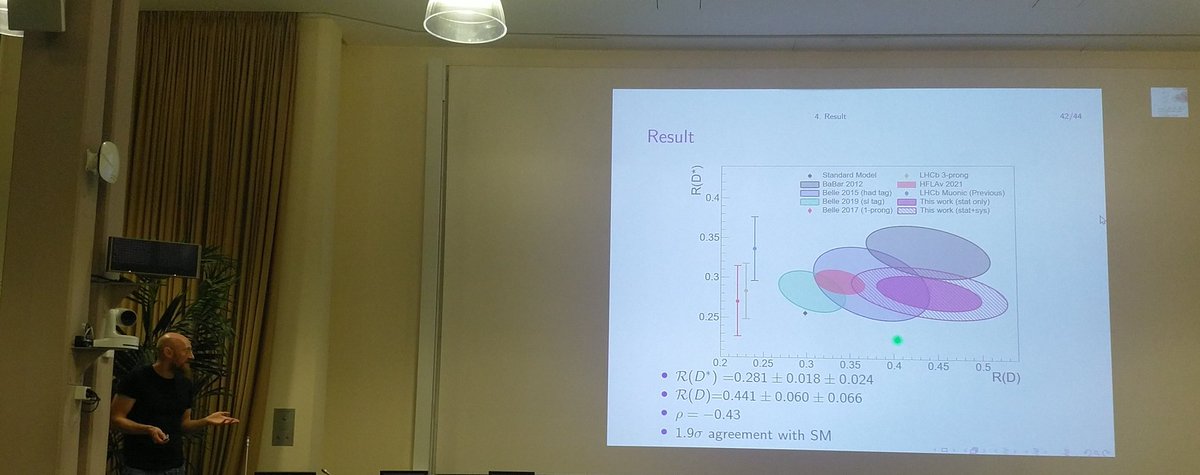
Here's how the world average changed today.
(Thanks to Marcello Rotondo for making a plot with same y axis as in 2021).
#CautiouslyExcited #FlavourAnomalies. [23/23]
(Thanks to Marcello Rotondo for making a plot with same y axis as in 2021).
#CautiouslyExcited #FlavourAnomalies. [23/23]
More on leptons, on how this plot is made (involving with glow-in-the-dark darts) by the master of physics threads
https://twitter.com/martinmbauer/status/1582872835546312704?t=t9XizOpPp-29OT23y6Ct3w&s=19
And something in Dutch/Flemish engineeringnet.be/nl/nieuws/item…
@threadreaderapp unroll
• • •
Missing some Tweet in this thread? You can try to
force a refresh