Trung Phan Profile picture
Nov 15, 2022 6 tweets 3 min read Read on X
Word count NYT's puff piece on SBF:

"Fraud": 0
"Enron": 0
"Crime": 0
"Illiquid": 0
"Stolen": 0
"Hidden": 0
"Criminal": 0
"Back door": 0
"He's getting sleep": 1
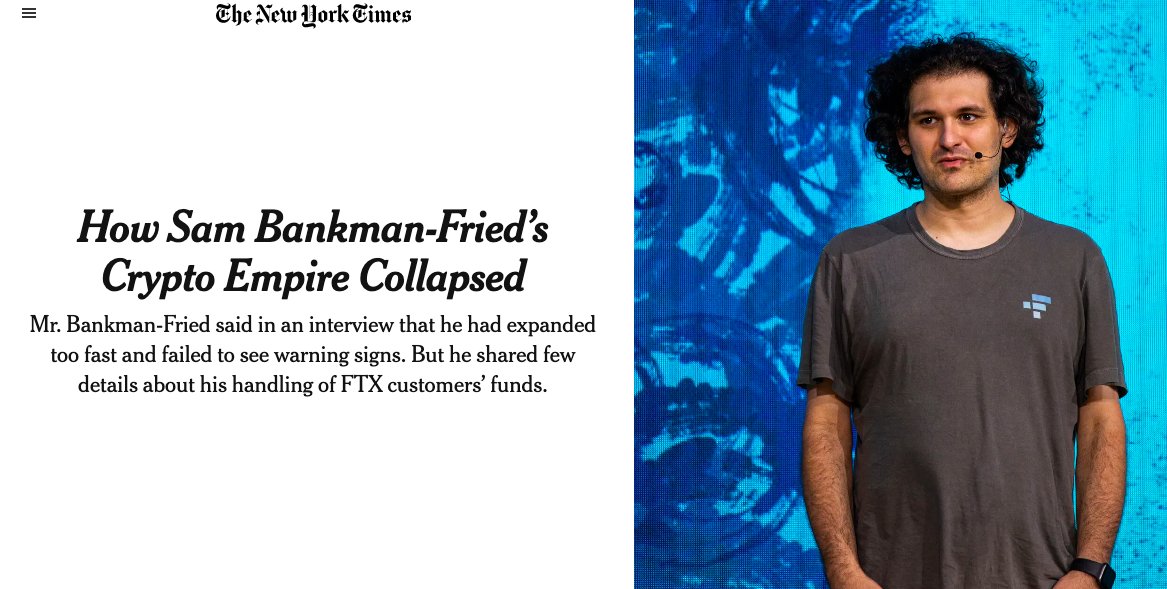
Then the NYT puff piece ends with a note on the cryptic thread, which SBF says "I'm making it up as I go."

It may actually be a ruse -- he adds one tweet after deleting an old incriminating tweet -- so as to fool tweet bot counters:
Conversely, I started with my FTX wrap with the words “criminal financial engineering f**kery” in the 2nd paragraph.

🔗 trungphan.substack.com/p/ftx-the-32b-…
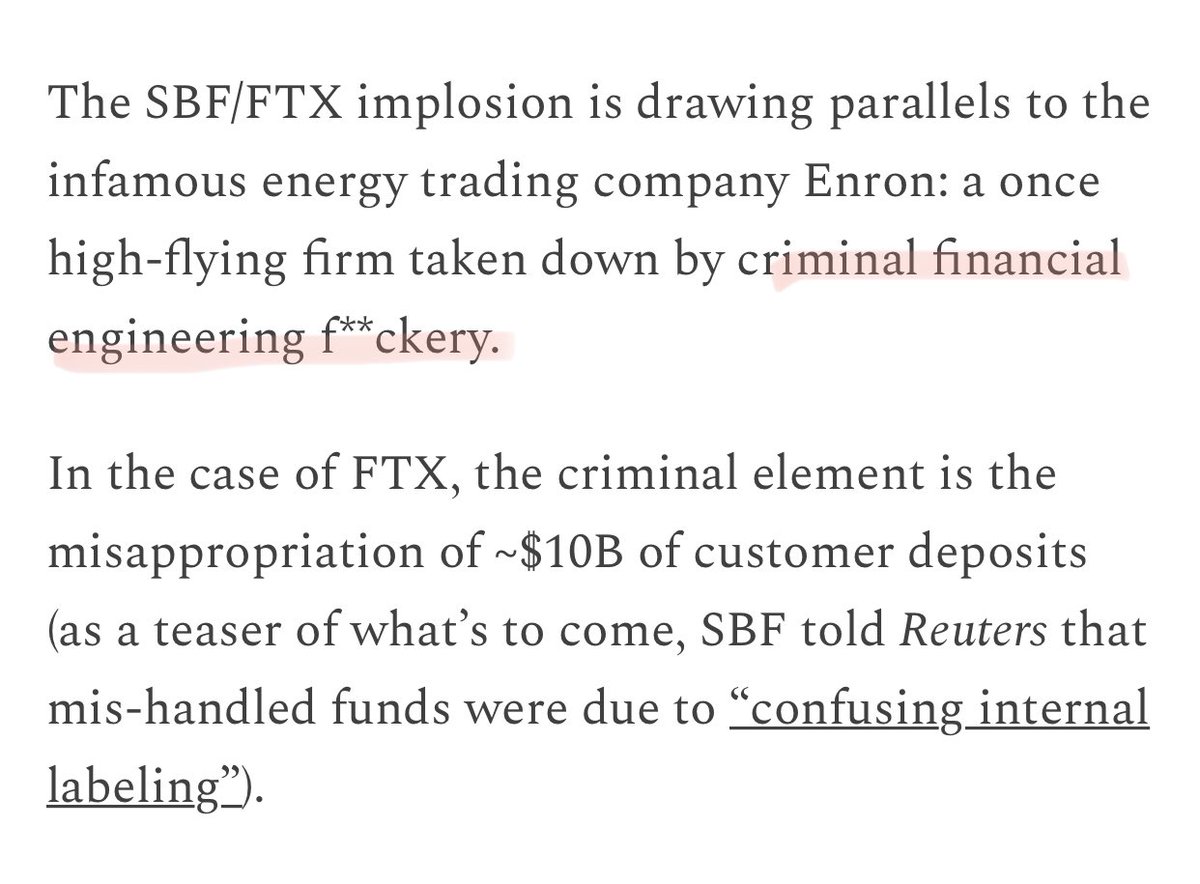
And yes, other financial media outlets have used those words
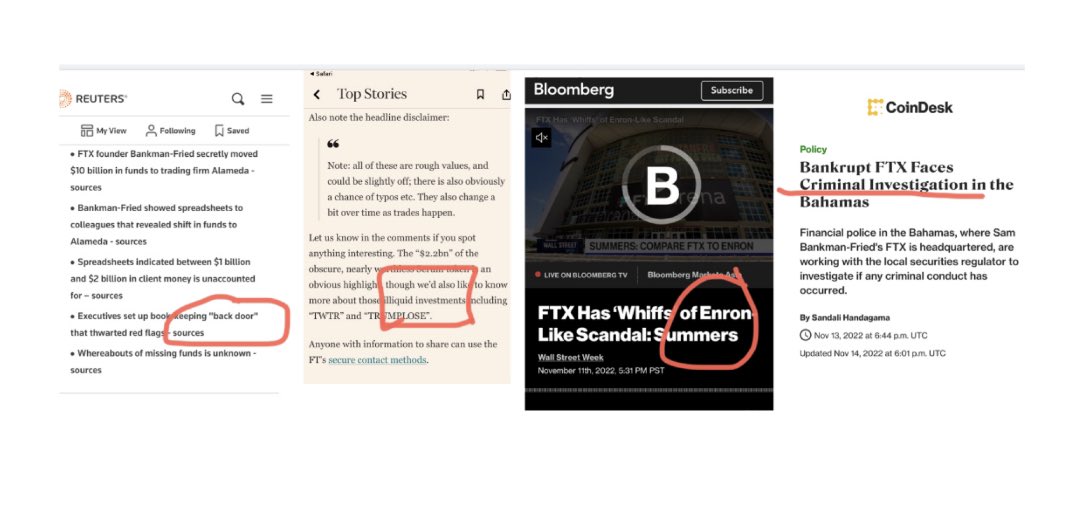
Recent articles from WSJ (uses word “criminal”) and CNBC (“illegal”)
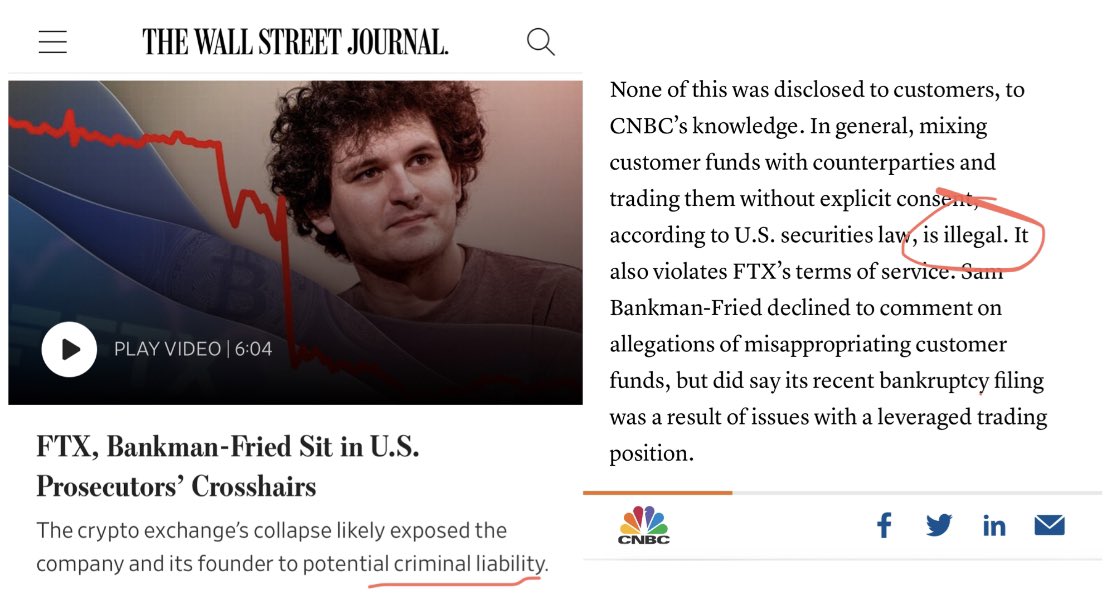
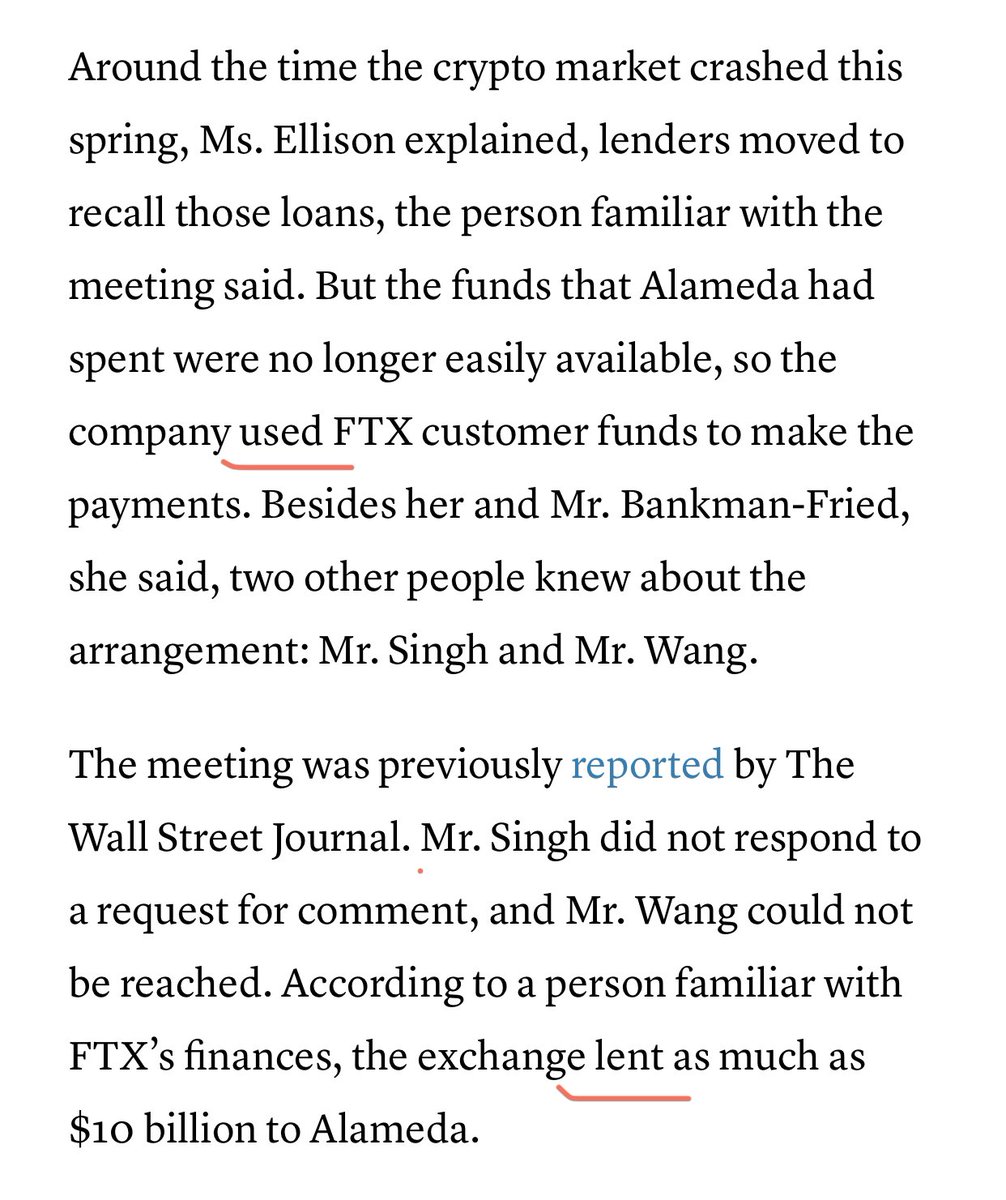
In NYT article, Alameda CEO admits to misappropriating FTX customer deposits.

Per FTX Terms of Service, the deposits are not FTX’s to use…and FTX can’t loan it.

NYT writes it up FTX “used” and “lent” deposits. Think the appropriate words are: “wire fraud”, “stole”, “theft”.
• • •

Missing some Tweet in this thread? You can try to force a refresh

 

Keep Current with Trung Phan

Trung Phan Profile picture

Stay in touch and get notified when new unrolls are available from this author!

Read all threads

This Thread may be Removed Anytime!

PDF

Twitter may remove this content at anytime! Save it as PDF for later use!

Try unrolling a thread yourself!

how to unroll video
  1. Follow @ThreadReaderApp to mention us!

  2. From a Twitter thread mention us with a keyword "unroll"
@threadreaderapp unroll

Practice here first or read more on our help page!

More from @TrungTPhan

Jan 16
Matt Damon and Ben Affleck on Rogan taking about how Netflix has changed filmmaking.

A major considerations is dealing with distracted viewers. To keep them tuned in, “you re-iterate the plot 3-4x in the dialogue because people are on their phones.”

Then, in action films, you change the ordering of climatic fights.

In traditional action films, you’d have “three set pieces” in every act (I, II, III) and each would “ramp up” (spend the big money on third set piece).

But streaming has to hook viewers within 5 minute, so the incentive is to put a major battle or action sequence much earlier.

Also, the directors have less incentive to make a film look great because so many people watch on laptops and phones.

They do say that streaming allows for more bets on risky projects since the theatre economics are geared towards IP, sequels and super-heroes.

Example: an independent film with a $25m budget would spend $25m on marketing (1:1 ratio). But since it splits box office with the theatre, the film needs to make $100m (1/2 of which is $50m) just to break even.

They’re realistic about the state of film and call it a supply-demand issue. If the demand is for at-home viewing (eg. Netflix 300m+ subs), then filmmaking approach will change to feed the algo.

When there’s demand for theatre, Damon will go team up with Christopher Nolan to make “The Odyssey”.
A similar dynamic is happening to streaming TV shows. The incentives for story arc, dialogue and character types warped thr medium.

I explain it more here: readtrung.com/p/the-case-aga…
Damon cooks.

Here is full Rogan: youtu.be/AVEZBy1uAk8?si…

Here is Hot Ones: youtu.be/yaXma6K9mzo?si… x.com/trungtphan/sta…
Read 4 tweets
Jan 15
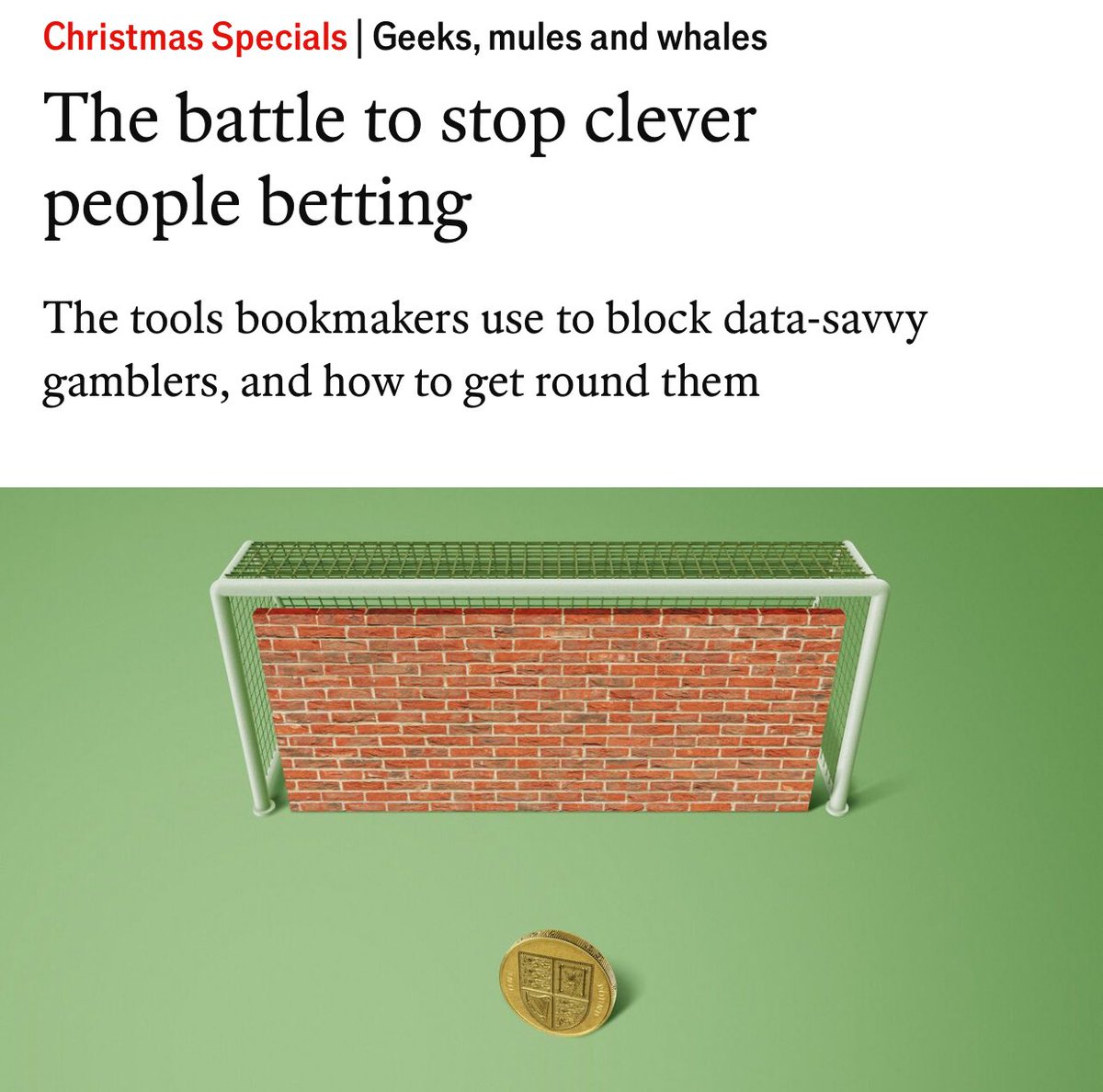
The Economist has a great piece on strategy sportsbetting apps use to throttle smart bettors:

▫️Skilled players are “sharps” and given “stake restrictions” if they play too well (bets are capped).

▫️Rest of players called “Square”.

▫️In 2025, 4.3% of active UK accounts had a “stake factor” below the maximum bet allowance of 100%.

▫️Sportsbook will take bets with a profit margin as low as 4.5%.

▫️If they are able to do good “player-profiling” and keep the “sharps” from playing, the profit margin can reach 10-20%.

▫️As important as keeping out “sharps” is hooking “whales”, the deep-pocketed players that are willing to keep playing (and losing) large sums.

▫️Some “whales” are actually “sharps” in disguise, though. They’ll lose a bunch of bets to lull the sportsbook then put down a massive bet when they have an edge.

▫️While there is a risk of a “whale” being a “sharp”, the value of a real “whale” is so high that sportsbook will take the risk

▫️“In March 2024 PointsBet, raised its share of online sports-gambling revenue in New Jersey from 11% to 24% after wooing a single cash-spouting customer away from DraftKings.” (I can confirm that this wasn’t me).

▫️How sportsbook profile players:

> Playing on Mobile is a good sign (where majority of people play)
> Playing on PCs is a bad sign (it’s easier to compare odds and run models)
> E-wallets are a red flag (sportsbooks prefer debit direct deposit that can attach a player to a single account; e-wallet is more anonymized and players can move cash between sportsbook more quickly to shop for the best odds)
> Women bettors are a red flag (most bettors are men and “sharps” often use women to place bets)

▫️First wagers are a major tells (typical bettors go after top leagues — NFL, NBA, EPL — and do so near the start of the game).

▫️Popular bets for “squares”: who will win, scoring margins and how star player will perform (also, they love multi-leg parlays).

▫️“Sharps” go after less popular leagues and place bets as soon as odds are published, when they are most mispriced. They also go after less popular bets such as “pts in Q3” or stats from a random player (“Sharps” rarely do parlays and don’t withdrawal winnings often).

▫️One gambling consultant tells The Economist that “By the time a customer places his first bet, [sportsbooks] are 80-90% certain they know the lifetime value of the account.”

▫️”Sportsbooks look at a player’s ‘closing-line value’ — a measure that compares the odds at which he bets with those available right before a match begins. If it is consistently ahead of the market over his first ten wagers, he is highly likely to beat the book in the long run.”

▫️Sportsbook mathematically monitor players and creates a new risk score every 6-8 hours (risk score = estimate of probability that customers will wind up unprofitable).

▫️E-wallet users, women and bets over $100 are flagged. These suspicious bettors are given 30% of maximum bet (and proven sharps only allowed 1%).

▫️High-skilled players will often get a “beard” to bet on their behalf. Most sportsbooks ban this practice but it is widespread.

▫️Safest “beards” are close friends and relatives because you can mostly rely on them to pay out any winnings. The “beards” try to look like degens (playing at 3am, bet non-stop and doing ridiculous parlays) before placing a winning bet.

▫️The most effective strategy for “sharps” is “whale-flipping”. Find a losing gambler, then ask to put a (likely) large winning bet amongst their pool of guaranteed losers.

▫️Once “sharps” max out the people they can use as “beards”, they tap professional networks called “movers”. These “movers” employ a bunch of “mules” who can put down bets on the behalf of the network. Low-end movers charge 10-20% while high-end movers charge 50% of winnings.

***

Lots other great details here: economist.com/christmas-spec…Image
On a related note, I wrote on how slot machines make $10B+ a year in Las Vegas (~70% of all casino gaming revenue).

The history, psychology and design of the device…which went from a throwaway game to the industry’s “cash cow” and “gambling’s crack cocaine.”readtrung.com/p/the-ludicrou…
Read 4 tweets
Nov 19, 2025
Satya Nadella on why Microsoft Excel has been so durable after 40 years:

> the power of lists and tables
> the malleability of the software (“a blinking canvas”)
> spreadsheet software is Turing complete (“I can make it do everything”)
> it’s the world’s most approachable programming environment (“you get into it without even thinking your programming”)
fantastic pod ep: Image
Read 4 tweets
Jul 28, 2025
The invention of bánh mì is a combination of climate, trade and urban layout of Saigon in late-19th century designed by French colonist.

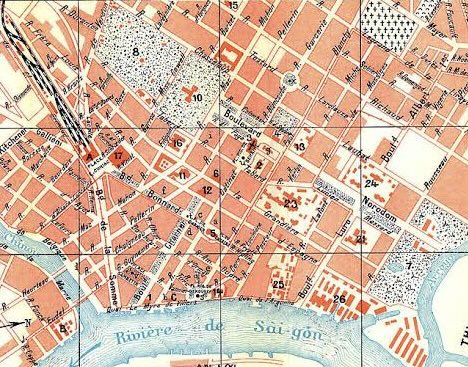
When the French captured the area in 1859, most economic activity in the region took place along the Saigon river.

The population built makeshift homes tightly bundled by the river banks. Outgrowth from this eventually lead to narrow alleyways between many buildings that is trademark of the city (the Khmer named the region Prey Nokor then French renamed it Saigon and then it was renamed to Ho Chi Minh City in 1976 after end of Vietnam War).

Over decades, the French created European street grids and built wide Paris-type boulevards in the city to funnel commerce to larger markets (also make the city easier to administer).

It was at these markets that French baguettes were introduced and traded.

Bánh mì bread is known for being flaky and crispy on the outside while fluffier on inside (so god damn good).

Two features of Saigon helped create this texture:

▫️Climate: The heat and humidity in Southeast Asia leads dough to ferment faster, which creates air pockets in bread (light and fluffy).

▫️Ingredient: Wide availability of rice meant locals added rice flour to wheat flour imports (which were quite expensive). Rice flour is more resistant to moisture and creates a drier, crispier crust.

Fast forward to the 1930s: the French-designed street layout is largely complete. Now, the city centre has wide boulevards intersected by countless narrow alleyways.

The design was ideal for street vendor carts. These businesses were inspired by shophosue of colonial architecture to sell all types of goods as chaotic traffic rushed by.

Vietnam has some of the most slapping rice and soup dishes, but many people on the move in the mornings wanted something more portable and edible by hand.

Bánh mì was traditionally upper class fare but it met the need for on-the-go food.

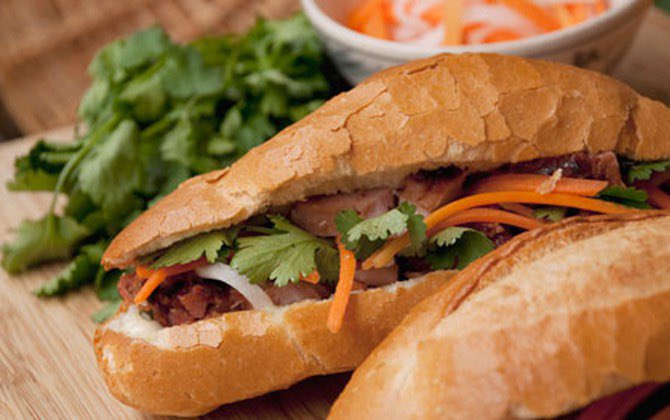
Just fill the bread with some Vietnamese ingredients (braised pork, pickled vegetable, Vietnamese coriander, chilies) along with French goodies (pate).

Pair it with cà phê sữa đá (aka coffee with condensed milk aka caffeinated crack) and you’re laughing.Image
Image
Image
Image
Haven’t lived in Saigon for 10+ years but ate a banh mi every other day when I did.

While there, I also sold a comedy script to Fox (pitch: “The Fugitive meets Harold & Kumar set in Southeast Asia”).

It never got made but fun story to retell: readtrung.com/p/im-making-a-…
Classic episode Image
Read 4 tweets
Jul 26, 2025
the most underrated winner of the AI boom is the 15,000 person Caribbean island of Anguilla (which has a GDP of ~$320m) Image
The research team is happy to announce that we’ve played our part contributing to Anguilla’s windfall.

We also paid $99 to GoDaddy to see if we could secure one more .AI domain. Bearly.AIImage
Polynesian island Tuvalu has an even smaller population (10,000)!!
Read 4 tweets
Jun 8, 2025
someone used Veo3 to make Moses as a YouTuber live-streaming the Exodus
accent does change at end: reddit.com/r/ChatGPT/s/bO…Image
On-demand history vids like this in few years with Google Veo very plausible.

I previously wrote on YouTube as greatest athletics learning machine ever…could get souped up: readtrung.com/p/youtube-the-…
Read 4 tweets

Did Thread Reader help you today?

Support us! We are indie developers!


This site is made by just two indie developers on a laptop doing marketing, support and development! Read more about the story.

Become a Premium Member ($3/month or $30/year) and get exclusive features!

Become Premium

Don't want to be a Premium member but still want to support us?

Make a small donation by buying us coffee ($5) or help with server cost ($10)

Donate via Paypal

Or Donate anonymously using crypto!

Ethereum

0xfe58350B80634f60Fa6Dc149a72b4DFbc17D341E copy

Bitcoin

3ATGMxNzCUFzxpMCHL5sWSt4DVtS8UqXpi copy

Thank you for your support!

Follow Us!

:(