Market knows for AI photonics now. But is AXTI a potential robotics & autonomous vehicle play too?
Past posts around AI interconnects typically pointed to InP, whether today's EML, CW SiPh or coherent DCI, or tomorrow's 3.2T+ with various modulation techniques or new optical scale-ups.
Here are AXTI's physical AI comments:
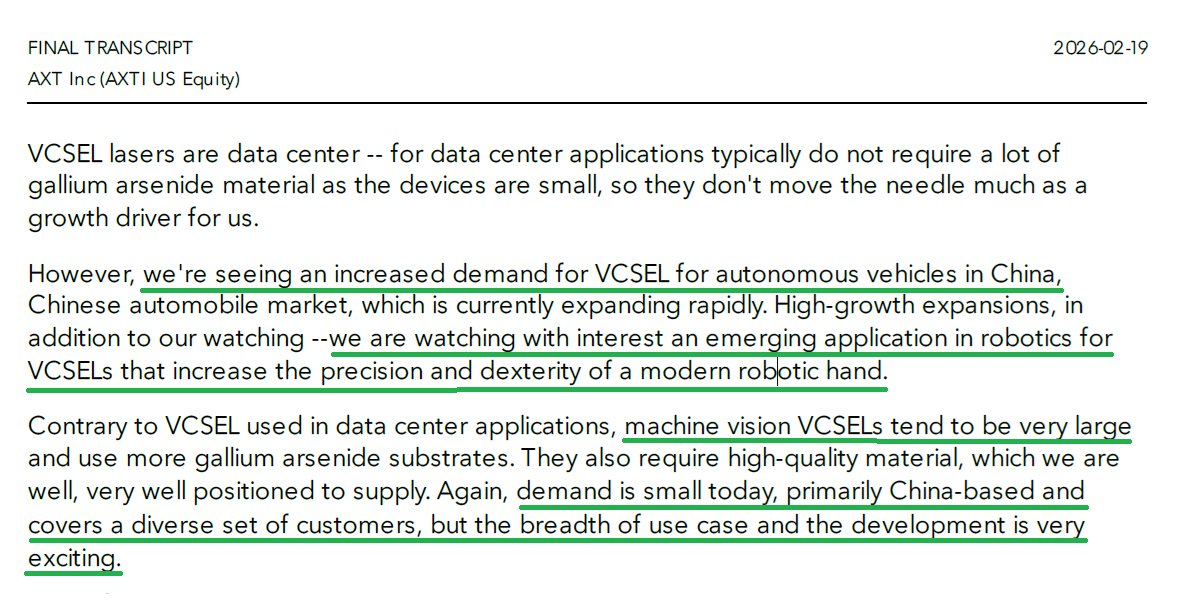
- AXTI is seeing increased demand for GaAs VCSEL substrates for autonomous vehicles in China
- Emerging robotics applications to increase precision and dexterity of a modern robotic hand
- Small today but breadth of use cases & development is exciting
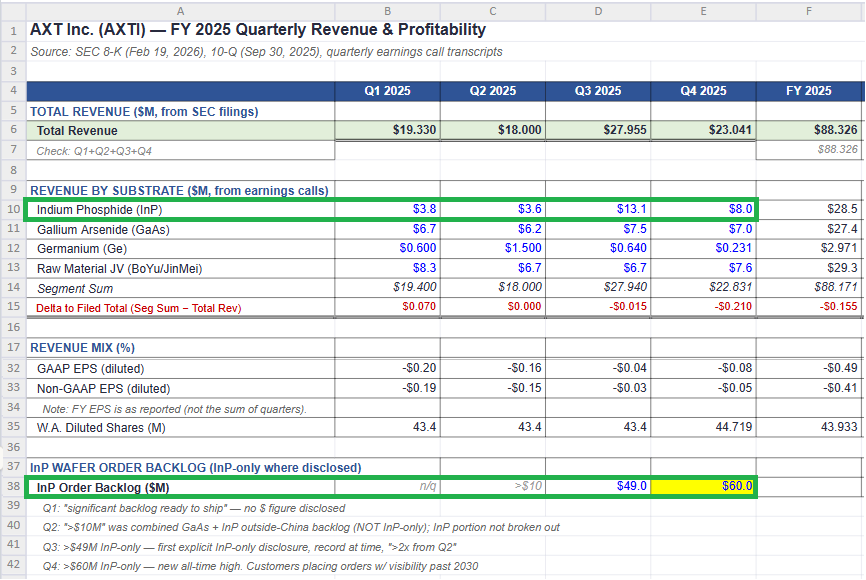
2) GaAs substrates historically dominated AXTI shipments. InP inflected in 2025 due to AI datacom.
InP shipments have been limited at times due to timing of Chinese export licenses, but AXTI order backlog ramped to > $60M due to InP demand.
InP shipments were gated by export licenses in Q4. AXTI guided $26M for Q1 based on permits already received, but said there "could see significant upside" if additional permits are received by end of Q1.
Like other AI scaling beneficiaries, industry is adding capacity. AXTI will 2x capacity this year, but consider demand variances from units, new applications, content. E.g. CPO CW lasers can driver higher content.
3) VCSELs are one of the techs I've been tracking for 3D physical AI.
Suppliers include $LITE $COHR (via FNSR) and others. Here's $HSAI AT128 and a LITE use case.
Contrast VCSELs in iPhone's Face ID - short distance, lower power = smaller VCSEL content.
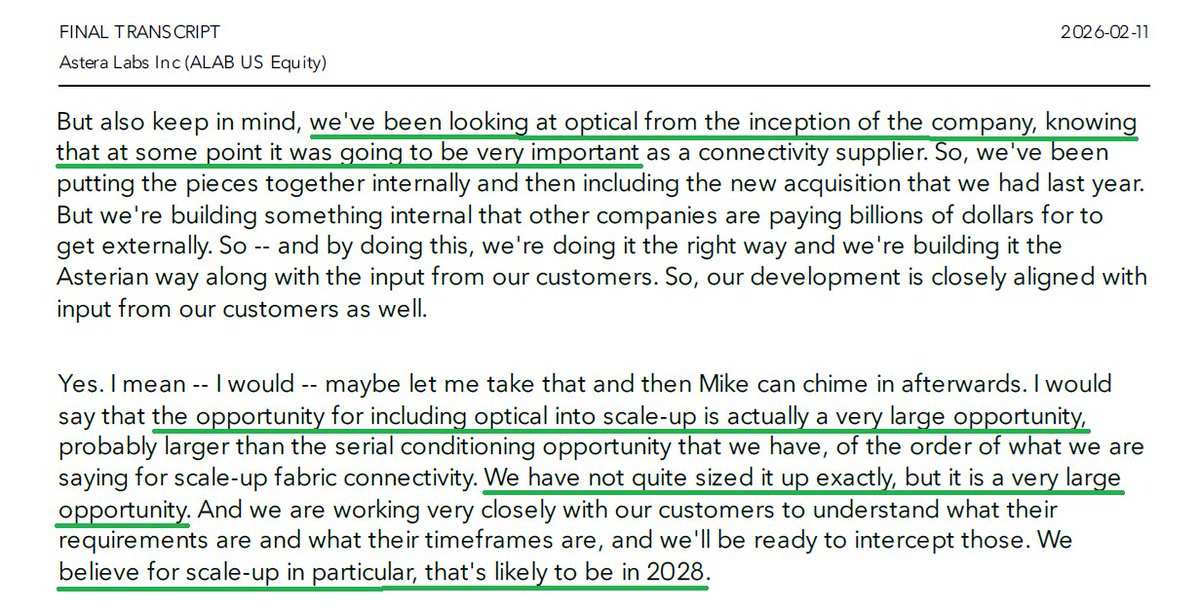
1) Copper to optical. When copper interconnect guys like $ALAB $CRDO start saying they've always looked at optical because it's such a large opportunity?
ALAB. Optical including scale-up is "actually a very large opportunity."
Two main reasons shares were hit hard.
- Little earnings leverage due to high photonics R&D
- Uncertainty about future optics positioning & share
ALAB doesn't have the capability to design high margin, core photonics components. $LITE $COHR benefit despite the initial uncertainty.
ALAB is down 51% since September and -26% YTD.
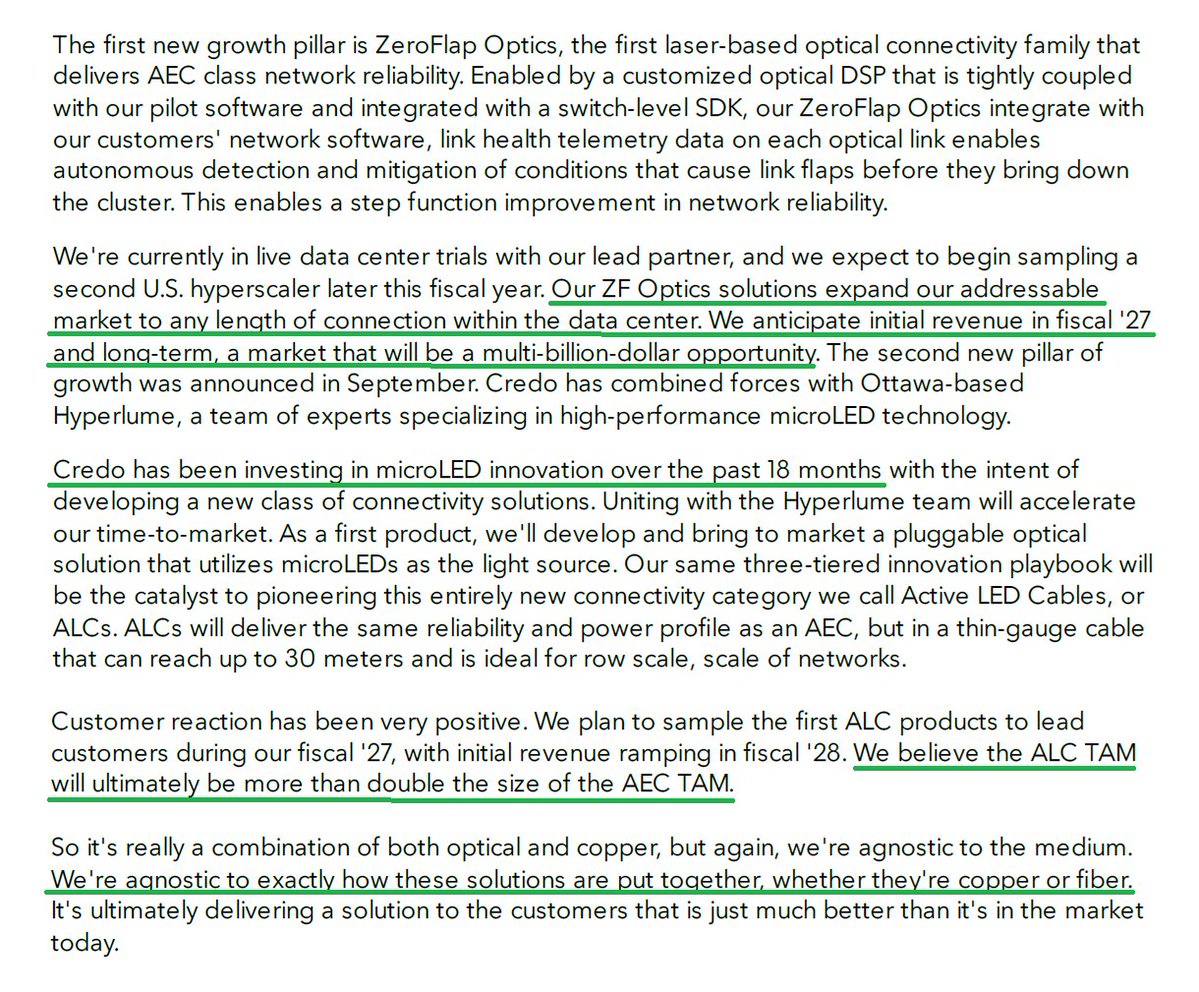
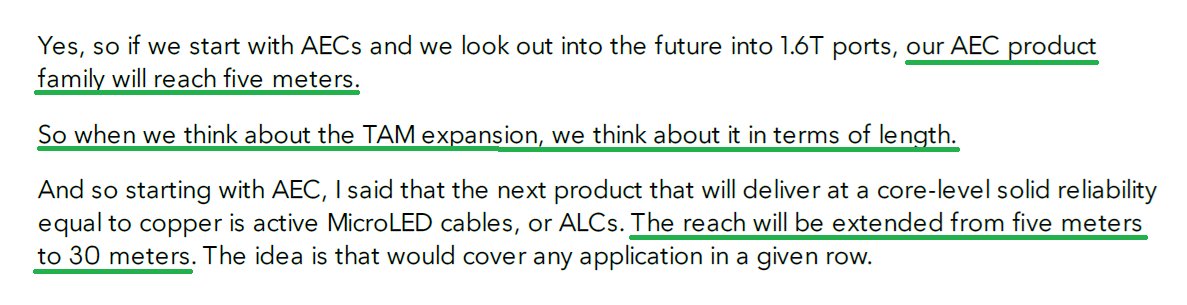
2) $CRDO optical road map based on Dec earnings call and Jan conference comments. ZeroFlap Optics and Active (micro)LED Cables or ALCs.
CRDO thinks ALC TAM will "ultimately be more than double the size of the AEC TAM."
ZF Optics uses standard transceivers with CRDO optical DSPs and software/firmware to improve reliability, remotely manage, efficiently maintain etc. ZF is "multi-billion dollar" opportunity long term.
Both speak to transitions toward optical, from shorter reach AECs to longer distances.
3) ALCs use microLEDs and not lasers. So they're slow and aren't coherent sources. But likely much cheaper.
CRDO didn't discuss specs beyond TAM expansion due to 30 meter vs 5 meter reach. But slower microLEDs suggest parallel arrays & transmissions.
Like ALAB, transitions toward optical do create more uncertainty. CRDO is down 34% since Dec and down YTD despite preannouncing Jan Q sales of $406M (up 3x Y/Y) vs $340M cons.
1) Mainstream DRAM and NAND spot prices were up 10% last night alone. DDR5 spot just doubled. I've never seen this before.
$MU and SK Hynix almost doubled since local bearish peak for DRAM & HBM in Aug. Large parts of buy & sell-side as well as Fintwit.
Do math for "commodity" DRAM margins. Assume spot goes sideways and contract (which lags spot) ~ catches up. If 100 price/50 cost = 50% GM. 200 price/50 cost = 75% GM (!).
It's not surprising every time I turn around, any incremental price negotiations for HBM3e and HBM4 sound better. Have discussed varying fungibility timeframes between DDR and HBM as well as flash.
Peak EPS power looks a little nutty. Again, normalized earnings matter as much. I.e. when there is a future downturn, will trough EPS also be higher?
2) Then consider that this is happening in what just could be the very beginning of several AI drivers that are very storage & memory intensive.
Maybe not. But could this cycle also be unlike pre-AI cycles that investors reflexively pattern match to?
1) $COHR risk/reward improved IT, and I rotated a part of LITE back into COHR. It's still a smaller position.
$LITE almost tripled past year and outperformed COHR 2.2x. For good reasons. LITE was, and still is, better positioned across a range of current and future interconnect technologies & products.
As a result, LITE's forward earnings cons rose > 30%. COHR's forward cons was almost flat after last 2 Q's.
But based on data today, COHR numbers also have greater upside vs downside while valuation compressed. LITE also became much too big in the portfolio, but that's portfolio dependent.
2) A number of interconnect stocks have been explosive. So have stocks in other sectors discussed since spring. Cool to hotter storage, tier 2 & 3 infra & power capacity, physical AI, rare earths etc.
Not that classic AI infra leaders haven't done well. And my confidence has grown recently that chance of bigger $NVDA upside(s) by Jan Q is higher than normal, even as the stock lagged some recently.
A common denominator is high leverage (in a good way) to AI growth. It's interesting that the range of sectors and stocks that are, or will soon be, levered AI beneficiaries, or losers, is growing rapidly.
Not a surprise. AI is touching everything we do and has started to transform entire industries.
3) Back to COHR and LITE (which remains a top interconnect position). In May, I mentioned LITE CQ4 2026 could be well into $600M's, which was well above cons. That cons is now $678M, and a > $700M Q is a now decently more likely than not.
A very interesting narrative is wrt certain new techs being, or will soon be, real drivers of growth. These are "high multiple technologies that should drive investor imagination." Even some products that seemed less interesting, such as VCSEL MMF interconnects, are promising again. Short distance scale-up, which has become a high multiple set of words.
Another reason to mention LITE is that it has real apple to apple compares from late 90's to early '00. Hence the wording of high multiple technologies. On a valuation basis, it's nowhere near that bubble.
Price is also far more extended from long term averages than anytime in history since its spinoff from $VIAV in 2015, yet price extension is also nowhere near similar companies during the dotcom boom.
Nothing is guaranteed, but if markets enter what I've referred to as pre-bubble stages, will discuss those compares in detail then. None of those patterns have to repeat, including typical post-bubble busts, even if bubble-like behavior occurs. AI is fundamentally different. But there might still be some lessons.
1) Remember that Feb mini-panic about data center oversupply? Here's a DC & DC supplier update. 10Q's are also must reads. And perhaps Larry does believe what he said last week. $ORCL is making commitments.
Here's one of the Cowen notes that triggered that scare. $MSFT cancelling leases "points to a potential oversupply position." AI trade was all over, again.
Mentioned at the time "what DC industry is seeing globally is the opposite." Cowen had taken -1 + 2 = +1, but only pointed out -1. And this was before the huge surge in inference, which is continuing.
What were MSFT & ORCL lease commitments in Q1?
MSFT. Commitments dropped from $117B (CQ2 2024 peak) to $99.2B (CQ1 2025).
ORCL. Commitments rose from $22.9B to $48.4B in same period (Feb Q ≈ CQ1). ORCL's gains alone more than offset MSFT, even though it was a smaller player.
And MSFT stated "the next spend will begin to shift back to short-lived assets, which are more correlated to revenue growth" on its earnings call Jan 29th.
At most, MSFT lease commitments might've overshot some (lease commitments had risen $74.9B in just one year to CQ2 2024 peak, or from $42.1B CQ2 2023 to $117B CQ2 2024!) while they shifted focus to filling data centers with AI infrastructure.
And finally, MSFT and ORCL, and most other CSPs, guided to significantly higher capex in latest calls.
2) What are the most recent numbers? ORCL's lease commitments shot up by $56.4B Q/Q or more than doubling Q/Q! This doesn't include $6.6B in further commitments 10 days into Nov Q.
Looking at ORCL & MSFT alone, data center lease commitments are up $55.8B, or by +41%, YTD.
I'd also take 50:50 odds that MSFT DC commitments starting to rise again Sep Q.
3) So does Larry believe what he said, even if some don't? He's committing real $'s.
One might also argue aggregate future token demand won't depend on whether @OpenAI $GOOGL or someone else is the market leader. Or could there be true AI disaggregation?
1) $NVDA is more likely have bigger upside(s) than usual by Jan Q.
Based on a pretty broad set of data points. It's also not impossible that Oct Q could also be quite decent. Given NVL run rate by Q4, one week in timing could mean over +/- $3B.
But timing won't matter if NVDA DC rev has larger than usual midpoint for combined Oct + Jan Q vs $101B DC cons for that period.
This is independent bottoms up & top down build. I.e. most sell side models look more conservative than typical. There's always a spread, could be wrong, but my midpoint is higher than normal vs expectations. Subject to quick change with.
More importantly, 2026 outlook and even beyond is still improving due to variety of demand drivers. AI top down is accelerating is still crazy.
2) One recent data point.
Few believe/model HH +300% Q/Q. HH reiterated +300% during JPM Asia tech tour days ago with 1M left in Q3. Upside risk vs models?
"Temporary" small ODM issues were Quanta & Wistron. Order strength. Keep in mind other suppliers.