So you're worried about your pearly whites and your smile? Let's dig a bit deeper. About your 🦷. 🧵...
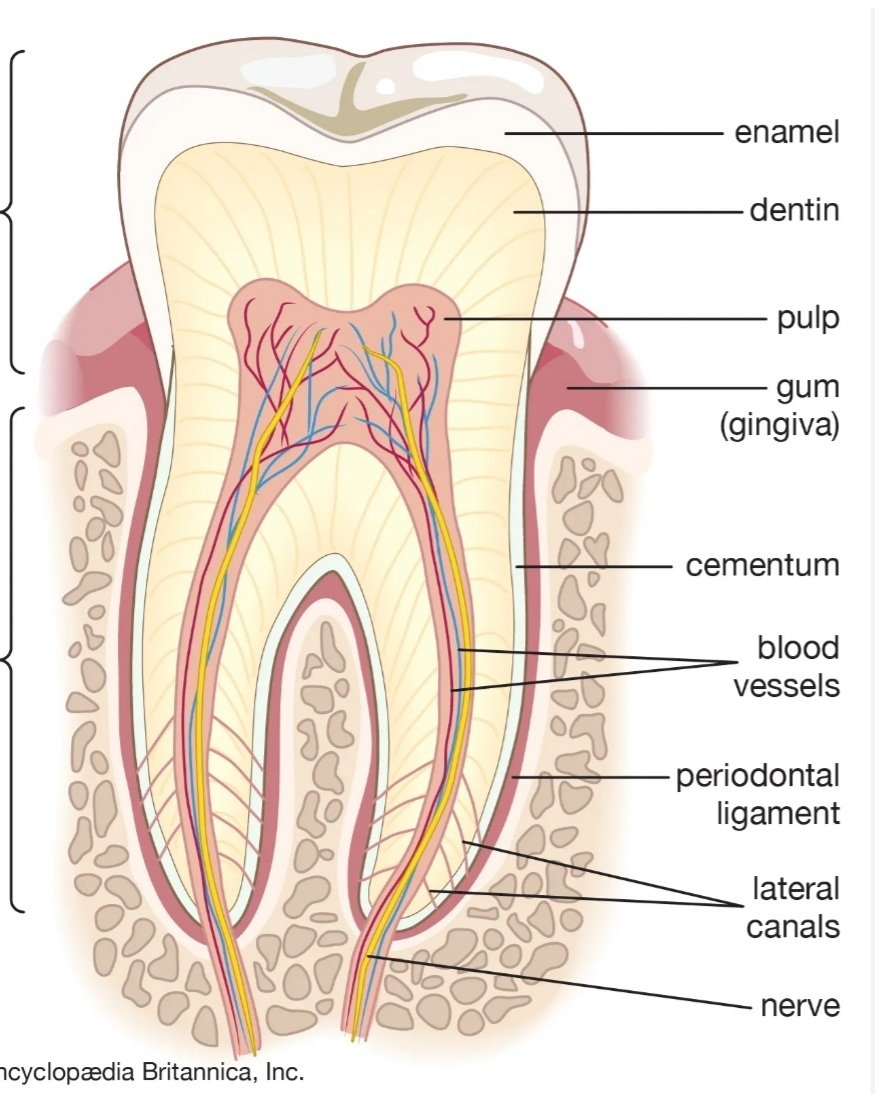
The teeth are divided into 2 parts: the crown (above gum line) and the root (below gum line). The tooth tissue that you see when you see is the enamel. It's mostly made of inorganic stuff and is one of the hardest tissues in the body. (Fun fact).
Underneath the enamel...
Underneath the enamel...
is another layer of tooth tissue called the dentin. It is what makes up the bulk of the teeth.
Below the gum line is/are the root/s. It's also made of dentin and is covered by cementum. (No enamel down there).
What keeps your teeth "alive" (dentists say "vital") is the pulp...
Below the gum line is/are the root/s. It's also made of dentin and is covered by cementum. (No enamel down there).
What keeps your teeth "alive" (dentists say "vital") is the pulp...
where you have your blood vessels and your nerve.
The upper part of the pulp is called the "pulp chamber" and the lower part, which supplies the roots, is known as the root canal.
So everyone has root canals, but not everyone goes through root canal treatment/therapy....
The upper part of the pulp is called the "pulp chamber" and the lower part, which supplies the roots, is known as the root canal.
So everyone has root canals, but not everyone goes through root canal treatment/therapy....
(Dentists call this endodontic therapy and it falls under the field of endodontics)... 
The enamel, being a very hard structure, protects the crown from strong occlusion (biting) and masticatory (chewing) forces but can easily be destroyed by acid from bacteria. (Cavities!)
As enamel is destroyed, cavities start to reach the second layer --the dentin...
As enamel is destroyed, cavities start to reach the second layer --the dentin...
An interesting thing about dentin though is that this layer is capable of repair, which is great since the dentin is what protects the pulp.
One very interesting thing about oral immunology is that the immune reaction in the pulp is separate from the whole 👄.
The pulp is an...
One very interesting thing about oral immunology is that the immune reaction in the pulp is separate from the whole 👄.
The pulp is an...
Entirely enclosed structure which contains structures called "odontoblasts" on its surface. These are activated during low-grade infection in order to initiate repair of dentin when inflammatory signals are initiated from the pulp...
sciencedirect.com/science/articl…
sciencedirect.com/science/articl…
The pulp harbors quite a number of immune cells that will easily respond to any pathogen.
Most notable is the presence of immune cells called NK and NKT cells which are pretty good at killing viruses without having to go through all the red tape....
sciencedirect.com/science/articl…
Most notable is the presence of immune cells called NK and NKT cells which are pretty good at killing viruses without having to go through all the red tape....
sciencedirect.com/science/articl…
that other immune cells go through.
Pathogens reaching the pulp is never a good thing.
Unlike other body parts which allow for swelling to happen as a form of "release" during inflammation, the pulp, being an enclosed chamber, is not able to do so. (You haven't heard of a...
Pathogens reaching the pulp is never a good thing.
Unlike other body parts which allow for swelling to happen as a form of "release" during inflammation, the pulp, being an enclosed chamber, is not able to do so. (You haven't heard of a...
swollen tooth, right?)
This leads to either of two conditions: reversible or irreversible pulpitis.
With pinpoint exposures of the pulp and low-grade inflammation, reversible pulpitis happens and repair is possible. This can be easily treated by a filling...
This leads to either of two conditions: reversible or irreversible pulpitis.
With pinpoint exposures of the pulp and low-grade inflammation, reversible pulpitis happens and repair is possible. This can be easily treated by a filling...
When too much inflammation happens, a patient ends up with irreversible pulpitis. This gives the patient the option of getting root canal treatment or an extraction.
So what does this have to do with #COVID19 ?...
So what does this have to do with #COVID19 ?...
Although pulpitis is a condition that is usually associated with bacteria, viruses may also cause harm to the pulp.
The dental pulp also happens to be filled with ACE2 making this vulnerable to Covid...
nature.com/articles/s4143…
The dental pulp also happens to be filled with ACE2 making this vulnerable to Covid...
nature.com/articles/s4143…
Take note too that NK cells are dysregulated in Covid which may hamper repair by dentin...
nature.com/articles/s4142….
nature.com/articles/s4142….
The gingival sulcus--the space between the tooth and the gums-- too can harbor SARS-CoV2 and can easily provide a route of entry to the pulp.
ncbi.nlm.nih.gov/pmc/articles/P…
ncbi.nlm.nih.gov/pmc/articles/P…
Anecdotally, patients post Covid have been reporting incidences of tooth pain and onset of cavities that involve irreversible pulpitis. Although, of course, this warrants further studies, it wouldn't be surprising for Covid to affect even the teeth themselves.
• • •
Missing some Tweet in this thread? You can try to
force a refresh