Inheritance in Python
It is a way of creating a new class by deriving it from an existing class.
With inheritance, the new class inherits all properties and behaviors of the existing class, allowing to reuse code and create classes that build on each other
A thread🧵
#Python
It is a way of creating a new class by deriving it from an existing class.
With inheritance, the new class inherits all properties and behaviors of the existing class, allowing to reuse code and create classes that build on each other
A thread🧵
#Python

In Python, we can define a class that inherits from another class using the syntax class DerivedClass(BaseClass):
This means that the DerivedClass is inheriting from the BaseClass.
1/10
This means that the DerivedClass is inheriting from the BaseClass.
1/10
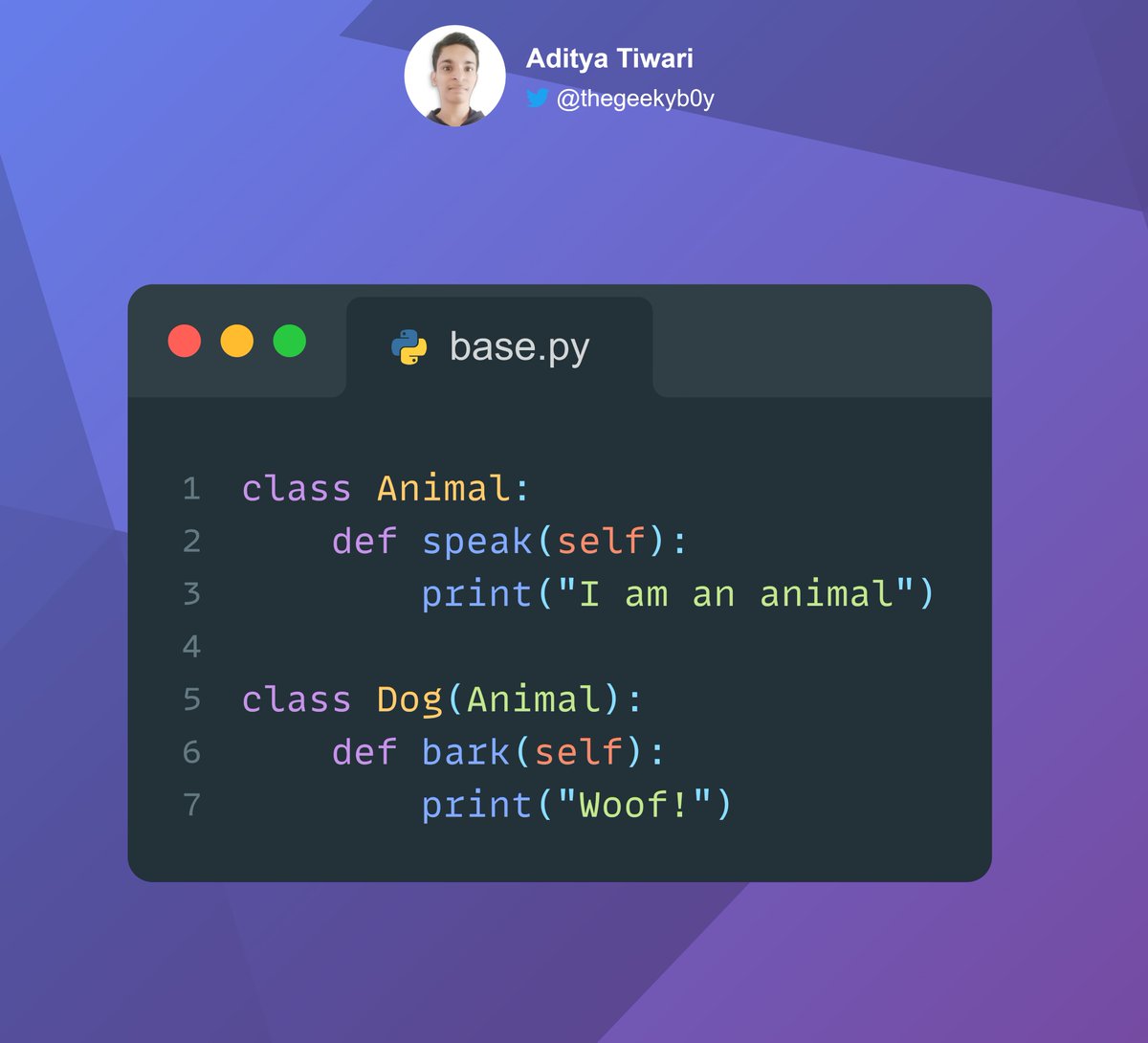
Here is an example of how to define a class that inherits from another class:
In this example, we have a Animal class with a speak method that prints "I am an animal". We also have a Dog class that inherits from Animal and adds a bark method that prints "Woof!".
2/10
In this example, we have a Animal class with a speak method that prints "I am an animal". We also have a Dog class that inherits from Animal and adds a bark method that prints "Woof!".
2/10
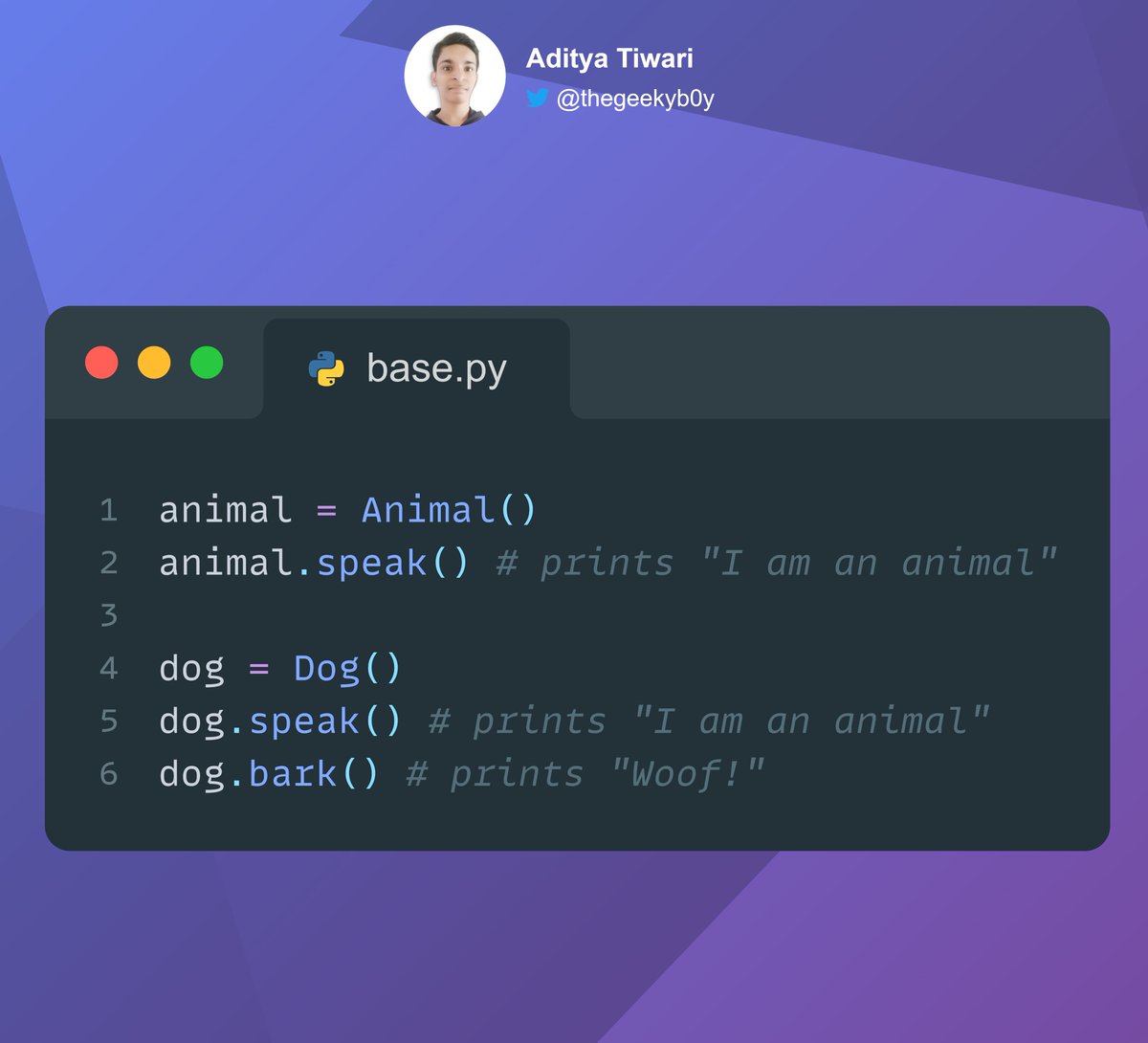
Now, let's create an object of each class and call their methods:
As we can see, the Dog object inherited the speak method from the Animal class, and we were also able to call the bark method specific to the Dog class.
3/10
As we can see, the Dog object inherited the speak method from the Animal class, and we were also able to call the bark method specific to the Dog class.
3/10
Inheritance allows us to create more specialized classes that inherit attributes and methods from a base class. This is useful when we want to reuse code and avoid duplication.
4/10
4/10
For example, we create a Cat class that is similar to the Dog class but has a different sound attribute and method. Instead of defining the speak method from scratch, I can inherit it from Animal class & only define the sound attribute and method specific to the Cat class
5/10
5/10

In above example, we have a Cat class that inherits from Animal. We define a sound attribute that is specific to the Cat class and a meow method that prints the sound attribute.
Now, let's create a Cat object and call its methods:
6/10
Now, let's create a Cat object and call its methods:
6/10

As we can see, the Cat object inherited the speak method from the Animal class and we were also able to call the meow method specific to the Cat class.
7/10
7/10
Inheritance is a powerful tool in object-oriented programming that allows us to create more specialized classes based on existing ones.
By reusing code and avoiding duplication, we can create more efficient and maintainable code.
But..
By reusing code and avoiding duplication, we can create more efficient and maintainable code.
But..
It's important to use inheritance judiciously and avoid deep inheritance hierarchies that can become difficult to understand and maintain. In general, it's a good idea to limit inheritance to a few levels and favor composition over inheritance when possible.
That's it for this thread on objects and classes in #Python I hope this was helpful!
Don't forget to follow me for more Python content:
@thegeekyb0y
Don't forget to follow me for more Python content:
@thegeekyb0y
Thanks for sticking with me through this Python twitter thread! If you're feeling extra generous and want to support my work, consider becoming a member and getting some sweet perks.
thegeekyboy.gumroad.com/l/memberships-…
Either way, thanks for being part of my community!
thegeekyboy.gumroad.com/l/memberships-…
Either way, thanks for being part of my community!
Get back to the top of the thread
https://twitter.com/TheGeekyB0y/status/1631210711551492097?s=20
• • •
Missing some Tweet in this thread? You can try to
force a refresh