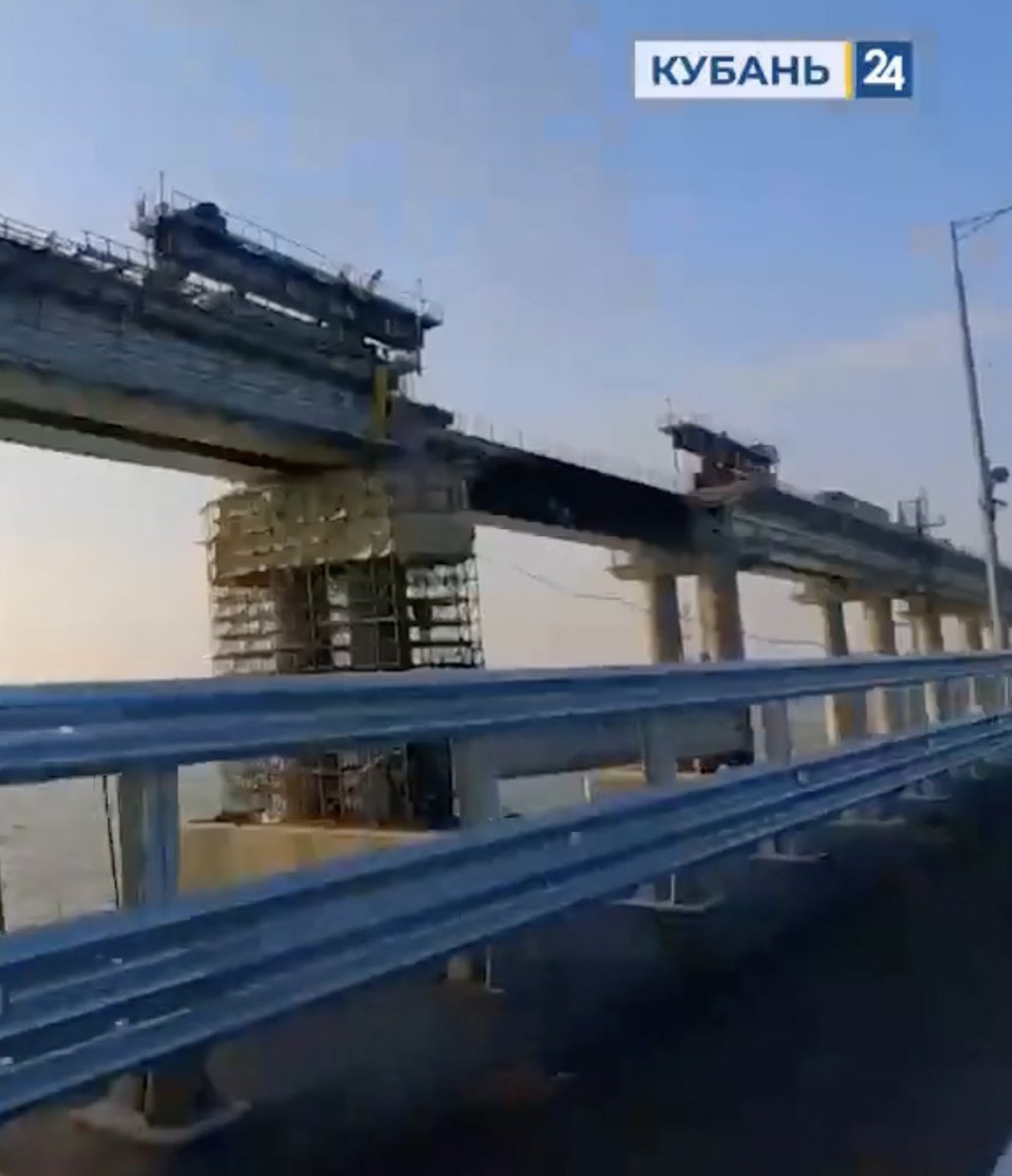
1/ Russia appears to have recently removed a span of the Kerch railway bridge to Crimea, presumably to carry out repairs following the (likely Ukrainian) bomb attack on the bridge last October. Here's why this is significant. 

2/ Seven fuel tankers ruptured on a 4,000 ton train that was, apparently coincidentally, crossing the rail bridge when the explosion on the parallel road bridge happened. It caused a huge fire that lasted several hours.
https://twitter.com/i/status/1578612198448181248/video/1
3/ (For more on the background to the explosion, see the thread I compiled below on the Russian, Bulgarian, Georgian and Armenian account of what led up to it. It's the most detailed and most fully documented account that I know of.)
https://twitter.com/ChrisO_wiki/status/1580303771208339456
4/ The fire could have been a lot worse – the rail bridge was likely saved by the quick thinking of the train crew (see the thread below), who unhitched the burning tankers and got the rest of the train away to safety.
https://twitter.com/ChrisO_wiki/status/1584466020177432581
5/ Nonetheless, it still caused significant damage to the rail bridge. Further damage was likely caused by helicopters water-bombing the train to put out the fire. Video from the scene afterwards showed a lot of surface buckling.
6/ Before the attack, the rail bridge was a crucial element of Russia's war effort in southern Ukraine. It was used to bring huge quantities of troops, military equipment, fuel and ammunition to Crimea.
7/ Not surprisingly, Russia made it a priority to repair the damaged track and restore traffic over the rail bridge. However, while this was a propaganda boost, it obscured some major issues.
8/ Following the explosion, the Russians converted the rail bridge temporarily to single-track use. Videos such as the one below, from only a few days ago, show trains using the other track on the far side from the road bridge.
9/ What kind of damage might have been caused to the rail bridge's structure? Unlike the road bridge, which has a single deck, the rail bridge has two in parallel, with tracks sitting on top of twin decks made of steel girders supported by double piers.

10/ Crucially, the track rests on top of an EPS (expanded polystyrene) layer, covered by a geoblanket, which can be seen being installed in the pictures below. This will have saved a lot of weight but is likely to be very vulnerable to heat.


11/ The video in tweet 5 above shows two distinct types of damage: the steel walkway and the rail tracks are severely deformed. Damage to the underlying deck, the girder main structure and pier bearings is not visible.

12/ There's no doubt that the span was exposed to very high temperatures. The deformation of the tracks indicates temperatures of 1200-1400°C. As can be seen from this frame of the video, the track directly underneath the burned wagons was melted.

13/ The heat will almost certainly have damaged the underlying geoblanket and EPS layer. It's also likely that the rubber bearings between the girders and the pier cap were affected. They protect the piers from vibration and absorb the girder's movement under heavy loads.

14/ To compensate for the loss of one side of the rail bridge, the Russians reopened the old ferry crossing between Crimea and Russia, at the narrowest point of the Kerch Strait, north of the bridge.

15/ This has had to accommodate a huge amount of traffic – between 9 October and 24 November 2022, 2,622 rail cars, 24,227 vehicles and 37,114 passengers were transported by ferry. There have been lengthy tailbacks due to limited ferry capacity.


16/ The damaged road spans were replaced over the last five months, leading to a full reopening of the road bridge on 23 February 2023. This should enable the ferry traffic to be diverted onto the road bridge.
https://twitter.com/i/status/1628860491165474816/video/1
17/ With transport capacity now fully restored on the road bridge, the Russians have likely decided that the time is right to fully repair the rail bridge. It's probable that they've removed the damaged span to replace the damaged EPS layer and fully inspect the structure.
18/ Taking the span out should also enable them to inspect and if necessary replace the bearings on the piers, which would likely have been impossible to do with the span still in place.
This work is likely to take a while, particularly if the girders need repairs.
This work is likely to take a while, particularly if the girders need repairs.
20/ It's been reported that Russia is aiming to complete the repair job by July 2023, although the Russians are clearly working hard to expedite repairs before then. /end
(With many thanks to @andre_bida for the engineering explanations and diagrams!)
(With many thanks to @andre_bida for the engineering explanations and diagrams!)
• • •
Missing some Tweet in this thread? You can try to
force a refresh