Over the last 2 months, Russia has undertaken a series of thrusts in eastern #Ukraine to capture territory & weaken Ukraine’s armed forces. Soon, it will be the turn of the Ukrainians to resume their offensive operations. 1/20 🧵
2/ It is important to explore the purpose of these offensives because those planning them will have to balance multiple political, strategic and military imperatives for the coming attacks against Russian forces. abc.net.au/news/2023-03-2…
3/ Purpose in these circumstances is vital. It provides the starting point for strategy, and operational planning. But, it also ensures that those who will participate in these offensives understand why they do so.
4/ Soldiers will always follow orders. But it is purpose that inspires them, provides the foundation for extra exertions and often is the reason why so many offer their ‘last full measure of devotion’ on the battlefield.
5/ What are the elements of purpose in Ukraine’s forthcoming offensives?
6/ First, Ukraine wants to re-seize the initiative in this war. Their Kharkiv and Kherson offensives grasped the initiative from the Russians and forced them onto the defensive over winter.
7/ However, for a variety of reasons including slow arrival of western support and the injection of Russian mobilised troops, Ukrainian momentum seeped away over the Christmas-New Year period.
8/ Now, with the Russians generating some momentum with their Easter attacks, the Ukrainians will be keen to reverse this momentum and regain their battlefield advantage.
9/ In doing so, it demonstrates to Russians that nothing they do can destroy Ukrainian resolve. In this battle of wills, destroying Russian morale will be an important objective of the Ukrainian offensives.
10/ Ukraine will want to spread the word to the entire Russian invasion and occupation force that their days in Ukraine are numbered. This psychological aspect of offensive operations is very important.
11/ The Ukrainians also want to take back their territory. This is an obvious and important goal, and one constantly referred to by President Zelensky in his speeches.
12/ Large parts of eastern & southern Ukraine remain under Russian occupation. For those in areas occupied by Russia, the Ukrainian offensives will provide a ray of hope that their turn for liberation will come soon.
13/ Another obvious purpose of the offensives is to continue degrading the the Russian Army. The Ukrainians will want to destroy as much of the Russian army as possible, but this is subordinate to recapturing territory.
14/ The Ukrainian offensives will also be a vital message to the west that the Ukrainian armed forces are able employers of the military assistance provided over the last few months.
15/ Finally, the offensives matter greatly to the Ukrainian people at home and those who remain refugees abroad.
16/ Since 2014, Russia has occupied its territory and conducted a sustained information campaign against the notion of Ukrainian sovereignty.
17/ Since February 2022, the people of Ukraine have endured rape, murder, destruction of their cities, and systemic attempts by Russia to eradicate Ukrainian culture, symbols and nationhood.
18/ The offensives launched in the next few months will be heartbreakingly bloody, and may not be the final blow that destroys the Russian Army in #Ukraine. abc.net.au/news/2023-03-2…
19/ But, if the west holds its nerve, and the Ukrainians steadfastly apply their fighting power against the Russians while taking back large swathes of their land, the offensives may be the beginning of the end of this war. End.
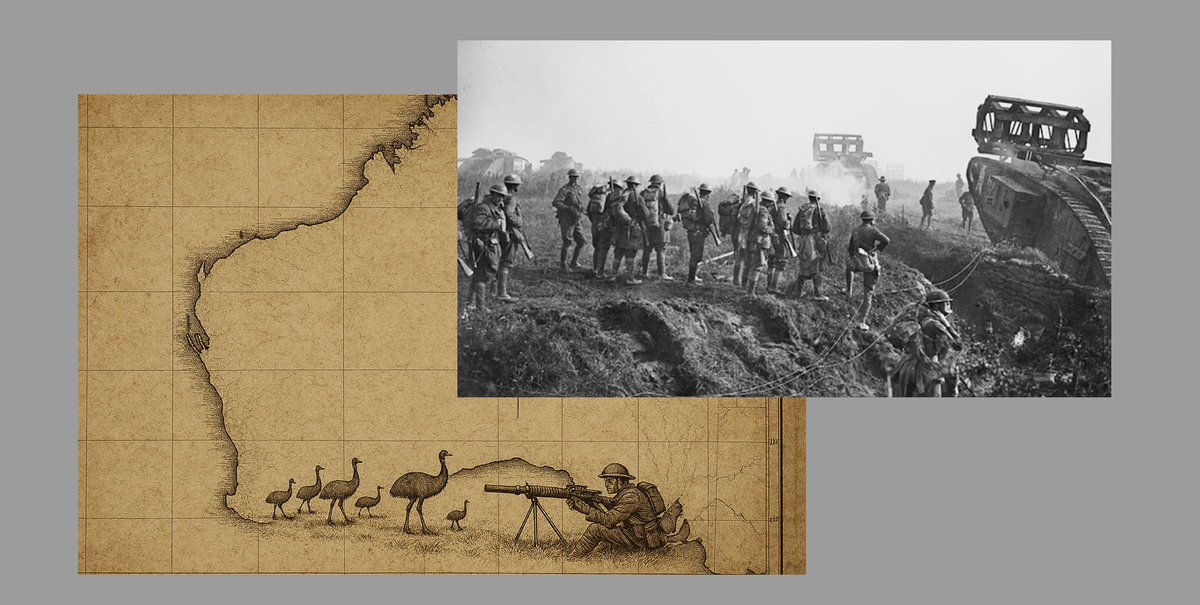
My latest article was fun to research and write. Military history offers few case studies as informative as they are absurd. In 1932, the Australian Army deployed against an emu population in the Western Australian wheatbelt. It failed comprehensively. Big brained, well-armed soldiers were beaten by flightless birds with brains the size of a walnut. 1/5 🧵
2/ What makes this worth serious attention is the institutional context. This was the same army that, fourteen years earlier at Hamel, had run one of the most sophisticated combined arms operations of the First World War under Monash. By 1932, that institutional learning had evaporated.
3/ The Emu War showcases in a single low-stakes campaign, five failure patterns that recur in every serious military disaster: the wrong tool for the problem, no intelligence preparation, no functioning adaptation loop, the wrong success metrics, and force employed for optics rather than strategic logic.
100s of drones downed over Moscow & a major oil refinery ablaze for the 2nd time in a week. Ukraine's largest strike on Moscow leads this week's update. 1/5
2/ The deep-strike campaign is now a central element of Ukraine's war to defend itself and secure a just peace. By Kyiv's own accounting it has knocked out roughly a tenth of Russia's refining capacity. On the ground, Russia's spring offensive in Donetsk looks close to culminating.
3/ In the Pacific, INDOPACOM reverts to Pacific Command as Beijing presses around Taiwan, the Philippines and Japan.
Ukraine has just struck a Russian defence plant with its new long-range FP-5 missiles and damaged a key bridge to Crimea. Things keep getting worse for Putin and Gerasimov. My Part 2 assessment of Russia's losing war, and how Putin might reverse things. 1/5 🧵
2/ Russia is losing its war on Ukraine. But a losing trajectory is not a settled outcome. Part 2 of Losing on Every Dimension examines the five "reversal conditions" that could still rescue Putin, and what the West must do to lock in his defeat.
3/ The most revealing point about these five reversal conditions. With one exception, none lies within Russia's own control: a US settlement, the oil price, China's treasury, North Korean manpower, and Western fatigue. Russia's escape from defeat depends on the decisions of others.
For the first time since the invasion, Russia is losing more troops than it can recruit. Net territorial movement over the past three months has favoured Ukraine. Part 1 of my new assessment, I explore how Russia is "Losing on Every Dimension" - military, cognitive, moral, industrial and economic. 1/7 🧵
2/ MILITARY. In 2025 Russia paid roughly 200 casualties per square mile taken. In the first five months of 2026, with a net gain of 17 square miles, it paid over 9,600 per square mile. The meat grinder is grinding through Russian men faster than Russia can produce them. Tactical operations are now unified with mid-range and long-range strikes.
3/ COGNITIVE. Russia's narratives are decoupling from a battlefield made visible by open-source reporting. When Putin has to ask Ukrainian permission to hold parades, and cannot hold an international forum without a Ukrainian attack, his narrative about inevitable war crashes.
Our darker angels have returned. For a decade, influential scholars argued that major war was on an irreversible decline. Pinker's 'Better Angels' thesis became almost orthodoxy in parts of the security studies world. But, as @lawdavf has written, war has a future. 1/4 🧵
2/ Fast forward to 2024. PRIO records 61 state-based conflicts — the highest since World War II. 129,000 battle deaths. The fourth most violent year since the Cold War. The 2024 data from SIPRI and PRIO is unambiguous: a historic peak in state-based conflicts, the fourth most violent year since the Cold War, and a Russo-Ukrainian war that has now consumed an estimated 500,000 lives.
3/ The analytical failure wasn't just academic. Governments that accepted the 'war is fading' narrative underinvested in defence, deterrence and industrial capacity. Ukraine paid some of the price. But most Western nations are still underinvested in force structure, defence industry, war stocks and most importantly, national will to resist authoritarian aggression.
China fields a military where 70-80% of soldiers are only children. Every battlefield death risks extinguishing a family line. This demographic reality shapes Xi's strategic calculus in ways Western analysis should pay more attention to. My new piece explores this. 1/5 🧵mickryan.substack.com/p/one-child-on…
2/ China's one-child policy ended in 2015. Its military consequences are only beginning. By 2015, ~70% of PLA soldiers and 80% of combat troops came from one-child households. There is almost no historical precedent for a major military force comprised almost entirely of only children.
3/ The research is sobering. Only children are measurably less trusting, less resilient, less risk-tolerant, and less competitive than those with siblings. These are not ideal traits for combat. They are increasingly the defining traits of the PLA's human capital.