
1/ CONQUERING CRIMEA: PART 3
This is the third in a short series of threads exploring the military history of Crimea, which may soon become a battlefield again as Ukraine seeks to recapture it.
This is the third in a short series of threads exploring the military history of Crimea, which may soon become a battlefield again as Ukraine seeks to recapture it.

2/ In this part, I'll be looking at the Ukrainian conquest of Crimea in 1918 and the Red Army's reconquest in 1920.
For the first part, on Crimea's military geography, see here:
For the first part, on Crimea's military geography, see here:
https://twitter.com/ChrisO_wiki/status/1640428287200509961
3/ For the second part, on invasions of Crimea from 1675 to 1771, see here:
https://twitter.com/ChrisO_wiki/status/1641172285967982594
4/ The 1917 Russian Revolution sparked a civil war across the former Russian Empire and political chaos in Crimea. Between December 1917 and November 1920, it was successively ruled by the Crimean People's Republic, the Taurida Soviet Socialist Republic,…
5/ … the Ukrainian People's Republic, the First and Second Crimean Regional Governments, the Crimean Socialist Soviet Republic, the South Russian Government and the Government of South Russia.
6/ The Bolshevik takeover was resisted by the White movement, a loose coalition of anti-Bolshevik forces, and by local nationalist movements which established their own 'People's Republics' in several regions.

7/ A short-lived Ukrainian People's Republic (UNR) was created in 1918 with German backing. It aspired to capture Bolshevik-controlled Crimea but Germany also wanted the peninsula as a stepping-stone to the Caucasus oilfields, in support of their war effort in the West.
8/ The Ukrainians were determined to get to Crimea first, so in April 1918 UNR forces under Colonel Petro Bolbochan mounted an audacious invasion of the peninsula.

9/ Bolbochan led the Bolsheviks to believe that he would attack across the strongly defended Perekop Isthmus, but instead led his force of 9,000 men to the Chonhar railway bridge, which carried the Mariupol-Simferopol railway across the Syvash.

10/ 5,000 men of the Red Army were dug in and entrenched on the Crimean side, opposite the Chonhar Peninsula. On the night of 21-22 April, Bolbochan launched a lightning attack on their positions on the far side of the bridge.

11/ Twenty Cossacks with light machine guns crossed the bridge under the cover of darkness on a large drezin (railcar) and routed Bolshevik forces on the other side before they could blow up the bridge.

12/ Two armoured trains followed, machine-gunning the Bolshevik trenches alongside the railway line and sending the Red Army soldiers fleeing. By the morning of 22 April, the Ukrainians were in full control of the bridge.
13/ Bolbochan advanced to the rail junction of Dzhankoi by the evening and divided his force to capture the southern Crimean ports. At the same time, 30,000 men of German 52nd Division under Robert Koch smashed through the Bolshevik defences at Perekop in a single day.
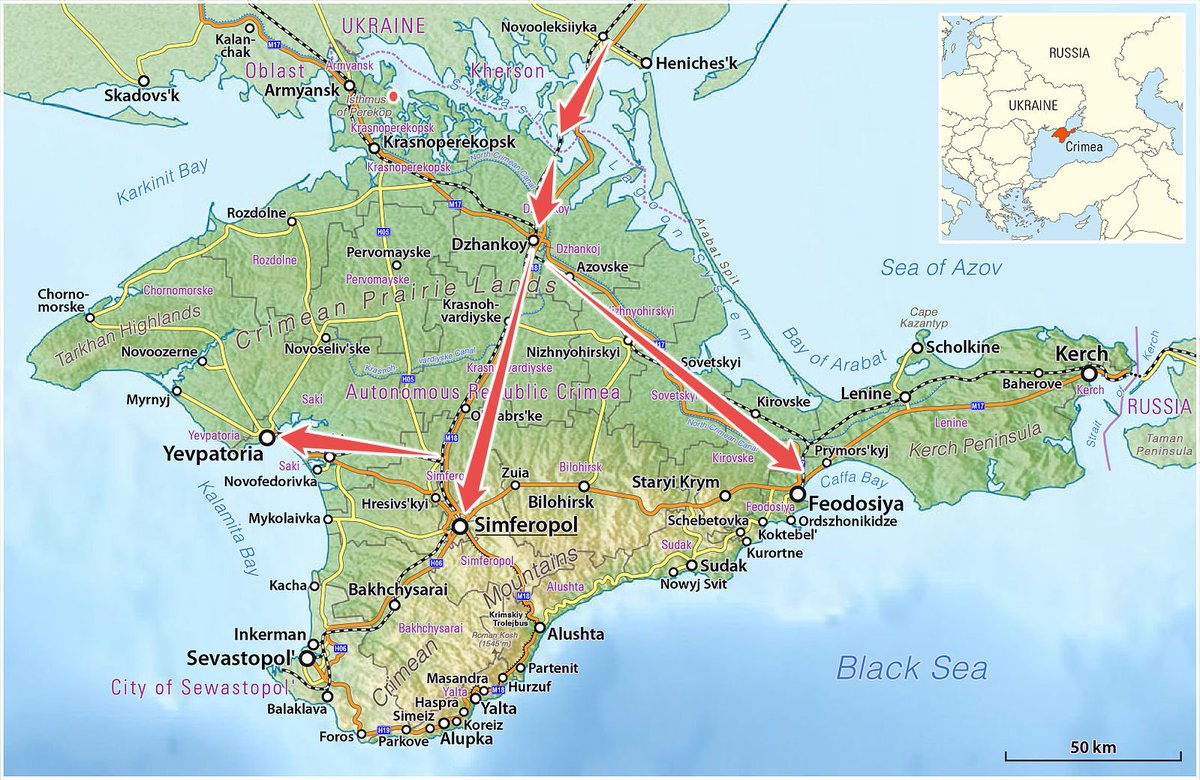
14/ Bolbochan never made it to his objective at Crimea. The Germans ordered the Ukrainians to leave and established a short-lived puppet state in Crimea that lasted until the German collapse in November 1918.
15/ By 1920 the peninsula was in the hands of the White movement. The Whites' military leader in the south, Pyotr Wrangel, attempted to lead an offensive from Crimea towards the Dnipro and Donbas in September-October 1920.

16/ Wrangel's offensive was defeated by the Red Army's Southern Front under Mikhail Frunze. He was driven back into the peninsula and retreated behind the fortifications at Perekop, which he had made even more formidable.
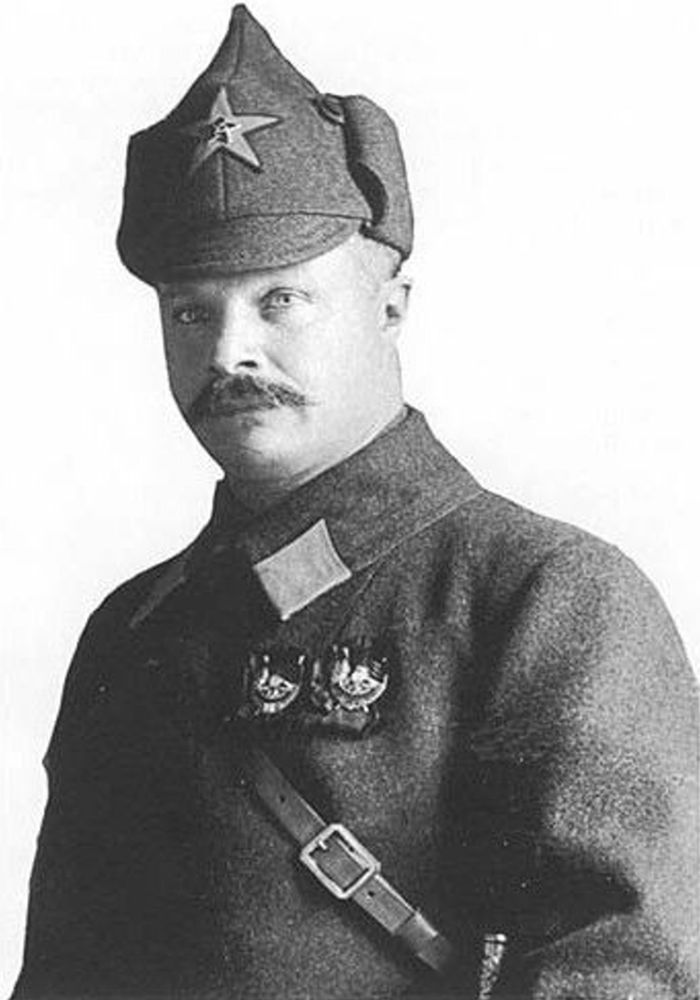
17/ The Whites had three lines of fortifications: the old Tatar Ditch which Wrangel had deepened and steepened, a line of trenches and emplacements in front of it, and outposts 2 km beyond that. It was guarded by 750 machine guns, 180 artillery pieces and an armoured train.
18/ Fortifications had also been constructed 20 km further south in the Ishun area, another natural chokepoint created by three lakes just to the east and the Black Sea to the west.
19/ The bridges on the Chonhar Peninsula connecting the Ukrainian mainland to Crimea had been blown up and more defences had been built on the Crimean side. The Arabat Spit was guarded from the sea by the White-controlled Azov Sea Fleet and on land by a Cossack regiment.

20/ Wrangel claimed that "the Crimea is impregnable." However, he was hugely outnumbered. Frunze had vast numerical superiority – 100,000 infantry and 40,000 cavalry, against Wrangel's 33,000 men.
21/ Wrangel had about 10,000 men at Perekop, 3,000 at Chonhar, 6,000 in reserve and the rest either on the Arabat Spit or fighting Bolshevik partisans within Crimea. He also had around 200 artillery pieces, 1,500 machine guns, 5 armoured trains, 20 armoured cars and 3 tanks.
22/ Although Frunze had a nearly 3 to 1 artillery advantage, artillery did not play a major role in the offensive – largely due to the inadequacies of his own artillery commanders – and air power was not a factor.
23/ Frunze, who obviously knew his military history, wanted initially to invade Crimea via the Arabat Spit just as Peter Lacy had done in 1737. However, he had to abandon this plan as the Reds' Azov Sea Fleet was unable to leave its base at Taganrog due to sea ice.
24/ Without naval support, an advance along the spit would have been hopelessly exposed. Frunze therefore switched to making a frontal assault at Chonhar and Perekop, with the main effort at Perekop.
25/ Frunze divided his force at Perekop in two. Taking advantage of a strong westerly wind and low tide, part of his force was able to ford the Syvash after 22:00 on 7 November 1920 and wade around 5 km to the lightly defended Litovsky Peninsula.


26/ Inexplicably, the Reds did not coordinate their attack against the Litovsky Peninsula with their main effort at Perekop. It was not until 13:00 on 8 November that the assault was launched.
27/ It was a disaster – a frontal charge into machine gun emplacements with little artillery support because of their commanders' incompetence, inexperience and a lack of coordination with the artillery. Some Red units suffered 60% casualties.

28/ Frunze called up reserves and managed to make a breakthrough on 9 November. His other forces attacked from the Chonhar Peninsula at midnight on 10-11 November, using log rafts to cross the narrow strait and infiltrate the White defences under the cover of darkness.
29/ The Whites fell back from Perekop to their second line of defences at Ishun. As the Reds pursued them to Ishun, the Whites feigned a retreat then confronted them with 150 tachanki – horse-drawn wagons carrying machine guns – which mowed down the Red cavalry.

30/ The defensive line at Ishun enabled the Whites to hold off the Reds for a few more days while inflicting heavy casualties on them. However, Wrangel realised the war was lost, as the Whites could not hold off the Reds for long.

31/ There was also no realistic possibility of them holding off the Reds on the plains of central Crimea. The entire region north of the coastal mountains in the south is a flat and featureless, and lacks any natural lines of defence or cover.
32/ By this time his army was also demoralised, short of men and had lost many of its weapons. Making a stand at Sevastopol was pointless.
33/ Wrangel ordered a retreat to Sevastopol during the night of 11-12 November. From there his army used the remains of the Russian Black Sea Fleet to evacuate itself to safety in Constantinople (Istanbul) and eventual asylum in France.

34/ The Reds made a leisurely advance to Sevastopol and took the remainder of the peninsula with little resistance. They had won, but at a very high price: they suffered around 10,000 casualties, against the 2,000 sustained by Wrangel's forces.
35/ Frunze had essentially won through sheer mass. He was proclaimed a hero and the victory became a key moment for the Red Army. It's still commemorated by a diorama in the Central Armed Forces Museum in Moscow.
36/ In my next threads, I'll look at the much bloodier battles in World War II as Nazi Germany and the Soviet Union invaded and reconquered Crimea, and then draw some conclusions for today's situation. /end
Part 4 is here:
https://twitter.com/ChrisO_wiki/status/1645516747129192448
• • •
Missing some Tweet in this thread? You can try to
force a refresh





