Abdulla A. Damluji, MD, PhD Profile picture
Apr 5 2 tweets 1 min read Twitter logo Read on Twitter
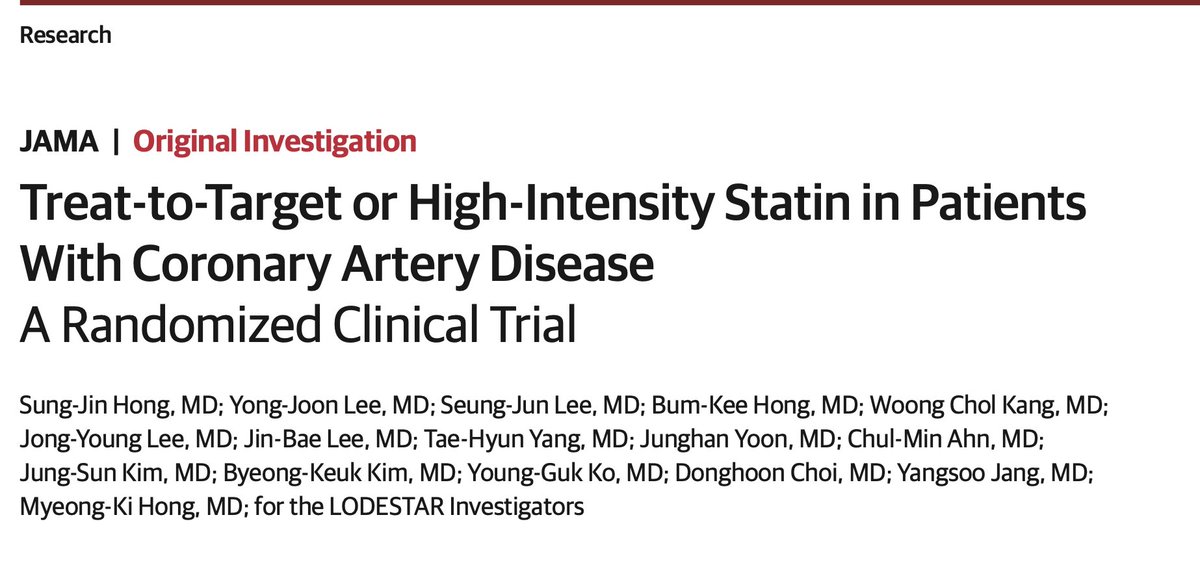
Treat-to-Target or High-Intensity Statin in Patients With Coronary Artery Disease A Randomized Clinical Trial: @JAMA_current

High intensity statin rate of MACE at 3 years = 8.7%
LDL target 50-70 mg/dL = 8.1%

Here is 10 point summary 👇👇👇 Image
MACE = composite of death, myocardial infarction, stroke, or coronary revascularization.

Noninferiority margin = 3.0%

• • •

Missing some Tweet in this thread? You can try to force a refresh

 

Keep Current with Abdulla A. Damluji, MD, PhD

Abdulla A. Damluji, MD, PhD Profile picture

Stay in touch and get notified when new unrolls are available from this author!

Read all threads

This Thread may be Removed Anytime!

PDF

Twitter may remove this content at anytime! Save it as PDF for later use!

Try unrolling a thread yourself!

how to unroll video
  1. Follow @ThreadReaderApp to mention us!

  2. From a Twitter thread mention us with a keyword "unroll"
@threadreaderapp unroll

Practice here first or read more on our help page!

More from @DrDamluji

Apr 4
Toll-Like Receptor 3 Mediates Aortic Stenosis Through a Conserved Mechanism of Calcification: @CircAHA

Mechanistic study: Toll-Like Receptor 3 = TLR3

Here is few point summary

👇👇👇 Image
1/ 🧪 This study identifies TLR3 as a key element in aortic valve calcification. BGN, a central component of the extra cellular matrix (ECM), induces the TLR3 signaling cascade, resulting in valvular interstitial cells (VICs) transforming into bone-forming osteoblast-like cells.
2/ 🔍 The study reveals the first direct interaction between BGN and TLR3 in the cell type primarily responsible for aortic valve calcification. This suggests that BGN may govern TLR3-dependent levels of basal type I interferons (IFN) in human fibroblasts.
Read 8 tweets
Apr 3
Alirocumab and Coronary Atherosclerosis in Asymptomatic Patients with Familial Hypercholesterolemia: The ARCHITECT Study: @CircAHA

5-point summary below: 👇👇 Image
(1/5)

🚫 This trial is a single-arm, open label, phase IV clinical study that evaluated coronary atherosclerotic plaque regression with a PCSK9 inhibitor in asymptomatic patients with familial hypercholesterolemia (FH)
(2/5)

💊 The study tested alirocumab (PRALUENT) at 150 mg every 14 days for 78 weeks + high-intensity statin therapy, and assessed plaque burden by noninvasive coronary CTA imaging in both men and women.
Read 7 tweets
Apr 2
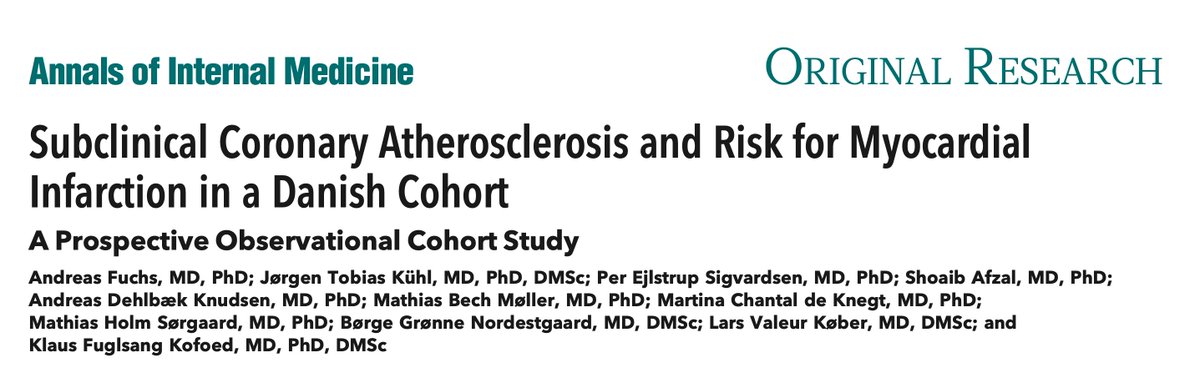
Subclinical Coronary Atherosclerosis and Risk for Myocardial Infarction in a Danish Cohort: @AnnalsofIM

Subclinical disease is common; CTA for prognostication!

Summary 👇👇👇👇 Image
1. This Danish study found that subclinical coronary atherosclerosis may be found in more than half of middle-aged men and one third of middle-aged women without known ischemic heart disease.
2/ The most common type of subclinical disease was nonobstructive and/or nonextensive coronary atherosclerosis.
Read 14 tweets
Mar 31
Angina After Percutaneous Coronary Intervention: Patient and Procedural Predictors: @CircIntv

1 in 3 patients post FFR guided PCI had symptoms, but delta FFR (pre vs post) may be useful predictor of post PCI angina!

Here is 10 point summary 👇👇👇
1. The TARGET-FFR randomized trial found that one in three patients reported angina 3 months after undergoing percutaneous coronary intervention (PCI), which is a substantial proportion but reported previously in literature.
2. Defining a level of post-PCI angina that might be acceptable to patients or represent a clinically meaningful improvement would be arbitrary metric, as improved but persistent symptoms may be considered a success by some patients yet be completely unacceptable to others.
Read 14 tweets
Mar 30
Influence of Culprit Lesion Intervention on Outcomes in Infarct-Related Cardiogenic Shock With Cardiac Arrest: @JACCJournals

Excellent: culprit-only is for AMI-shock and now for AMI-cardiac arrest - @thiele_holger

Here are few highlights, but pls read full study

👇👇
1. In CULPRIT-SHOCK, a cohort with infarct-related cardiogenic shock (CS), more than 54.2% had cardiac arrest (CA) before admission.

That is quite high!
2. Patients with cardiac arrest were younger and had fewer comorbidities, but had a higher rate of impaired end-organ perfusion on admission.
Read 13 tweets
Mar 30
Prognostic Value of Machine-Learning- Based PRAISE Score for Ischemic and Bleeding Events in Patients With Acute Coronary Syndrome Undergoing PCI: @JAHA_AHA

Editorializing: 3 major applications of AI/ML in medicine: automation, prediction, cognitive reasoning!

Summary 👇👇
1/📊This study investigates PRAISE score for predicting 1-year all-cause mortality, recurrent AMI, and major bleeding events in post-PCI ACS patients treated with DAPT.

Application for #prediction in medicine using 6433 ACS pts
2/🔍Study finds PRAISE score has moderate discrimination for all-cause mortality but poor discrimination for recurrent AMI and major bleeding in an Asian population.

(Chinese cohort)
Read 12 tweets

Did Thread Reader help you today?

Support us! We are indie developers!


This site is made by just two indie developers on a laptop doing marketing, support and development! Read more about the story.

Become a Premium Member ($3/month or $30/year) and get exclusive features!

Become Premium

Don't want to be a Premium member but still want to support us?

Make a small donation by buying us coffee ($5) or help with server cost ($10)

Donate via Paypal

Or Donate anonymously using crypto!

Ethereum

0xfe58350B80634f60Fa6Dc149a72b4DFbc17D341E copy

Bitcoin

3ATGMxNzCUFzxpMCHL5sWSt4DVtS8UqXpi copy

Thank you for your support!

Follow Us on Twitter!

:(