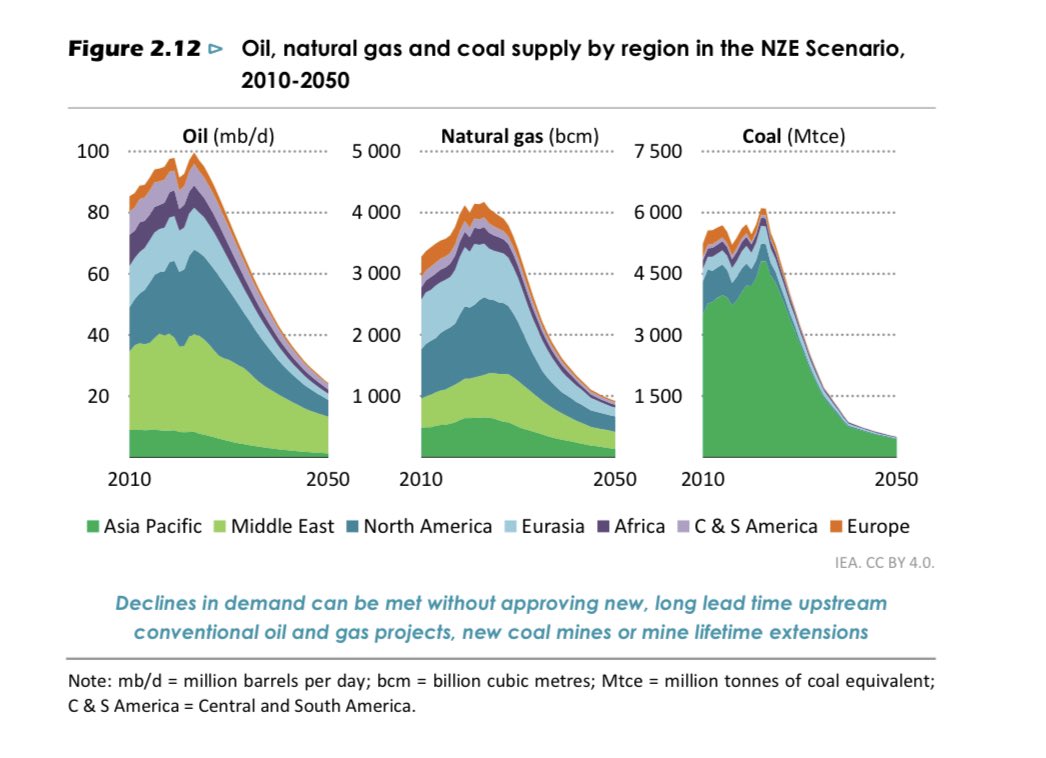
CHART OF THE DAY: On its net-zero by 2050 normative pathway (not forecast), the IEA says that oil demand needs to plunge from >100m b/d currently to 77m b/d by 2030 and 24m b/d by 2050 (in 2021, it said 72m b/d by 2030). #OOTT Full report pdf: iea.blob.core.windows.net/assets/7c02e77…
The 2030 target is unreachable. Pure and simple. And I think everyone knows it, including nearly everyone a the IEA.
Not even at the height of the covid-19 pandemic, with billions at home under lockdown and global GDP in free fall, did oil demand drop as much.
And we know what the IEA really thinks about 2030, because they published this year their forecast of the most likely oil demand path to 2028, showing consumption rising to >105m b/d.
So please, what’s the point of its net-zero model if their best knowledge says it won’t happen?
• • •
Missing some Tweet in this thread? You can try to
force a refresh

Teck’s shareholders are voting until Apr 26 on the company’s split in the middle of Glencore's $23bn hostile approach. By the weekend, Teck would have a good idea of where the vote is going. It needs 2/3 support of the voting B-shares.
Teck has tabled a plan to split the company in two (one mining base metals and another mining coal) – but keeping a financial link between them for years to come. You can read my take on the split – and why it amounts to greenwashing – below | 2/12 bloomberg.com/opinion/articl…
Typically, the Keevil family, thanks to its super-voting A-shares, controls Teck (despite owning just ~1% of the miner's equity). But because this is a company split, Canadian law gives the B-shareholders a chance to get their voice heard at par with the Keevils | 3/12
The full letter from Teck rejecting the unsolicited approach by Glencore is here: teck.com/media/Letter-A…
Teck also confirms our reporting on talks with Glencore:
"As you know, our respective teams engaged in conceptual discussions in 2020 regarding a similarly structured transaction and, following a careful review by our Board, we determined at the time not to proceed further"
I have written only one story about fusion energy. For my university's newspaper 25 years ago. Thankfully, it isn't online.
Since then, I'm skeptical of surprisingly well-timed announcements by budget-starved laboratories about breakthroughs for technologies decades away |🧵1/10
But first, the FT story (confirmed now by others, including Bloomberg) about the US Lawrence Livermore National Laboratory near San Francisco set to announce that a fusion experiment released more energy than the lasers used in the experiment emitted 2/10 ft.com/content/4b6f0f…
There's a caveat to the story. The same laboratory announced a slightly different breakthrough nearly a decade ago (by Nature), announcing it achieved a net energy output vs the energy **absorbed** by the fuel. The new breakthrough is superior | 3/10 nature.com/articles/natur…
Saudi Arabia has priced its oil in US dollars since 1974 and channeled the surpluses into the US Treasury market (aka, the petro-dollar recycling).
For a history of oil and the petro-dollar, read this good paper from the Journal of Energy History: energyhistory.eu/en/special-iss… 2/7
Historically, Riyadh has been reluctant to even consider shifting oil pricing away from the dollar.
In 2007, for example, a top Saudi official said the dollar could "collapse" if OPEC just talked about it. ft.com/content/33a4f7… (@Ed_Crooks surely remembers this one) 3/7
OPEC+ appears ready to become a "spectator" of the market (as one delegate put it to me) as the G7 oil price cap talks continue. As things stand, it's likely to keep its output unchanged when it meets virtually Dec 4, although a small cut isn't completely ruled out | #OOTT 1/4
OPEC+ remains concerned about the impact of a slowing global economy and China's covid-zero policy on global oil demand growth. So the cartel retains a decidedly output "cut" bias, and the group can call for an emergency meeting if needed at any point | #OOTT 2/4
But for now OPEC+ ministers take comfort that beyond a very shallow contango at the prompt, Brent remains backwardated further out. Oil demand growth is OK-ish and the SPR sales are winding down. Brent crude isn't too far from the $90-$100 range preferred by Riyadh | #OOTT 3/4
OIL MARKET: Washington eases its oil sanctions on Venezuela, allowing Chevron (for the next 6 months) to pump crude in the Latin American nation and export it into the United States. A major shift in the White House policy | #OOTT#Venezuela $CVX 🇻🇪 ⛽️ 🇺🇸
The easing of the oil sanctions come as the Venezuelan government and the democratic opposition re-started talks, brokered by Norway and Mexico. The talks between the two sides are the first direct contact in a year | #OOTT
A bit of extra context: before the sanctions were imposed, the joint-ventures between Chevron and PdVSA, the Venezuelan state-owned oil company, pumped about 200,000 b/d. So that's probably as much extra crude as we can expect -- and that will require time, money and expertise