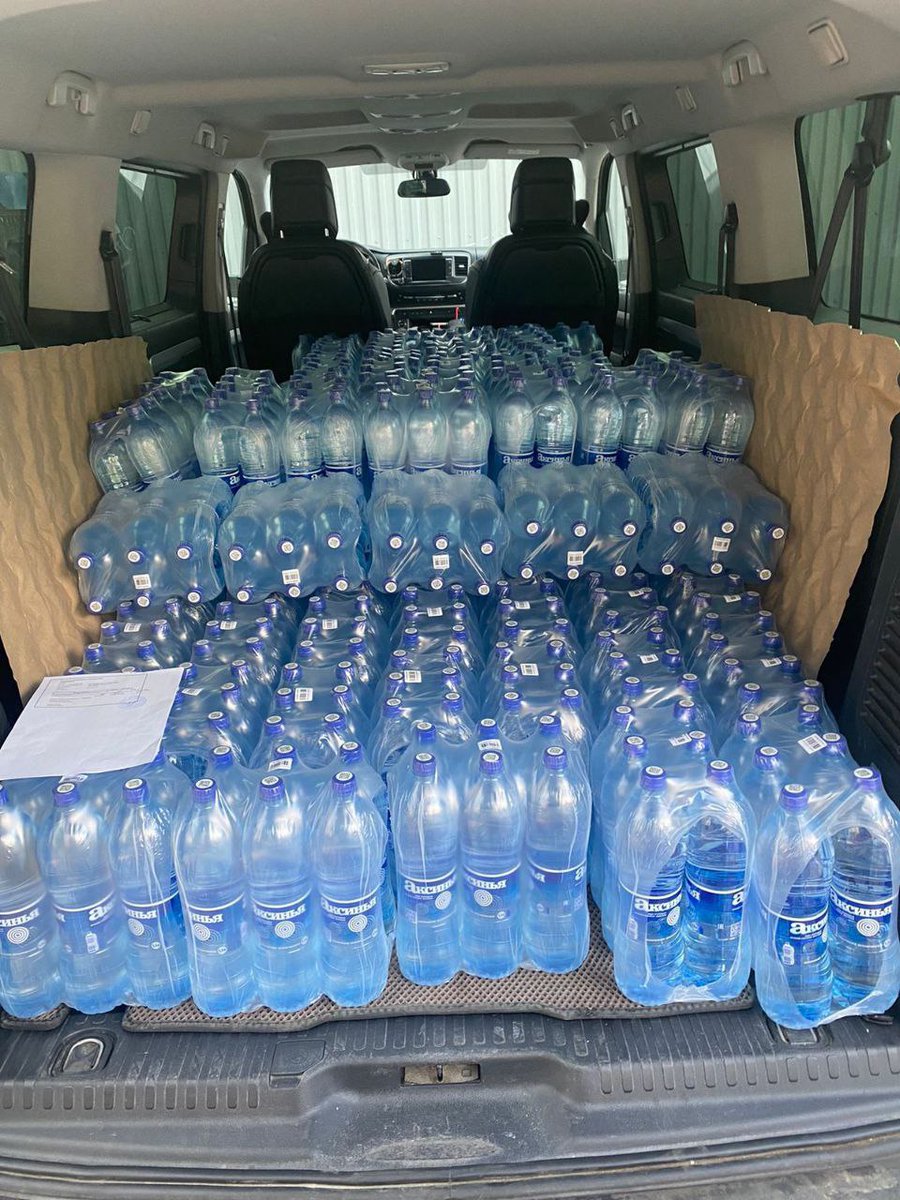
1/ Russian forces in southern Ukraine appear to be experiencing an increasingly desperate shortage of water. Water rations for all personnel – from soldiers in the trenches to fighter pilots – are now limited to only 1 l (36 oz) per day, as little as 8% of what they need. ⬇️
2/ The Fighterbomber Telegram channel last week posted an appeal to Russian companies to supply Russian Air Force regiments with bottled water. It reports that 3,300 litres have now been donated to one airfield – enough to last a month.
3/ However, seven more regiments still need a total of 23 tonnes of water (23,000 litres / 6,000 US gallons). The huge shortfall almost certainly indicates a major breakdown in Russian logistics across the region, exacerbated by drought and the destruction of the Kahkovka Dam.
4/ The channel notes: "The standard of one litre of bottled water a day is not only for pilots. It's the same for the whole army, but now they've added pilots to it.
It's the same for those in the trenches."
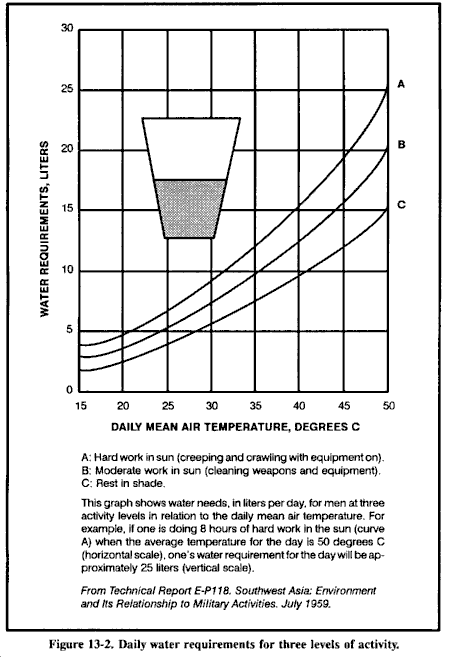
5/ This quantity is far below what is needed. According to this chart (thanks @TrentTelenko), at current temperatures of 30-35°C men are likely to need between 7-13 litres per day if they are carrying out moderate to hard work. They are getting between 8-15% of this amount.
6/ Not surprisingly, Russian soldiers on the front line are taking increasingly desperate measures to obtain water, such as creating crude filters to try to strain out contaminants, or simply drinking untreated water directly from puddles.
7/ Given that ground water in the vicinity of trenches is likely to be contaminated with human feces, spilled fuel and decaying corpses, it's probable that Russian troops are experiencing significant rates of water-borne diseases.
8/ While this is likely to affect combat effectiveness through dehydration and disease, it's possible that Russian casualties are so high - reportedly currently 1,200 per day – that they are dying so quickly that many do not have time to get ill.
1/ Iran is seeking to establish a pay-to-sail regime in the Strait of Hormuz, under which it could earn over a quarter of a billion dollars a day. A senior member of the Iranian parliament says that vessels seeking to transit the strait will be charged $2 million each time. ⬇️
2/ The Financial Times and Rudaw report that the Iranian government intends to fully monetise the strait by forcing passing ships to pay a fee for each passage. The "new regime" has been announced on state television by Alaeddin Boroujerdi, a senior Iranian parliamentarian.
3/ Boroujerdi, a member of the parliament's National Security Committee, said that "For some ships which cross, for whatever reasons, Iran is charging them $2 million for the crossing ... In practice we have established a new regime governing the Strait of Hormuz after 47 years."
1/ Claims by pro-Russians that Ukrainian drone attacks on Russian Baltic ports went via Poland and the Baltic states have been met with scepticism by warblogger 'Fighterbomber'. If that's so, why has Russia not protested to those states?, he asks. ⬇️
2/ 'Fighterbomber', who has close links with the Russian Air Force, points out what Conan Doyle might have called the dog that didn't bark: the fact that the Russian government has said nothing about Ukrainian drones supposedly being routed over NATO territory:
3/ "Well, first of all, the airspace bordering Russia has been closed in countries like Poland and the Baltics for a long time.
Accusations from beauty bloggers that drones are being launched from the territory of these countries have been circulating for several years as well.
1/ With American ground forces building up in the Gulf region, much attention has been paid to Kharg Island in the northern Persian Gulf. But what about the Iranian-held islands in the Strait of Hormuz? Here's why they might be a higher priority for possible landings. ⬇️
2/ Seven Iranian-controlled islands punctuate the narrow strait between Iran and Oman: from west to east, Abu Musa, Greater and Lesser Tunb, Qeshm, Hengam, Larak and Hormuz itself. All are part of Iran's Hormozgan province.
3/ Two more Iranian islands, Bani Forur and Sirri, are located further west, in the Persian Gulf proper. They have strategic value as locations for reconnaissance, surveillance of shipping traffic, and possible interdiction. Both have an Iranian military presence.
1/ The Ukraine war is a "dead end" which "could last for a hundred years", according to a gloomy Russian commentary. The transparency of the battlefield and its domination by drones has made large offensives "downright impossible" and is causing vast numbers of casualties. ⬇️
2/ 'Voenkor Kotenok' has written a long and detailed analysis of the situation at the front lines, following similarly gloomy outlooks by other warbloggers (see the thread below).
3/ "I have repeatedly pointed out that the front in the Ukrainian theatre of military operations is in a stalemate. This situation took shape last year, marked by the Battle of Pokrovsk.
1/ An experiment by Russia's FSB has indicated that thousands of Russians are likely to be willing to carry out sabotage attacks on behalf of Ukraine or other foreign actors. In only three hours, the FSB recruited ten would-be saboteurs via Telegram. ⬇️
2/ Russia has experienced regular sabotage attacks carried out by people who have been recruited by foreign agents over the Internet, usually via Telegram. They are sometimes tricked into thinking they are working for the Russian security forces.
3/ More often, however, saboteurs act purely for money. Russia has used the same methodology to recruit saboteurs in Ukraine and elsewhere in Europe.
1/ Russian warbloggers are increasingly concluding that the war in Ukraine is stalemated and cannot be won by military means. Two prominent warbloggers have published gloomy commentaries explaining why. ⬇️
2/ 'Fighterbomber', a blogger with links to the Russian Air Force, comments:
"We still have 15% of Donbas left to liberate, and then Donbas will be liberated.
In my opinion, we have three main options."
3/ "The first is to continue the creeping offensive with varying success, regardless of losses, which will be, to put it mildly, very heavy.
Judging by the current slow pace, that [needs] at least five years.