The British CEO who plotted to k*ll @ElonMusk's 𝕏 has now been caught orchestrating a “BLACK OPS” campaign to silence Robert Kennedy Jr.
What this means is there was a covert order by the UK's CCDH to shut RFK Jr. down by any means necessary because they were “nervous” about his “impact” on “the election.”
Why is the UK's Center for Countering Digital Hate (CCDH) orchestrating a “black ops” operation on a US political figure?
While the mainstream media shouts, “Russia! Russia! Russia!” it seems the real foreign election interference is coming from the UK’s censorship czars.
🧵 THREAD
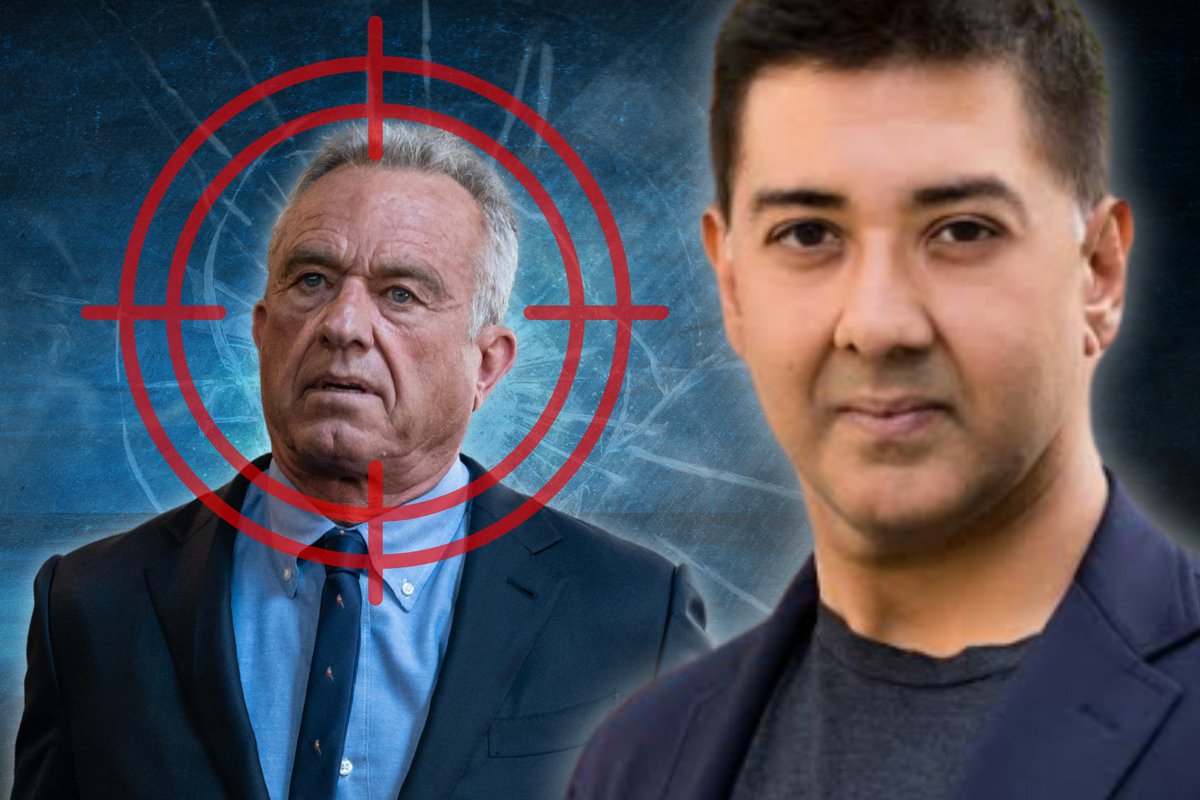
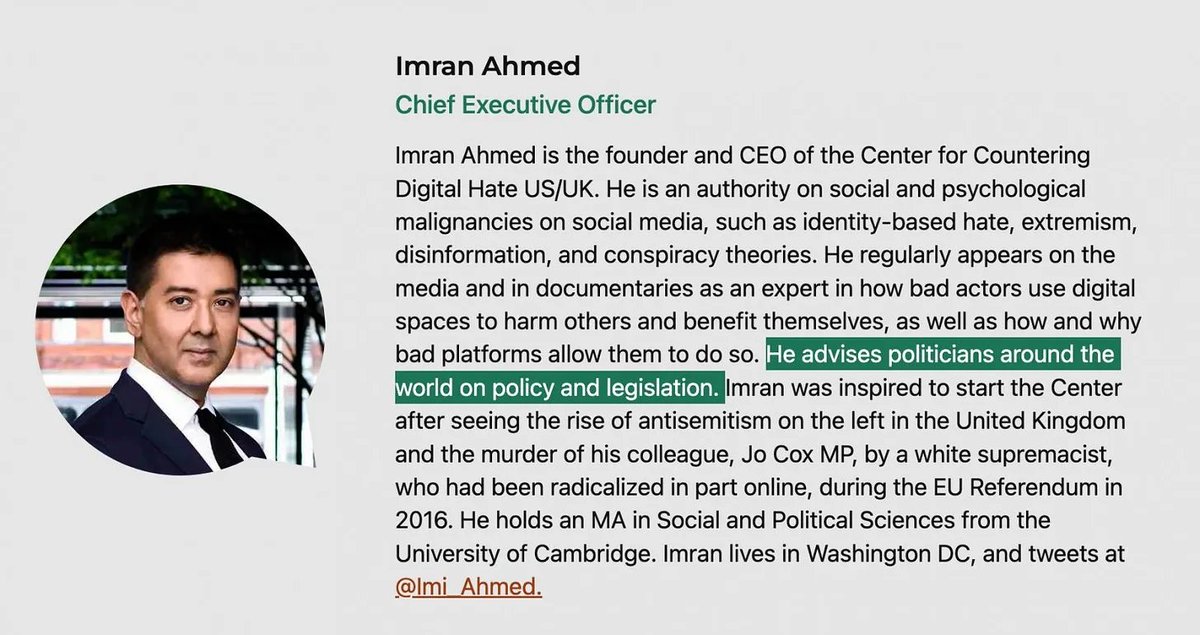
The man pictured in this image, Imran Ahmed, is the “founder and CEO of the Center for Countering Digital Hate (CCDH).”
“He advises politicians around the world on policy and legislation.”
A bombshell report by seasoned journalists Paul D. Thacker and Matt Taibbi revealed that one of CCDH’s “annual priorities” was to “kill Musk’s Twitter” and to drain its revenue stream by shaming and harassing advertisers away from the social media platform.

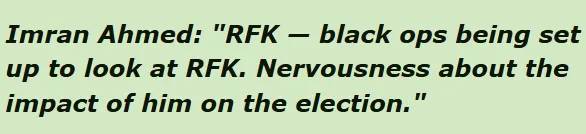
The story about the “black ops” operation launched against Robert Kennedy Jr. starts with a shocking statement made by Ahmed himself during a meeting on January 8, 2024.
He said, “RFK - black ops being set up to look at RFK. Nervous about the impact of him on the election.”
"Black ops" (short for "black operations") typically refer to covert operations that are carried out in secret, often by military, intelligence, or government agencies.
While black ops can involve a wide range of activities, including intelligence gathering and cyber espionage, they are often associated with violent or aggressive actions, such as assassinations, sabotage, or paramilitary strikes.
The key characteristic of black ops is secrecy and plausible deniability, meaning that even if they are discovered, the entity behind them can deny involvement.
Source: @sayerjigmi
CCDH (Center for Countering Digital Hate) claims to be a non-profit organization that combats “hate,” yet it uses violent undertones in its language, like “black ops,” to target a US political candidate.
The level of aggression and hypocrisy here is off the charts.
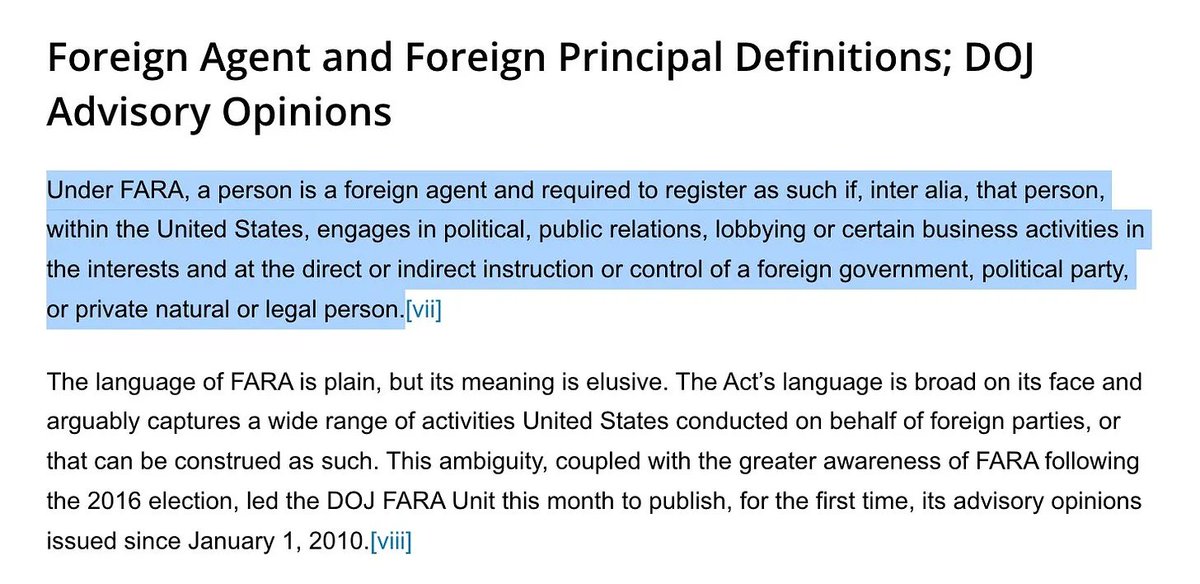
The revelations about CCDH’s “black ops” against RFK Jr. raise some serious legal concerns. If this UK-based organization is actively trying to influence U.S. elections, it could be violating key U.S. laws—especially the Foreign Agents Registration Act (FARA).
This law requires foreign entities involved in U.S. political activities to register as foreign agents, something CCDH has not done.
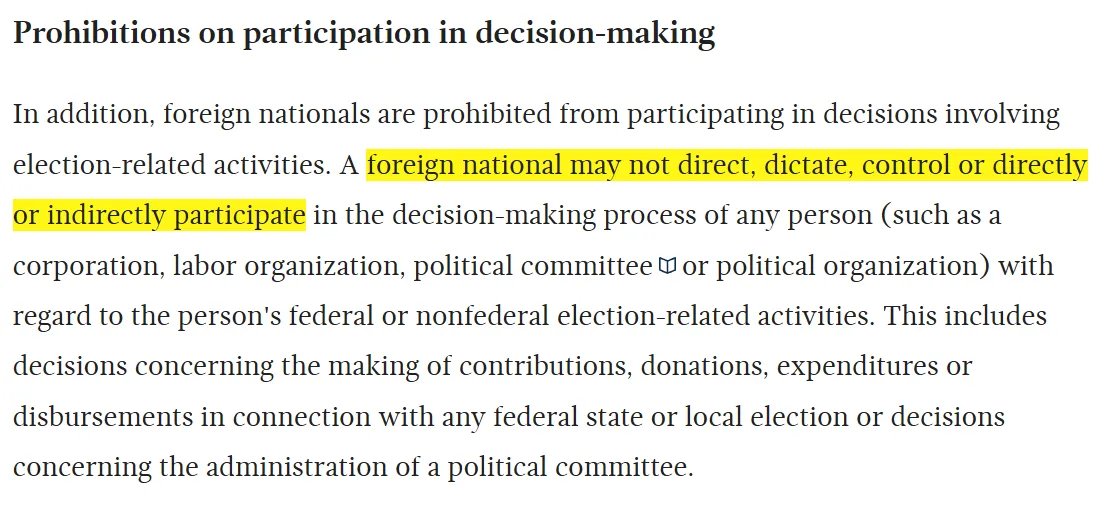
On top of that, CCDH’s tactics could run afoul of the Federal Election Campaign Act, which bans foreign nationals from making any contributions or engaging in activities that influence U.S. elections.
By running covert operations aimed at shutting down a political candidate like RFK Jr., CCDH may have crossed a line into illegal territory—engaging in what looks a lot like foreign interference in a US election.
Thanks for reading! If you found this revelation as alarming as I did, please do me a quick favor and share this thread before you go.
A New York Times reporter did the unthinkable and exposed the “worst test in medicine” — the one that five decades of evidence says doesn’t work.
The research is damning: continuous fetal monitoring raises C-sections by 66% and instrumental deliveries by 16%, with no drop in infant deaths or disability.
It flags a problem that usually isn’t one, and doctors rush to cut the baby out.
It’s not just a false flag problem; it’s a money incentive. Sarah Kliff says the quiet part out loud:
“Nobody gets sued for doing the C-section. You only get sued for not doing the C-section.”
Doctors are so terrified of legal consequences that they’ll push unnecessary surgery on their patients, not for the baby’s health, but to protect their pocketbooks.
That’s how the cascade starts. In a hospital delivery, one intervention triggers the next. It’s like an avalanche that can’t be stopped.
Next thing you know, you’re recovering for weeks from a major surgery you never needed.
If someone you love is about to have their first baby, share this before they ever set foot in a labor and delivery unit.
@MidwesternDoc investigated what hospitals don’t tell you about birth outcomes, and it only gets worse from here. 🧵
For most of human history, childbirth happened at home, guided by a midwife who had already done this hundreds of times.
Today it’s one of the most heavily monitored, medicated, and surgical events in modern medicine.
Something clearly changed, and it’s not women’s bodies. They’re just as capable today as they were thousands of years ago.
But today, most parents walk into a delivery room having no idea what may happen next—or why.
This information comes from the work of medical researcher @MidwesternDoc. For all the sources and details, read the full report below. midwesterndoctor.com/p/the-hidden-d…
At 17, Amy Tippins was dying of liver failure. A transplant saved her life.
After the surgery, she noticed “some of my traits had changed.”
Amy suddenly found herself drawn to hands-on home projects she’d never cared about.
“What gives?” she thought. So she tracked down the obituary of the stranger whose liver she’d received and discovered something staggering:
“Not long after surgery, some things about myself and some of my traits had changed… I really started to love projects like replacing flooring on my own. I never saw flooring being put in. I never saw anything like that being done.”
“I knew he was 47 and that he had been killed in a car wreck in Columbus, Georgia. So I went to the library and I started looking up obituaries for that time. And I backed into his obituary.”
“What I discovered is he was a police officer. He was 47, and his name was Mike. His sister told me that he did a lot of his own home renovation. He also liked to work with his hands. He liked to do projects.”
“When I found out who my donor was, it made a lot more sense on why some things about myself and some of my traits had changed after transplant.”
Is a donated organ just an organ? Or can it actually change who you are?
Conventional medicine laughs at the idea. But is it really so crazy?
Let’s take a look at the evidence. 🧵
When organ transplantation became possible, doctors called it a miracle. And it is. Giving someone a second life through another person’s death is incredible.
But the full story isn’t quite so simple.
Oftentimes, something else seems to come with the organ. Something nobody signed up for.
The standard model is pretty straightforward. Your heart is a pump. Your kidney is a filter. Personality and memory live in the brain, and nowhere else.
Swap a failing organ for a healthy one and you’ve simply updated the plumbing, not the person.
But that’s been nothing more than an assumption.
For decades, a significant number of cases has been building up that say otherwise.
This information comes from the work of medical researcher @MidwesternDoc. For all the sources and details, read the full report below.
Before the hepatitis B vaccine was mandated for kids to attend school in almost all 50 states, the risk of a baby dying from hepatitis B was 1 in 7 million.
“That means you need to give 7 MILLION hepatitis B vaccines to prevent ONE death,” RFK Jr. says.
When you give 7 million vaccines to save one life, you’d better make damn sure it’s safe.
But is it really? Let’s take a look at the evidence. 🧵
Every newborn in America is pushed toward a Hepatitis B vaccine within hours of being born.
And that sounds completely normal to most people because the policy has been normalized for decades.
But when you take a close look at Hepatitis B, the risk group, the benefit math, and the forgotten safety record, the birth-dose policy becomes very difficult to defend.
Hepatitis B is a real disease.
Chronic infection can damage the liver, lead to liver failure, and increase the risk of liver cancer later in life.
That part is not the dispute.
The dispute is whether every newborn, including babies born to mothers who test negative for Hepatitis B, should receive the vaccine on their very first day of life.
You may have missed this news recently - the health insurance system in America is so broken, that the Trump administration is quietly rewriting the Affordable Care Act and buried deep in a monstrous 1,000+ page document is a ploy to let health insurance companies start lending money to patients to pay for their medical care.
That's right: if you get hit with a devastating diagnosis or an unexpected emergency, your "insurance" company won't just pay the bill... they'll offer you a loan instead. So you can go deeper into debt to the very same industry that's already failing you.
Let me say that again. You pay health insurance so that you'll be insured in a time of a health crisis. Already, health insurers are denying nearly 20% of claims and out of pocket expenses keep rising. So instead of them paying your bill, which is what you pay the insurance for, they'll now be incentivized to deny even more bills or raise out of pocket expenses in order to cash in on the interest they'll be collecting.
A third of American households are already drowning in medical debt — and now insurers get to pile on even more, with interest. While these companies rake in billions in profits, everyday people will be trapped paying back loans for the care they thought was "covered." This isn't fixing healthcare.
This is turning your health insurer into your loan shark — and making an already predatory, dysfunctional system even more financially crushing for ordinary Americans. Classic "you get sick, you go broke" American healthcare — now with extra debt servitude.
On the plus side, there is a company that is providing a solution to this problem. CrowdHealth, a member focused health care company is saving Americans tens of thousands of dollars, and in May of this year 100% of medical bills were funded.
No loans needed. No exorbitant premiums. No crazy out of pocket expenses. A model that is actually working, is not throwing Americans into bankruptcy because of an unexpected health event, is saving people money, and getting them the health care they need.
Andy Schoonover from CrowdHealth joins us now to discuss.
A billionaire recently mused that the ultra-wealthy get the top doctors, the best lawyers, the elite tutors, and wondered aloud what it would take to give every American that kind of access. Andy’s answer is that it already exists, just not the way Reid Hoffman imagines it.
Inside CrowdHealth, your income doesn’t decide your doctor. “Whether you’re making $30,000 a year or $3 million a year, you have access to the same doctors.” Members up and down the economic ladder have walked into Mayo, MD Anderson, Stanford, Cleveland Clinic.
The real threat to that access isn’t money. It’s bureaucracy. As government plans expand, the best doctors are quietly heading for the exits. Mayo Clinic recently dropped a slate of Medicare Advantage plans rather than swallow the government’s reimbursement rates. Andy’s read on the pattern is blunt: “Free markets tend to exit stage left and the government bureaucracy enters as the main character.”
His prediction is that within a decade the top doctors stop taking insurance entirely. CrowdHealth’s bet is that members who already pay doctors directly are built for exactly that world.
But cash-pay only matters if the money actually arrives when you’re the one in the hospital bed. So how does a crowd of strangers guarantee your bill gets paid?
Health insurance in America is broken.
Over 200,000 Americans go bankrupt because of medical bills every year—and many of them already had insurance. On average, 20% of claims are denied, leaving families stuck paying massive out-of-pocket costs after spending thousands on premiums.
But there’s an alternative.
CrowdHealth is a community-powered model that has helped members fund over 40,000 medical bills at a fraction of the cost of traditional insurance.
So far, 30,000+ members have been helped, saving an estimated $73 million in medical costs.
CrowdHealth isn’t insurance. It’s a way to step outside the broken system and take control of your healthcare.
Get started today for $99 per member per month for the first three months.




