1/ This is a thread on the results from #LOCOME project (links at the end) which involved work by @precisionlifeAI. Excited to say once again that when different methods identify the same "hotspots", it raises our confidence about these findings. Let's see why :
2/ In the study by @precisionlifeAI a total of 259 genes were identified as core genes as shown below. Observe the associations discussed (Inflammation, Cellular stress response etc). The question is : What can we make out of this gene subset? cc @Michaeltikus
3/ Here is a snapshot of these genes with some of them being annotated. The annotated ones are ABCA1, CYP7B1, CH25H, ABCC6, UGGT1
4/ From my presentation at EUROMENE (2018) : ABCA1, CYP7B1 note also the term "Oxysterols"
5/ Looking at CH25H, why is it important? I hypothesize it is a key aspect of impaired immunity but immunologists are the ones who should be looking at this : see where CYP7B1 and CH25H are located (also from my presentation in 2018) :
6/ In an interview by @CortJohnson I explicitly mentioned CH25H as well as Ubiquitination (also later confirmed on another study) : Link of interview : healthrising.org/blog/2023/10/2…
7/ Moving on now to ABCC6. Some tweets :
8/ Another finding from this study points to brain synapses and glutamate. Other associations with calcium metabolism which have been mentioned during today's presentation by @precisionlifeAI , I have also seen and are confirmed. Probably relevant to mitochondria.
9/ As I mentioned many key areas are coming together and hopefully I shared an example on how we should be working to make sense of these genes. I am preparing a presentation with latest updates and key areas to focus our research efforts, will post soon. UGGT1 is part of it.
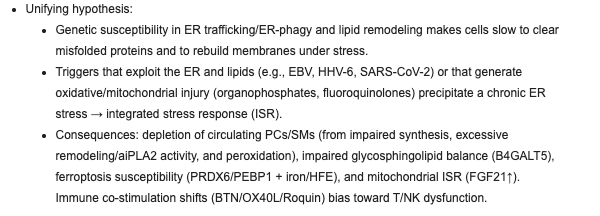
1/ Another coincidence given my recovery ? Below is a causal hypothesis and interventions using the best performing #AI model (Full info included at the end of this thread). The causal hypothesis is for an "unknown syndrome" (however, findings related to #MECFS were used)
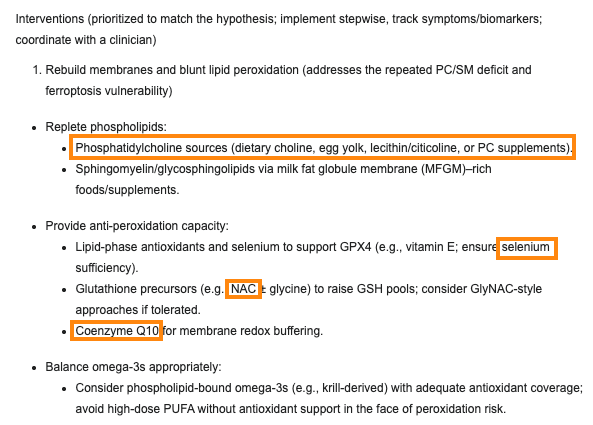
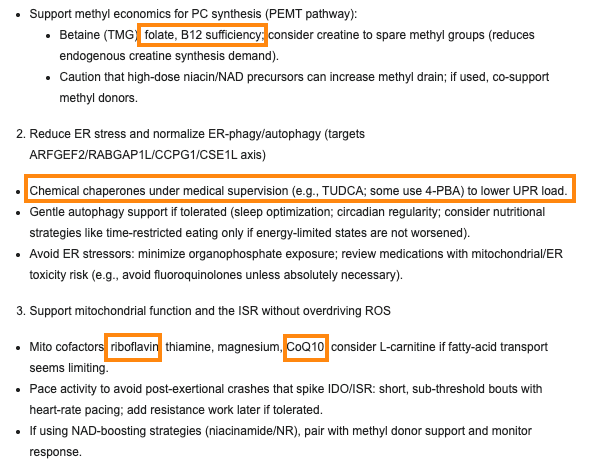
2/ So what are the proposed interventions ? A part of the answer is shown here, observe the annotated ones and also that a specific order of interventions is used :
3/ The reasoning engine explains why such order is important. Note that we begin by restoring the cell membrane (cc @tamararivc ). Steps 1 & 2 are shown above. ISR = "Integrated Stress Response"
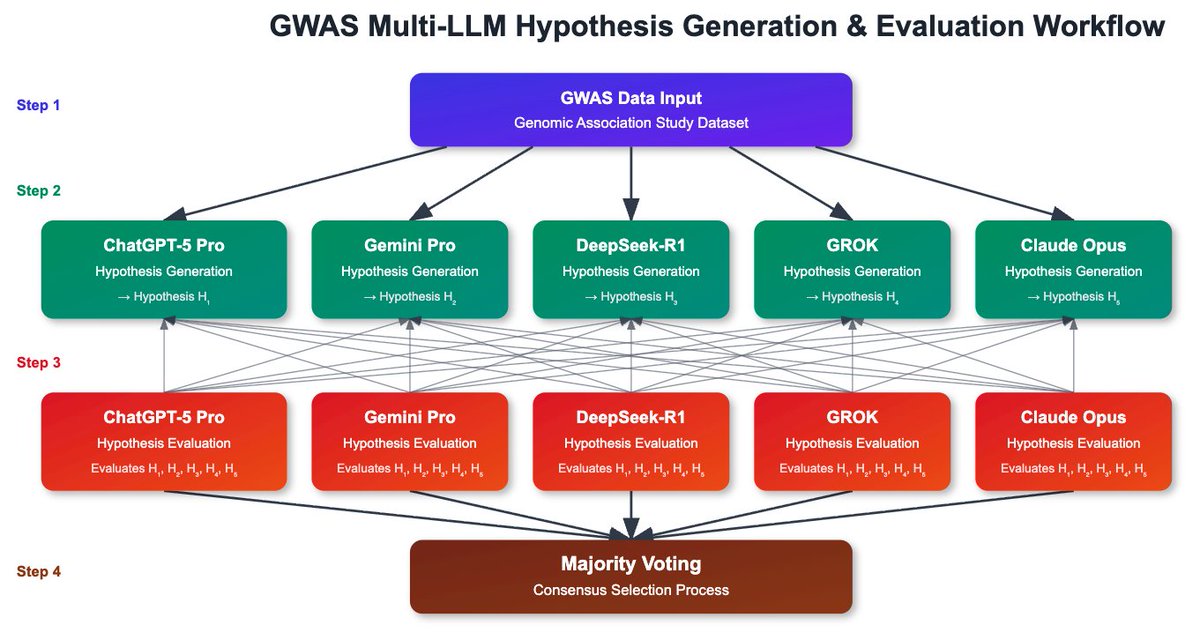
1/ This is a thread on the use of 5 #AI reasoning engines in order to better understand #MECFS given the latest results by @DecodeMEstudy #GWAS study. I want to express a huge "Thank you" to @genspark_ai : Without your tools this would have not been possible!
2/ I wanted to simulate a committee of 5 "experts" hypothesising on what is behind #MECFS while presenting different layers of information. Then, each "expert" checked hypotheses of other "experts" and gave which one is best.
3/ The clear winner was the hypothesis by @OpenAI #ChatGPT5 Pro. *All* "experts" agreed that it is the most concise of all others. During the process, novelties on reasoning were also identified. For example, relevance of Ubiquitin Proteasome System was picked only from #Deepseek
1/ I would like to share my personal experience with LOLA (L-Ornithine / L-Aspartate) supplementation and also an update from using it. When Dr Wenzhong Xiao first mentioned it to me, I told him about my first experience from using it which was in 2019. Back then, LOLA ..
2/ ...did not seem to "feel" right for me. I did not feel unwell but I had some strange lightheadedness after taking it so I decided not to move forward in further supplementing it. Given our recent publication (see below) & patient comments I decided to try it again, this time..
3/ ...using a different LOLA supplement brand from the one I used. In 2019, I did not have many buying options for LOLA (which is used for hepatic encephalopathy). I can definitely now say it is working for me. Total dosage is 2 grams / day, spread in 4 doses.
1/ 🧵 I am excited to share the latest results -as a hypothesis- , using computational #AI analysis applied to #MECFS and #LongCOVID research. To the best of my knowledge, this application of #AI is the first of its kind in #MECFS and #LongCOVID research.
2/ 🔍 How it was done : First, several AI models were given relevant information on what we know from various studies. Particular weight was given to replicated findings. Most common symptoms of #MECFS and #LongCOVID were provided and also a detailed list of syndrome triggers.
3/ 👉 Key point : Every mention of #MECFS, #LongCOVID, #PostViral, #PostInfection was removed from the text of the studies as these entries could potentially bias the reasoning process. The prompt given mentioned about an "unknown syndrome".
1/ I am amazed with @genspark_ai and what it could potentially do for medical applications. The reason for my amazement is the"Mixture-of-agents" approach . Here is the interaction for an imaginary #MECFS patient. Tagging @DeryaTR_ :
2/ What happens next, is that the prompt given is submitted to three Large Language Models (LLMs) and each LLM gives its response. In our case these LLMs are #GPT4o #Claude and #Gemini. Note also the "Reflection" dropdown which is where things get interesting
3/ Here are the responses from the 3 models responding to my prompt. There are many similarities but also some differences. And here is where "Reflection" comes in. What "Reflection" does is to compare the responses and identifies where they agree, where they disagree and....
1/ It is really exciting when different analytical methods and efforts converge to the same results. I looked at @DeryaTR_ docs that contain the output from @ManusAI_HQ. ManusAI was asked to perform Deep Research analysis for #MECFS and suggest hypotheses..
2/ Among the results we see peroxisomal dysfunction, a mention on PEX Genes, Peroxisome Proliferators (PPARs) among others (cc @chydorina).
3/ Also, we see a mention on PGC1α activators among potential interventions , the NRF2 pathway and also mentions of Autophagy and Heat shock proteins :