Since around 2010, the minority has essentially filibsutered everything. Then they either negotiate to a UC agreement, or force the majority to try to get to 60 votes for cloture to end debate. Almost nothing passes anymore by majority, without a UC agreement.
But it still can! If debate ends naturally or you can break a talking filibuster, you can still pass legislation with less than 60 votes. Has always been true.
Trying to wait people out and break a talking filibuster is near impossible. Getting a UC time agreement on strong party priorities is hard. And so the leaders have resorted to starting the process by filing cloture petitions before anyone debates.
As soon as the motion to proceed is made, the majority leader files for cloture. They then try to negotiate off the floor to get to 60 votes, and do other stuff on the floor while the petition ripens (2 days). If the they the 60 votes, they do the same thing with bill.
This results in a situation where no one actually filibusters by talking. Which is totally bizarre, but in some ways is a reflection that the filibuster has always been about raising the costs for the majority rather than principled debate.
The current system helps both sides in some sense: the majority can do other things and use the floor while it works on getting to 60, the minority doesn’t have to stand and talk. Nobody has to be up all night. Also good for lazy Senators.
Talking filibusters now are usually reserved for spectacles, either by Big Mad individuals, or parties that want to highlight minority recalcitrance. And they are rare. But the minority can do it, and the majority can force them to—nothing is stopping either side!
Now, many people want to change the Senate rules. This is beyond the scope of this thread, but a few words. First, that’s also by majority in the Senate, but is also debatable. And rules changes have a cloture threshold of 67 votes.
There is also the so-called nuclear option, where bare majorities can set precedents and back-door change the rules. This is how the cloture threshold was lowered on nominations in 2013 and 2017.
Some people in both parties would like to change the filibuster rules on legislation, either by abolishing it or making a talking filibsuter tougher on the minority. Either could be accomplished by rule changer or nuclear option.
Right now, the votes aren’t there. And that is the final word. The Senate rules aren’t magic, and if you don’t have 50 votes, you really can’t do anything, no matter how hard you wish you could.
• • •
Missing some Tweet in this thread? You can try to
force a refresh

Sadly, I have to (mostly) concur. If solution to military pay was not some clever way to xfer RDTE $ to MILPERS, but that they just decided to just spend RDTE $ on MILPERS, that's an absurdly egregious violation of constitutional/statutory approps law. 1/
As noted, this isn't the worst-case-scenario you can think of on the *facts,* because (1) paying the troops has wide support; and (2) the affected RDTE accounts will probably be squared in the future. 2/
But this is, indeed, a POTUS move that hints at the total upending of duration/amount/purpose restrictions on approps. You know, the ones that date back 400-500 years, when parliament transitioned from "supply" to "appropriations" to reel-in the King. 3/
Ok. Impoundment. Some links to relevant authorities and commentary, and then thoughts of my own. What Trump is proposing potentially amounts to an upending of the separation of powers, and while that's not *inherently* bad, in this case it's bad. Very bad. 1/ 🧵
1. The facts: last night, the Trump administration, via OMB, put out a memo directing a agencies to temporarily pause all obligation or disbursement of federal financial assistance. 2/
2. The memo is couched in terms like "consistent with law" but under current law and court precedent, the only way POTUS can temporarily pause spending of appropriated funds is via the Impoundment Control Act, which requires specific notice to Congress, which isn't mentioned. 3/
Remember that the viva voce voting in the House for the Speakership is done in alphabetical order; you can wait and vote at the end (or change your vote), but the order of the roll has several implications. 1/
First and most important, if you are early in the alphabet you can credibly to a dissenting vote, in a way you can't from the back of alphabet. Biggs can credibly signal better than Roy. 2/
The reverse if also true; if you talk tough from early in the alphabet in the days leading up to a revolt, your have to back it up. If someone with a B name is talking revolt and then gets cold feet and either votes Johnson or waits, it can cascade and end a revolt. 3/
Ok, Gaetz's House seat. Things I am certain about:
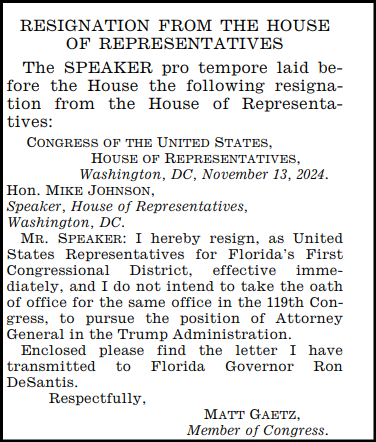
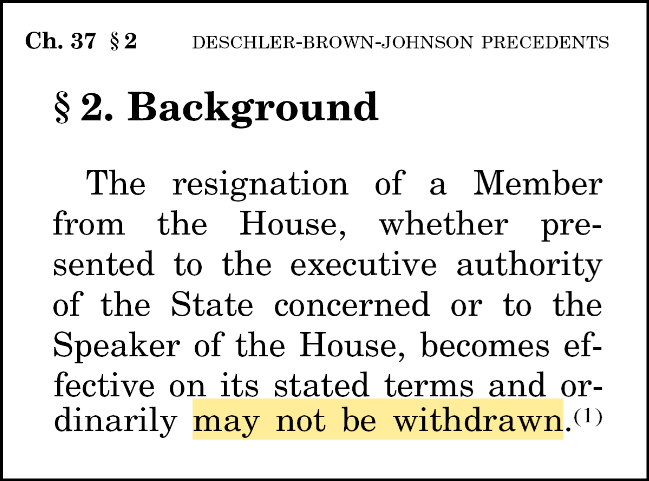
1. Gaetz may not come back to the 118th Congress. He has resigned his seat, and there are no backsies for Members who resign their seat. (h/t @ringwiss on precedent.) 1/
2. A Member-elect may resign their seat prior to being sworn-in to office. 2/
Things I'm not sure about:
1. Did Gaetz actual resign from the 119th Congress? He said in his resignation from the 118th that he "did not intend to take the oath of office" for the 119th. I can read that both ways as to whether he actually resigned. 3/
For all the talk about this & that & whatever with Trump, this is the real game/set/match for executive power: a SCOTUS ruling that the Impoundment Act is unconstitutional and that POTUS can refuse to spend appropriations. 1/
The power of the purse is the last strong power of Congress, and to reduce it to a negative power--the ability to refuse to appropriate, but not the power to positively appropriate--would upend the separation powers as we know it. 2/
It doesn't mean you wouldn't have any separation of powers; the negative power not appropriate what the executive wants is still pretty powerful. But that's the 16th-17th century English model--a powerful King barely constrained by a parliament--not the 1787 American model. 3/3
One other important thing to remember about parties that lose their House majority: they become more extreme, and often learn the wrong lesson. This is because it's the *moderates* who lose and cost them the majority; the remaining membership is far more ideologically pure. 1/
I always think about the Dems in 2010. They got crushed in the election, but the result was that the balance of power in the party swung in the progressive direction; the seats they lost were the Blue Dog seats. 2/
So while you might expect a House party to moderate after losing majority, often that's not where the membership is. And in case of 2010 Dems, I think, they made a conscious effort *not* to go after reclaiming the Blue Dog seats, but instead to build a progressive majority. 3/