Millie Marconi Profile picture
May 1 12 tweets 3 min read Read on X
Claude is scary good at marketing.

Upload your website, customer reviews, competitor pages, and old campaigns.

Then ask it to find:

- hidden pain points
- better hooks
- weak positioning
- content angles
- offer gaps

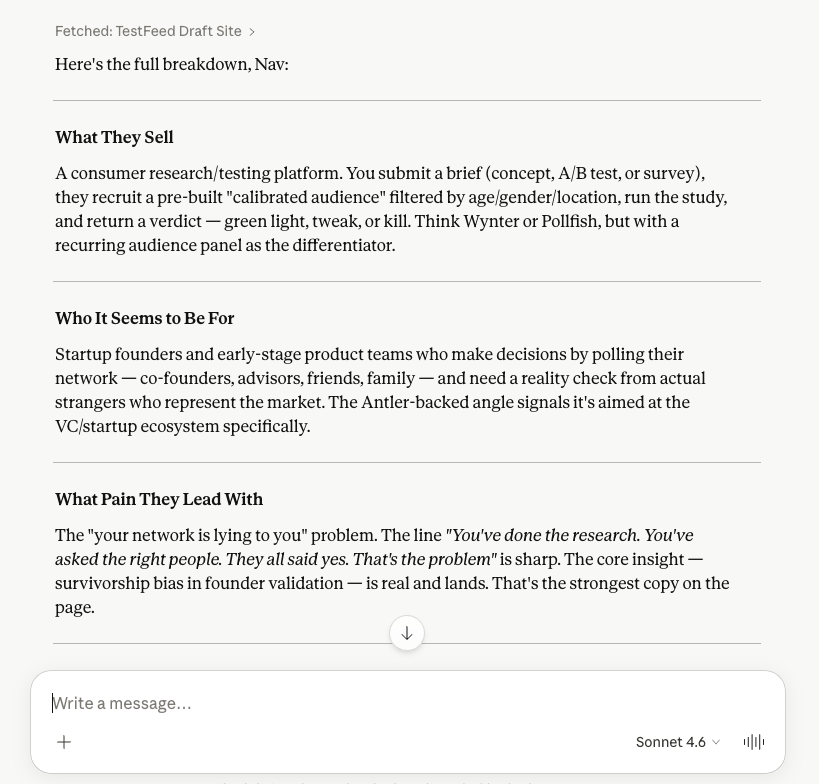
Here’s the workflow you can steal right now: Image
Step 1: Upload your own website.

Homepage.
Pricing page.
Features page.
About page.
Landing pages.

Then use this prompt:

“Analyze my website like a conversion strategist.

Tell me:

• what we sell
• who it seems to be for
• what pain we lead with
• what feels vague
• what would confuse a buyer”Image
Step 2: Upload customer reviews.

Use testimonials, G2 reviews, Reddit comments, support tickets, sales call notes, DMs, anything.

Prompt:

“Extract the real language customers use.

Find:
• repeated complaints
• emotional phrases
• buying triggers
• objections
• before/after moments

Do not rewrite them. Keep the raw wording.”
This is where the gold is.

Your best hook is usually not in your product page.

It’s buried inside some random customer sentence like:

“I’m tired of duct-taping 5 tools together.”

“I just want to know what’s working.”

“My team keeps guessing.”

That’s your ad copy.
Step 3: Upload competitor pages.

Then ask:

“Compare our positioning against these competitors.

Show me:
• what everyone is saying
• what we’re saying differently
• what nobody is saying
• where the category sounds repetitive
• the positioning gap we can own”

Step 4: Make Claude find weak positioning.

Prompt:

“Be brutally honest.

Where does our messaging sound generic?

Flag every line that could belong to 100 other companies.

Then rewrite each one to be sharper, more specific, and more painful to ignore.”
Step 5: Turn pain points into hooks.

Prompt:

“Using only the customer language and competitor gaps, create 30 hooks.

Split them into:
• problem hooks
• contrarian hooks
• before/after hooks
• founder-style hooks
• pain-agitation hooks
• ‘stop doing this’ hooks

Make them sound native to Twitter/X.”
Step 6: Build content angles.

Prompt:

“Create 20 content angles we can post about without directly pitching the product.

Each angle should:
• attract our ideal customer
• expose a painful problem
• teach something useful
• naturally lead to our product in the comments”
Step 7: Find offer gaps.

This one is underrated:

“Analyze our current offer.

Tell me:
• what feels weak
• what is missing
• what promise is unclear
• what risk the buyer still feels
• what bonus, guarantee, demo, or proof would make this easier to buy”
Step 8: Make Claude write the campaign.

Prompt:

“Now turn this into a 14-day content campaign.

For each day, give me:
• post idea
• hook
• angle
• core insight
• CTA for comments
• which pain point it targets”
Step 9: Make it judge the campaign before you post.

Prompt:

“Score every post idea from 1–10 on:

• scroll-stopping power
• clarity
• pain intensity
• originality
• buyer relevance
• likelihood to drive replies

Kill anything below 8 and replace it.”
The workflow is simple:

Don’t ask Claude to “write marketing.”

Feed it the market first.

Your site, your reviews, your competitors, your old campaigns, your customers’ own words.

Then make it find the patterns you were too close to see.

That’s where the good marketing is.
AI makes content creation faster than ever, but it also makes guessing riskier than ever.

If you want to know what your audience will react to before you post, TestFeed gives you instant feedback from AI personas that think like your real users.

It’s the missing step between ideas and impact. Join the waitlist and stop publishing blind.

testfeed.ai

• • •

Missing some Tweet in this thread? You can try to force a refresh

 

Keep Current with Millie Marconi

Millie Marconi Profile picture

Stay in touch and get notified when new unrolls are available from this author!

Read all threads

This Thread may be Removed Anytime!

PDF

Twitter may remove this content at anytime! Save it as PDF for later use!

Try unrolling a thread yourself!

how to unroll video
  1. Follow @ThreadReaderApp to mention us!

  2. From a Twitter thread mention us with a keyword "unroll"
@threadreaderapp unroll

Practice here first or read more on our help page!

More from @MillieMarconnni

Apr 29
Elon Musk didn't study rocket science.

He read textbooks on rocket science.

Then he called Russian rocket engineers to buy missiles. They quoted him $8 million per rocket.

He flew home, opened a spreadsheet, and calculated the raw material cost of a rocket from scratch.

It was 3% of what they quoted him.

SpaceX was born from that spreadsheet.

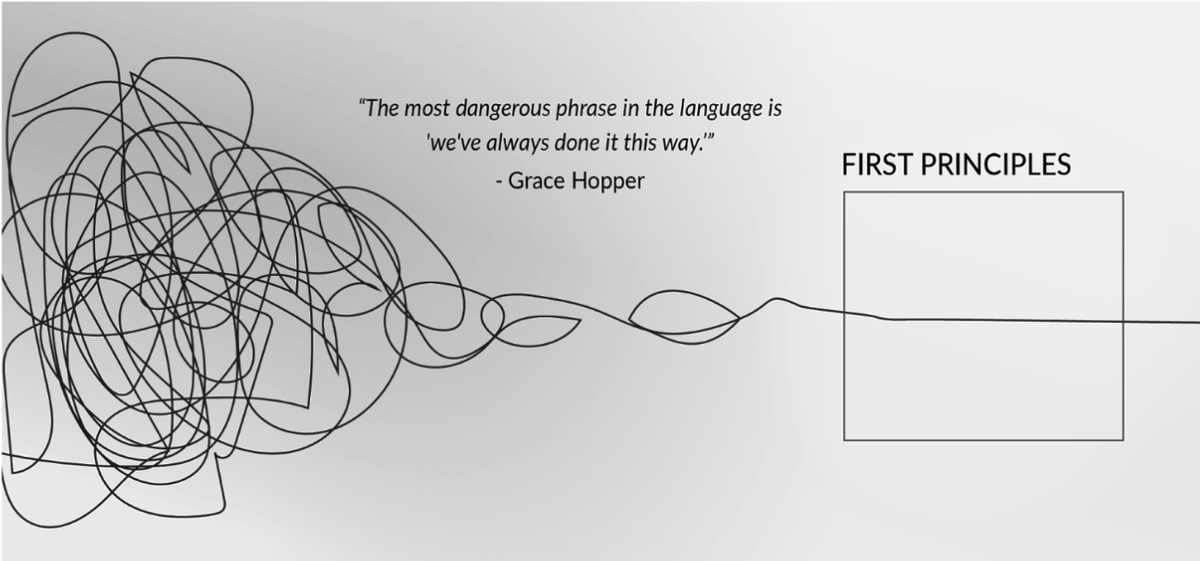
Here's the 7-prompt system that replicates how he thinks:Image
First, understand what first principles actually means.

Most people learn by analogy.

They see how something is done, copy it slightly modified, and call it thinking.

Musk calls this "the most common trap" in reasoning.

First principles means you stop at the bedrock.

You ask: what is physically, mathematically, logically true about this situation? Not what has always been done. Not what the industry assumes. What is actually true?

Then you rebuild from there.

The rocket cost $8 million because that's what rockets always cost.

The materials cost $240,000 because that's what the materials actually cost.

Every prompt in this system drills toward that gap.
PROMPT 1: The Raw Material Audit

This is the spreadsheet Musk built in his head on that flight home.

Run this on any expensive problem you are trying to solve:

"I am trying to [goal]. The conventional approach costs [time/money/resources]. Break this down to raw material first principles. What are the actual fundamental inputs required? What does each one actually cost or require in isolation? Where is the gap between what the market charges and what the underlying reality costs?"

You are looking for the same gap Musk found.

The gap between what something costs and what it has to cost.

That gap is always where the business lives.Image
Read 12 tweets
Apr 25
🚨BREAKING: Claude has a secret mode called "Rubber Duck Debugger."

Programmers explain code to a rubber duck to find bugs.

This mode does the same thing for any idea, essay, or argument.

You talk. It listens. Then it tells you exactly where your thinking broke.

Here's how to activate it:Image
1. The Core Prompt

Open Claude and paste:

“Act as a Rubber Duck Debugger for thinking.

Your job is not to solve my problem immediately.

Your job is to listen while I explain my thinking, then identify weak assumptions, contradictions, vague reasoning, missing steps, and places where I’m confusing emotion with logic.

Ask clarifying questions when needed.

Be precise. Be honest.”

That’s the engine.

Now start talking.
2. Use Voice or Messy Text

Don’t polish your thoughts.

That defeats the purpose.

Dump the raw version:

→ half-finished ideas
→ emotional reactions
→ confusing plans
→ arguments you’re unsure about
→ essays that feel off
→ decisions you can’t make

Claude works best with reality.

Not performance.
Read 9 tweets
Apr 23
A MIT PhD student told me he can predict exam questions before seeing the study guide.

Using NotebookLM.

I thought he was exaggerating.

Then he showed me the workflow.

He doesn’t wait for revision week.

He uploads past papers, lecture slides, textbook chapters, and old assignments into NotebookLM weeks in advance.

Then he runs 5 prompts.

By the time most students start studying, he already knows what the exam will probably look like.

Here’s the exact system:Image
1. The Pattern Hunter

Most students study topics.

Top students study patterns.

Paste this first:

“Analyze all past papers and course materials. What patterns exist in how this subject is examined? Identify recurring concepts, repeated question structures, favorite professor themes, and common traps.”

This changes everything.

Because exams rarely test randomly.

They test habits.
2. The Missing Topic Predictor

Professors don’t repeat the same paper.

But they often rotate neglected themes back in.

Paste:

“What important topics have not been tested recently but logically should be tested next based on course weight, chapter importance, and historical rotation?”

This is where predictions come from.

Not magic.

Pattern gaps.
Read 8 tweets
Apr 16
After testing every AI writing tool for 6 months, I found the one workflow that actually produces content worth reading.

It's not a tool. It's 5 Claude prompts run in a specific order that turns a rough idea into a finished piece in 40 minutes.

Here's the system: Image
Every AI writing tool has the same problem.

They start at the wrong end.

You give them a topic. They give you a draft. The draft is clean, organized, and completely hollow because the tool skipped the only part that makes writing worth reading.

The thinking.

Good writing isn't organized information. It's a writer working something out in public finding the angle nobody took, the tension nobody named, the insight that was obvious in hindsight and invisible before.

No tool finds that for you. But a system can force you to find it yourself before a single word of the actual piece gets written.

That's what these 5 prompts do. They run in order. Each one builds on the last. By the time you reach Prompt 5, you're not writing from a blank page you're writing from a position.

40 minutes. One rough idea in. One finished piece out.

Here's the system.
PROMPT 1 - The Angle Excavator

Most people start writing with a topic. The best writers start with a tension.

Run this first before you write a single sentence.

"I have a rough idea for a piece of writing. Your job is not to outline it. Your job is to find what's actually interesting about it.

Read the idea below and give me:

The obvious angle what everyone who covers this topic already says.
The contrarian angle what someone who has thought about this longer than anyone would say instead.
The personal angle the version of this idea that only someone with a specific lived experience could write authentically.
The tension the unresolved contradiction inside this topic that makes it genuinely worth writing about right now.

Do not write the piece. Give me the four angles and tell me which one has the most to say that hasn't already been said.

Here is my rough idea: [paste idea]"

Pick the angle that makes you slightly uncomfortable. That's the one.
Read 8 tweets
Apr 15
Inversion is the most powerful thinking tool most people never use correctly.

They invert the goal. They don't invert the system.

I turned Claude into a full inversion engine that runs Charlie Munger's method on any problem mapping every path to failure so precisely that the path to success becomes obvious by elimination.

Here are the 5 prompts:Image
Munger said it best: "Tell me where I'm going to die, so I'll never go there."

Most people use inversion as a cute thought exercise.

They ask "what if this fails?" write 3 bullet points, feel smart, and move on.

That's not inversion. That's journaling with extra steps.

Real inversion is forensic. You don't brainstorm failure. You systematically reconstruct it every assumption, every decision point, every handoff where things rot quietly before they collapse loudly.

The difference between someone who thinks about failure and someone who maps it is the difference between a smoke alarm and a fire investigation.

One warns you. The other tells you exactly what burned and why.
Prompt 1: The Pre-Mortem

"Assume it's 18 months from now and [your goal/project] has completely failed. Not stumbled failed. Dead. Done.

You're writing the post-mortem report.

Work backwards. Identify: the single decision that sealed it, the warning sign that appeared early but was ignored, the assumption that was never tested, and the person in the room who knew but didn't say it.

Be specific. Name the failure mode, not the feeling of failure.

Then rank the top 3 causes by how invisible they would have been at the start."
Read 9 tweets
Apr 14
A Goldman Sachs analyst once told me: "We don't read about competitors. We study them."

I turned that into a 5-prompt Claude workflow that does a full competitive teardown in 10 minutes.

Here's exactly how:
1. The Strategic Intent Decoder

Companies tell you what they did in their reports.

They accidentally tell you what they're planning in how they talk about it.

Word choice. Emphasis. What gets one paragraph versus five. What gets mentioned in the CEO letter versus buried in footnotes.

Goldman analysts read for intent, not just information.

"Read this competitor's most recent annual report, earnings call transcript, and investor day presentation: [paste or describe them]. Do not summarize what they said. Extract what they are planning. Where is language unusually emphatic or repeated across multiple documents and what does that signal about internal conviction? What did they mention once and drop that suggests a strategic experiment they're quietly watching? What segment, geography, or product line received more narrative attention than its current revenue contribution justifies and why might that be? What are they clearly building toward that they haven't announced yet?"Image
2/ The Hiring Pattern Intelligence Extractor

Job postings are the most honest strategic document any company publishes.

Because they reflect actual resource allocation decisions, not narrative ones.

A company can say they're focused on enterprise sales while posting 40 product engineering roles and zero enterprise sales roles.

The postings tell the truth. The press releases don't.

"Analyze the last 90 days of job postings from [competitor]. Map: which functions are they hiring into aggressively versus pulling back from, what specific technical skills or tools appear repeatedly that signal a platform or product direction they haven't announced, are they hiring senior people who would only make sense if a specific strategic initiative was already approved at the executive level, and what does the geographic distribution of their hiring tell you about where they're expanding versus consolidating? Cross-reference the hiring pattern against their stated strategic priorities. Where do they diverge and what does that divergence reveal?"Image
Read 7 tweets

Did Thread Reader help you today?

Support us! We are indie developers!


This site is made by just two indie developers on a laptop doing marketing, support and development! Read more about the story.

Become a Premium Member ($3/month or $30/year) and get exclusive features!

Become Premium

Don't want to be a Premium member but still want to support us?

Make a small donation by buying us coffee ($5) or help with server cost ($10)

Donate via Paypal

Or Donate anonymously using crypto!

Ethereum

0xfe58350B80634f60Fa6Dc149a72b4DFbc17D341E copy

Bitcoin

3ATGMxNzCUFzxpMCHL5sWSt4DVtS8UqXpi copy

Thank you for your support!

Follow Us!

:(