🚨 Callais plaintiffs accuse Louisiana of dragging out the redistricting process and concealing the state’s true election deadline to keep an allegedly unconstitutional race-based congressional map in place for the 2026 elections.
Plaintiffs argue that Louisiana’s leading proposed congressional map, SB121, preserves the race-based structure of the current majority-Black 2nd District, emulating the 2022 and 2011 maps.
The filing says Louisiana officials have repeatedly refused to disclose the state’s actual deadline for implementing a new congressional map, even as lawmakers move slowly on redistricting legislation.
Plaintiffs warn that if state officials wait too long to finalize a map, courts could become reluctant to order further changes close to the 2026 elections because of election-administration concerns under the Supreme Court’s Purcell doctrine.
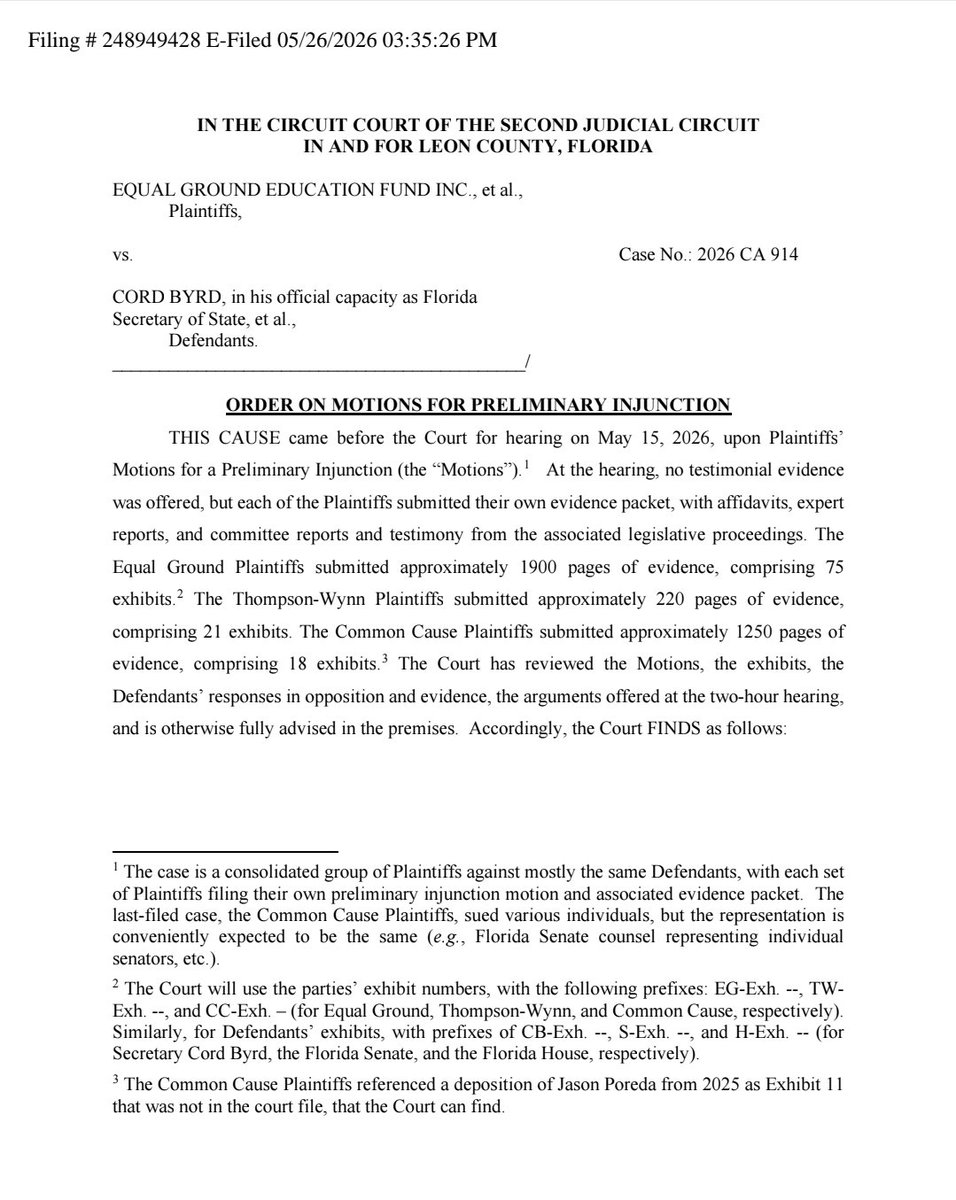
🚨 A Florida judge declined to block the state’s new congressional map for the 2026 elections.
Judge Joshua Hawkes says Florida courts cannot block the state’s new congressional map by temporarily reinstating the old 2022 map, because state leaders contend that map itself contains unconstitutional race-based districts.
Hawkes also says challengers have not yet shown enough evidence that the new map was drawn with unconstitutional partisan intent, calling the current record incomplete and emphasizing that expert evidence has not yet been fully tested in court.
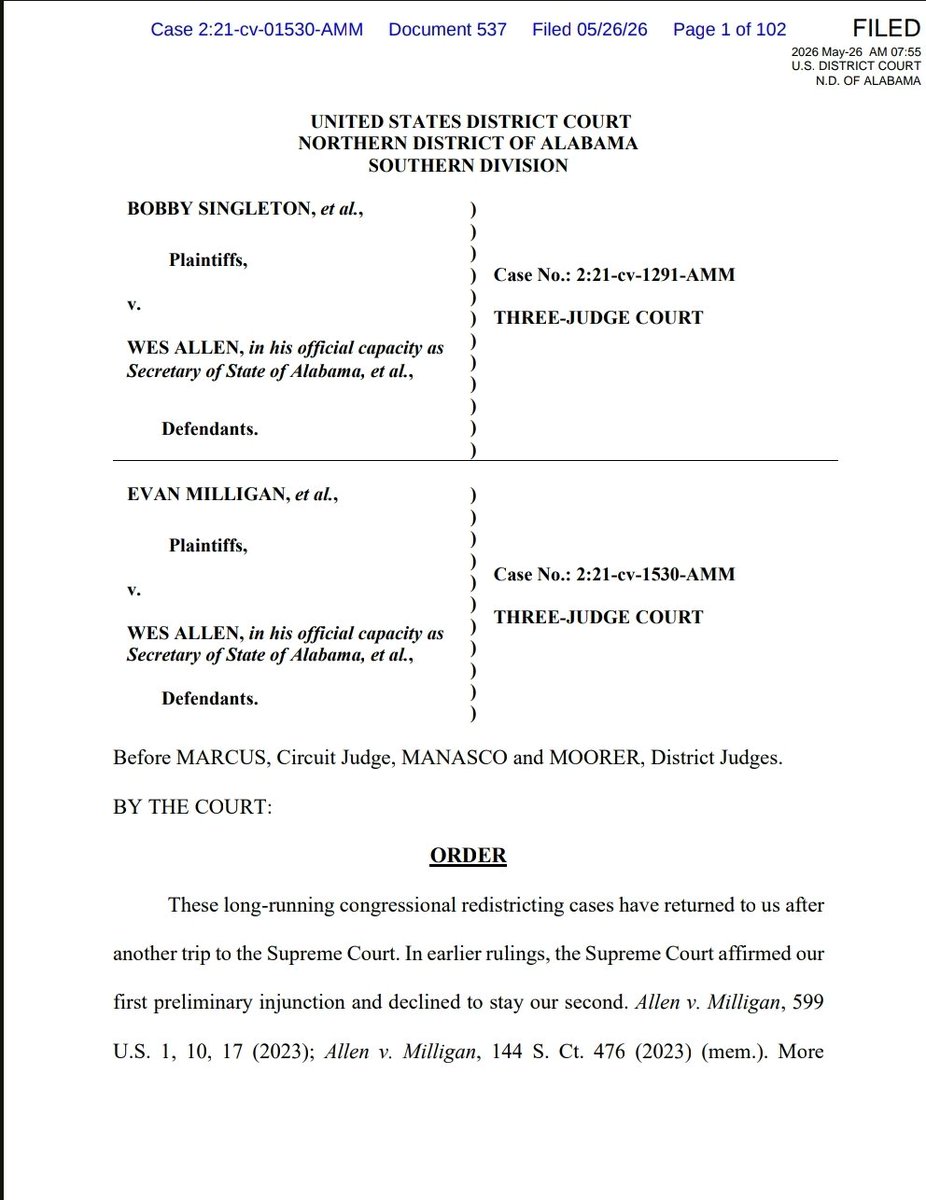
🚨 A federal court has blocked Alabama from using its new congressional map, ordering the state to use a court-imposed map with 2 majority-black seats for the 2026 elections.
The three-judge panel finds that Plaintiffs are likely to succeed on their Section 2 claims even after Callais.
It also finds that Alabama intentionally discriminated against black voters in violation of the 14th Amendment.
The Court finds that Purcell does not bar relief because the court-imposed map is the operational status quo.
🚨 The Supreme Court has temporarily restored nationwide access to mail-order abortion pills, staying a 5th Circuit ruling pending appeal.
Justice Thomas dissents, arguing that shipping mifepristone for abortion violates the federal Comstock Act. He says the manufacturers cannot claim irreparable harm from losing profits tied to what he described as a criminal enterprise.
Justice Alito also dissented, calling the Court’s order “remarkable.” He argues that mail-order abortion pills are being used to undermine Dobbs and Louisiana’s abortion ban, allowing nearly 1,000 abortions per month in the state despite its post-Dobbs restrictions.
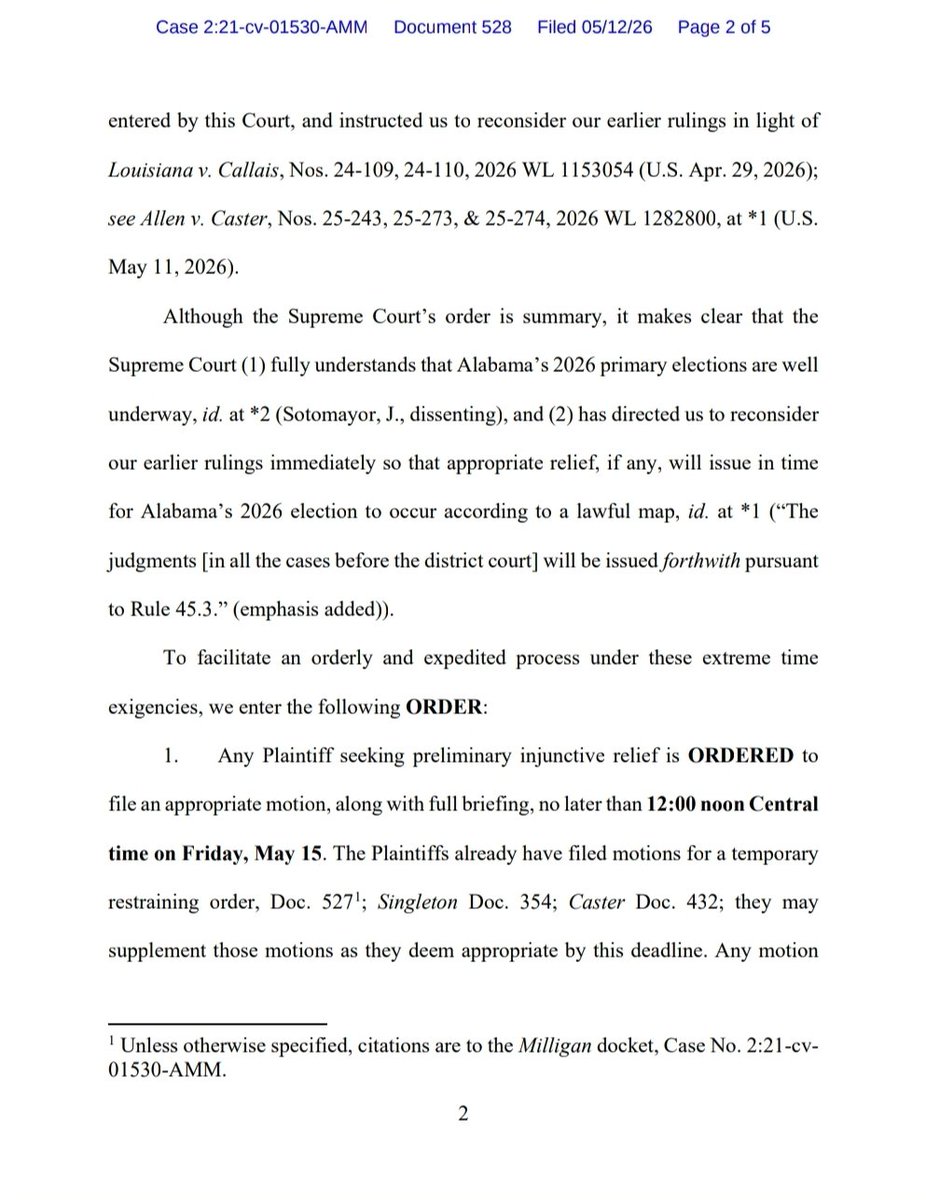
🚨 A panel of judges is considering blocking Alabama's 2023 congressional map a second time after the Supreme Court vacated its first injunction last night.
Plaintiffs have already filed for a Temporary Restraining Order. The Court invites them to file motions for preliminary injunctions under Section 2 and the 14th Amendment, briefing the effect of Callais.
The Court also orders Secretary Allen to file a brief on the practicality of election administration, including the date by which he needs a map in hand.
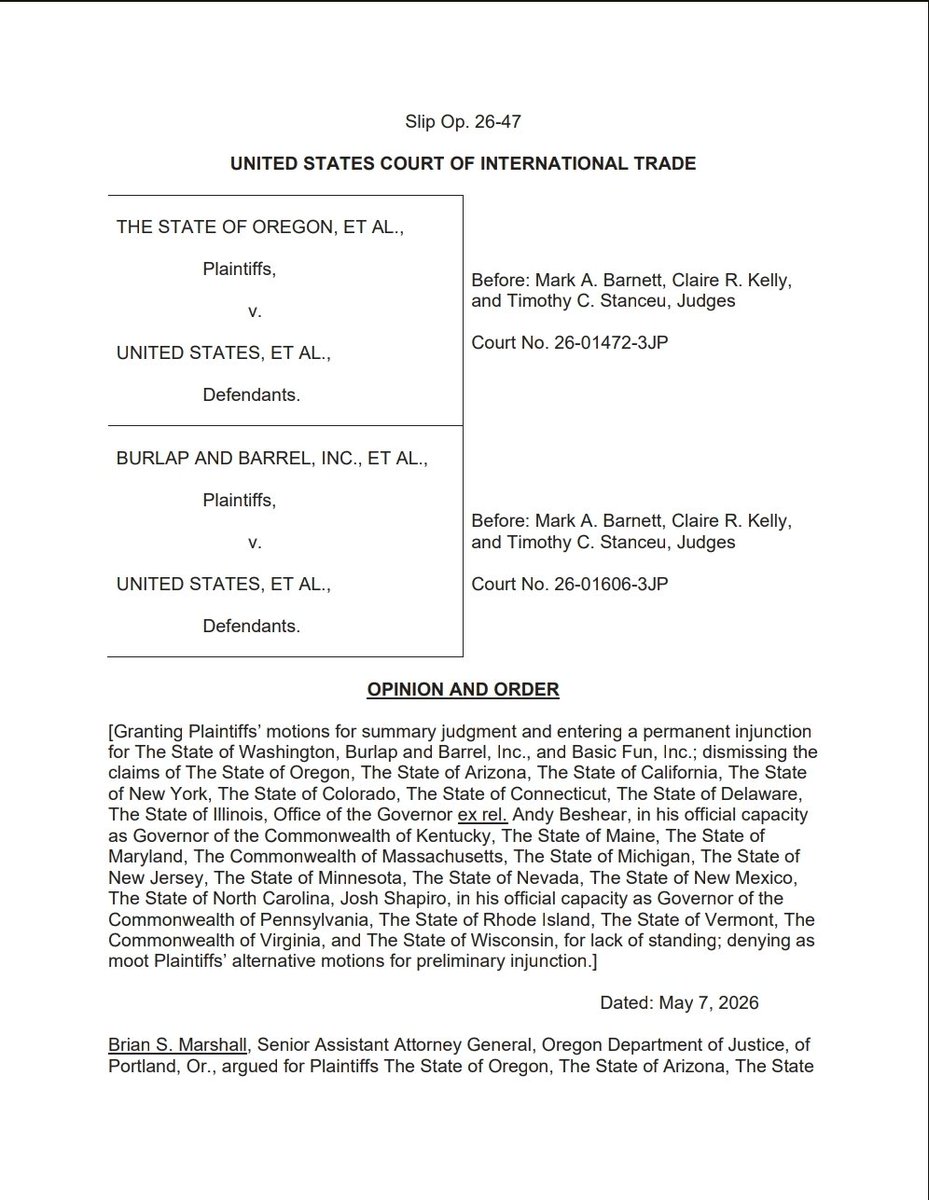
🚨 The U.S. Court of International Trade struck down President Trump’s 10% global tariff on imported goods, holding he exceeded his authority under Section 122 of the Trade Act.
The majority said Congress only gave presidents limited emergency tariff powers under Section 122, aimed at specific international payments crises tied to the old Bretton Woods financial system.
The Trump administration unlawfully used that law to target modern trade deficits.
Judge Timothy Stanceu dissented, arguing courts must defer to the President’s economic findings and that Section 122 gives the President broad authority to respond to balance-of-payments problems.
He also says the majority granted summary judgment too early in the case.
🧵 In today's Voting Rights Act ruling, the Supreme Court has fundamentally reshaped how courts apply Section 2 to voting maps, especially in relation to politics, making future Section 2 lawsuits extremely difficult to win.
1. For the first time ever, the Court holds that compliance with Section 2 of the Voting Rights Act can be a compelling interest to use race, but only when properly construed.
2. The Court holds that a minority voter is entitled to nothing more than equal opportunity, not equal outcome.